

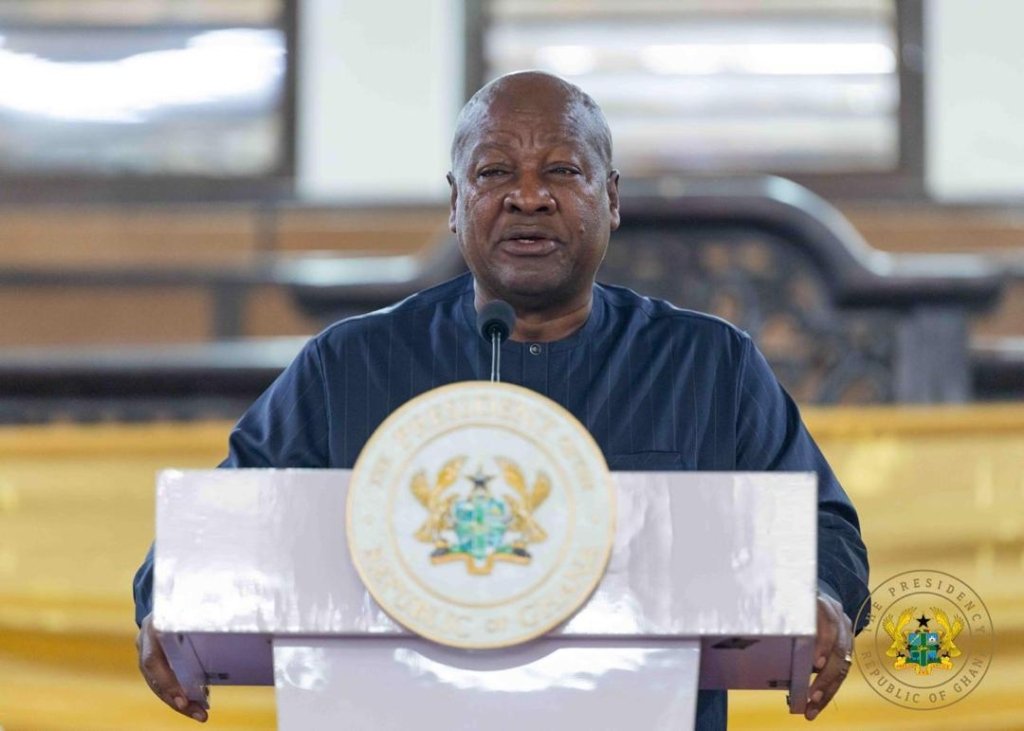
President John Dramani Mahama has announced that discussions are ongoing in the cabinet regarding Ghana’s TV licence law.
Speaking during a visit to the Ghana Broadcasting Corporation (GBC) on Thursday, January 8, President Mahama proposed a public media levy, which he says can replace the TV Licence.

He revealed the government is exploring amendments to replace the current TV licence.
John Mahama stated, “There are a few suggestions we have with regard to the so-called TV licence. And I think that our thinking is going in the same direction to amend that law to make it a public media levy of some sort”.
“When we’re ready, we’ll be discussing at Cabinet, but we’ll discuss with you what our thinking is before we finally go to Parliament and amend the law,” he said.
“I’m sure that with some of the suggestions we’ve got, you’ll be able to raise the amount of funding that it brings in and make it better able to do your work,” the President added.
Also, the Ghana Broadcasting Corporation (GBC) appealed to the government to help it settle its GH¢13m legacy debt.
The Director-General of the Ghana Broadcasting Corporation (GBC), Prof. Amin Alhassan, stated, “One issue that gives us sleepless nights is the legacy debt from ECG and NEDCO. These debts were not generated by GBC alone.
“In the past, when government agencies, including the military, police, and national security, shared power infrastructure at GBC, they drew electricity from the same source. When meters were later installed in GBC’s name, the debt started accumulating under GBC”.
“When we drew their attention, these agencies disconnected, leaving the accumulated debt for GBC to pay. Currently, we have paid GH¢5 million, but we still have an outstanding debt of GH¢13.6 million. We are appealing for the government to take care of this legacy debt,” he said.
Meanwhile, the GTV admin last year launched social media attacks on some Members of parliament and also other influential Ghanaians who have failed to pay their TV license in recent weeks.
The Ghana Broadcasting Corporation (GBC) has called on Ghanaians to pay their TV license fees.
According to the GBC, the state broadcaster must fulfil its mandate of providing quality content that reflects the country’s diversity.
The Director General of GBC, Professor Amin Alhassan, has noted that the TV license fee has remained unchanged for years, and is essential for the corporation’s survival.
Furthermore, the GTV have faced a barrage of criticisms from frustrated Ghanaians following their inability to telecast the Black Stars’ World Cup qualifiers.
The administrator of GTV’s social media platforms revealed the station is unable to show the games due to the need to pay a hefty sum of $750,000 to acquire the rights to broadcast the matches.
In a post, the GTV social media admin stated, “It is easy to take a feed and show it live. What is not easy is coughing up $750,000 ( GH¢9.1M) to pay for it. It does not take a ‘useless station’ to produce football matches to FIFA standards. There are real issues we need to address. After the privileged few have finished watching the match on satellite TV, we can now talk about how to bring World Cup matches to the masses”.
The TV license fee was introduced by the British nearly 100 years ago as a legal requirement for all Ghanaians who own a television or radio.
The TV license fee stands at GH₵36 for one TV set annually and GH₵60 for two or more TV sets. In commercial and industrial setups like hotels, every single TV set attracts a fee of GH₵36 each.