

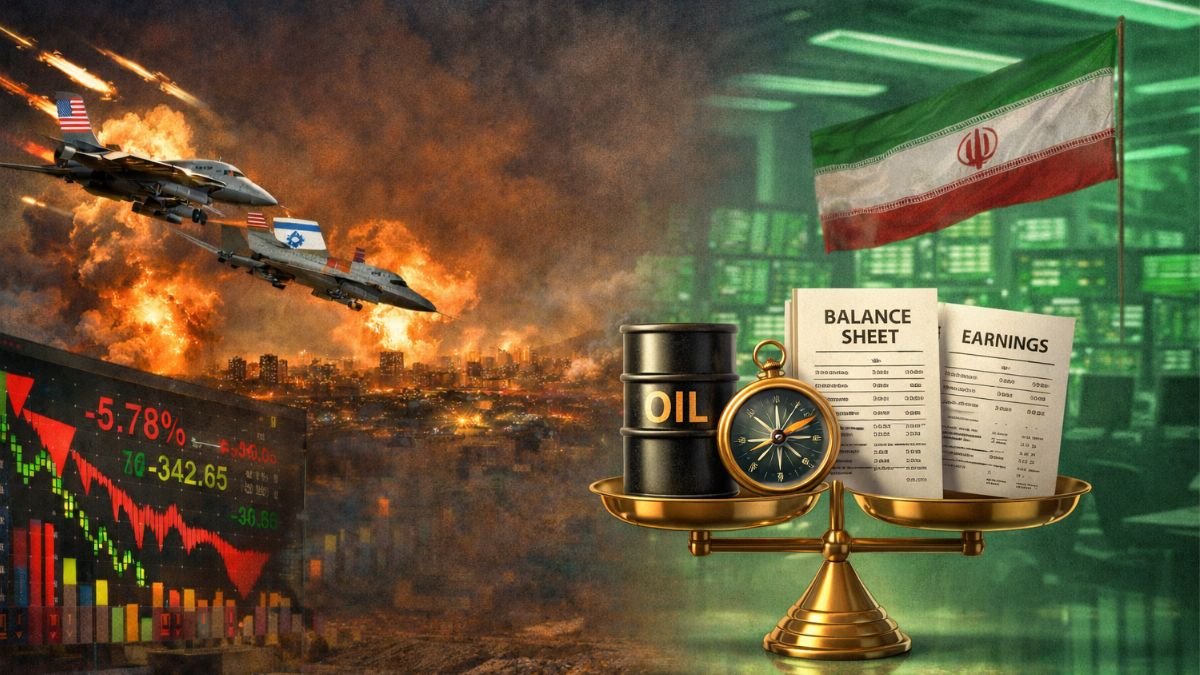
Global oil prices have hit $110 (£82.74) a barrel, with the stock markets slumping following the escalating US-Israeli war with Iran.
Reports suggest the increasing US-Israeli war with Iran has fueled fears of long-term disruption to shipments through the Strait of Hormuz.

The BBC in a news story stated, “The US and Israel launched fresh waves of airstrikes across Iran over the weekend, hitting multiple targets, including oil depots.
Major disruption to energy supplies from the region threatens to push up prices for consumers and businesses worldwide.
On Monday morning in Asia, Brent crude was almost 24% higher at $114.74, while Nymex light sweet was up by more than 26% at $114.78.
Stock markets in the Asia-Pacific region fell sharply in morning trade, with Japan’s Nikkei 225 index down by more than 7%, the Hang Seng in Hong Kong losing over 3%, and the ASX 200 in Australia more than 4% lower.
South Korea’s Kospi index, which has been hit especially hard since the conflict began, slipped by more than 8%, triggering a 20-minute halt to trading.
The so-called circuit breaker is a mechanism designed to curb panic selling. It also came into effect on Wednesday, when the Kospi slumped by 12%.
About a fifth of the world’s oil supply is usually shipped through the Strait of Hormuz. But traffic through the narrow passage has all but halted since the war started a week ago”.
Parts of the BBC story added, “US President Donald Trump responded to the jump in prices by saying that short-term rises were a “small price to pay” for removing Iran’s nuclear threat.
His energy secretary told US broadcasters on Sunday that Israel, not the US, was targeting Iran’s energy infrastructure, amid some concern about rising domestic pump prices caused by the war”.
In related news, Duncan Amoah, the Executive Secretary of the Chamber of Petroleum Consumers (COPEC), has warned that the Middle East tensions will hit Ghana’s pumps soon.
According to Duncan Amoah, although Ghana currently has enough fuel in stock, he argued that private traders are already factoring the crisis into their pricing decisions for future cargoes.
Speaking on JoyNews’ The Probe on Sunday, March 1, Mr Amoah explained, “If I was a trader and I woke up tomorrow to have to put stock on the market, I would definitely bear in mind the fact that these hostilities or tensions prevailing within the Middle East could affect the next cargo containment that I get down here”.
In a separate interview, Duncan Amoah warned of a possible surge in Global crude oil following the escalating tensions in the Middle East.
According to COPEC, the escalating tensions in the Middle East would significantly affect petroleum markets worldwide, including Ghana.
He disclosed that the Strait of Hormuz, a critical global oil transit route, is currently blocked.
Duncan Amoah further disclosed that crude prices have already reacted sharply to the disruption.
He indicated that oil prices had surged to $91 a barrel amid the Hormuz blockade, up from between 67 and 69 dollars recorded the previous day.
Speaking on Channel One Newsroom on Saturday, February 28, Duncan Amoah stated, “What I can confirm is that the Strait of Hormuz is blocked as we speak. The iron triangle is already active. Iran, Russia and China have paraded their maritime infrastructure.
Whatever they can deploy in that tunnel is already active. The US is also heading toward that corridor, which means no oil whatsoever has made passage since morning.”
“Over 22 per cent of the global oil supply that should have moved since last dawn has not moved,” he stated. “Inventories across Europe, the US and Asia will now attract higher premiums. You cannot expect anyone holding oil at this point to sell it cheaper.”
However, Abass Ibrahim Tasunti, the Director of Economic Regulation and Planning at the National Petroleum Authority (NPA), has said Ghana has enough fuel stock to last over 5 weeks amid Middle East tensions.
Speaking on JoyNews’ The Probe on Sunday, March 1, Abass Ibrahim Tasunti stated, “As of last Friday, we have diesel stocks to last us over five weeks. Roughly, it will last us up to 5.3 weeks. And then for petrol, we have almost 6.8 weeks to last”.
“So we have a plan where almost every day, discharge of petroleum products are being done. That’s for the imported products. And we also have the Sentuo oil refinery, which is consistently producing. It has been doing so since June 2025. And as we speak, they are producing on a daily basis and putting petroleum products on the market.
“The Atuabo gas processing plant is also producing and putting LPG on the market. So in terms of stocks, whilst we consume what is in-tank, we have a plan for import as well.”
“Even without this war, we always ensure that we have a plan to make petroleum products available for consumers in the country. So this is not something that is being done because of the war, but it’s something we do on the regular. It’s one of NPA’s major mandates,” he stated.