

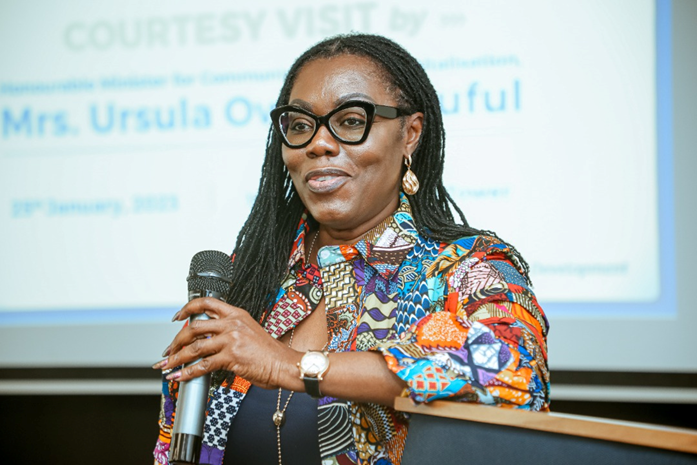
Ursula Owusu-Ekuful, the former Minister for Communications and Digitalisation, has issued a rebuttal, firing shots at claims made by President John Dramani Mahama and the current Minister for Communications, Sam George.
According to Ursula, the SIM card registration under her leadership represented real progress for Ghanaians and should not be undermined by misleading claims or political narratives.

She also criticised the government for failing to acknowledge the practical gains the registration during her time brought to the system, adding that if the government cannot praise her, they should not tarnish her reputation.
In a statement titled “Rebuttal Statement on SIM Registration Falsehoods,” Ursula Owusu-Ekuful stated, “I have deliberately refrained from commenting on events in the communications sector since I left office a little over a year ago, but am compelled to set the record straight when the President of the Republic himself repeats falsehoods. I have heard the comments made by President Mahama in the Bono Region on the SIM registration exercise, and I must say that a number of the comments he made are far from the truth.
Let us be clear from the beginning: the 2022–2023 SIM registration exercise did not come out of nowhere. It became necessary because the old SIM registration exercise done in 2010–2011 was not effective. That earlier process did not have any proper validation system due to the lack of any mass identification document.
That is why we introduced a more structured and legally compliant process tied to the Ghana Card. The idea was simple: if SIM cards are being used in Ghana, then they must be linked to a proper national identity system as required by law. That was the whole point.
The process itself had two stages. First, people entered their Ghana Card details through a shortcode. Those details were checked with the National Identification Authority to confirm that the information was correct. After that, the individual moved to the second stage, which involved data capture and biometric registration, including facial and fingerprint capture”.
The former Minister for Communications and Digitalisation highlighted that 80% of the facial biometrics captured matched with the data in the NIA database, adding that the process was not useless or an empty exercise, as people are now desperately trying to suggest.
She disclosed that all that is left now is less than 20% to be biometrically verified in what can only be termed stage 3 of what we started.
Mrs Owusu-Ekuful challenged the narrative, saying, “Now, a lot has been said to create the impression that the problems with the exercise were because of personal issues or bad blood between institutions. That is simply not true. I have known Professor Attafuah for many years, and at no point in time did we ever stop speaking to each other, either personally or professionally. We may have had disagreements, but I am too professional to allow differences of opinion to affect my work in any way.
The only issue was that the National Identification Authority did not allow the SIM registration system to connect to their database for biometric verification at that second stage. That was the challenge. This, however, did not prevent us from compiling a comprehensive database of all activated SIMS in Ghana, and I thank all well-meaning Ghanaians once again for their cooperation, which ensured that the mass registration exercise was successfully completed with the registration of almost 30 million SIM cards. That SIM Registry database exists and is hosted securely by the national Electronic Transactions Regulator, NITA, in the National Data Centre!!
And yet, despite that limitation, what do we know today? We know that when an audit was conducted in 2025, more than 80% of the facial biometrics captured matched with the data in the NIA database. That is important. That means the process was not some useless or empty exercise as they are now desperately trying to suggest. In fact, it shows that the major part of the work has already been done.
All that is left now is for the less than 20% to be biometrically verified in what can only be termed stage 3 of what we started. That is all.
So the question is simple: if they say the previous exercise had no value or no data, then where did the 80% verification result come from? What data did they use for that audit? You cannot say on one hand that there was no data, and then on the other hand use audit outcomes based on that same exercise. That is contradictory. That is dishonest”.
Ursula further added, “This government should stop pretending that it is starting afresh or doing anything new. It should stop acting as though nothing meaningful was done before now. Governance is a continuum. If something has been started and useful progress has been made, the duty of the next government is to build on it, improve it, and be honest about it.
“You cannot lie about a process, dismiss it in public, and then turn around and do the same thing again. If the previous method was so wrong, why are you repeating the same methodology, the same structure, and the same approach? You cannot condemn a process in the morning, copy it in the afternoon, and come back in the evening to claim you have invented something new,” she wrote.
In her concluding remarks, she wrote in Twi: “Wo nyi m’ayɛ a, mɛnsɛi me din!!” translating to English as “If you cannot praise me, do not tarnish my reputation.”
Read Ursula Owusu’s full statement below: