

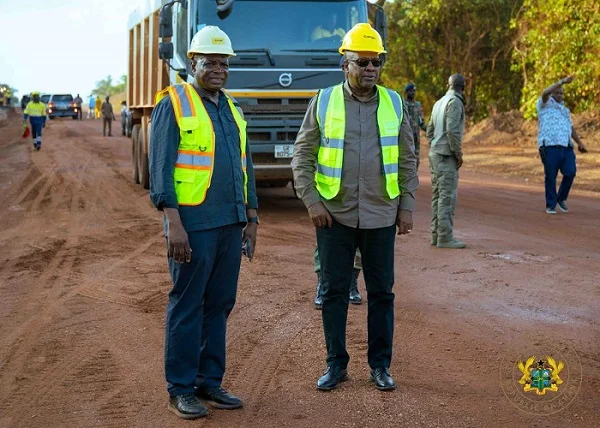
Reports gathered from The Fourth Estate have detailed that President John Dramani Mahama and his government have been paying lip service in terms of promises to minimise sole-source procurement to encourage competitive bidding.
President John Mahama, on numerous occasions, has reiterated his government’s commitment to make single-source procurement a rare exception rather than the norm.

In the NDC People’s Manifesto, they also pledged to “make single-sourced procurement (sole-sourcing) an exception and not the rule.”
John Mahama, during his recent SONA, also repeated his vow and commitment, “Mr Speaker, we are bringing legislation to this House to tighten our procurement processes by banning sole-sourced contracts, except in exceptional circumstances,” the President told Parliament.
However, after one year in office, the report by The Fourth Estate has unearthed that the Road Ministry awarded 81 sole-sourced contracts worth over GHS73 billion in 7 months.
The Fourth Estate, in a report, stated, “Data available to The Fourth Estate indicates that in the last seven months, the ministry has awarded 107 road contracts. Contrary to the President’s promise to ensure competitiveness and transparency in the awarding of public contracts, not a single one of 107 contracts was awarded based on competitive tendering.
A whopping 81 out of the 107 road contracts worth over GHS73 billion were awarded through sole-sourcing. The remaining 26 contracts worth about GHS8 billion were awarded through selective tendering. This means over 90% of the amount of money expected to be spent on roads under the Big Push programme so far was given out through sole-sourcing.
Despite this glaring contrast, the majority leader and leader of government business in Parliament, Mahama Ayariga, audaciously proclaimed to Parliament on March 11, 2026, that “let it be known, the era of the sole-sourced contract is dead.”
However, Minister of Roads and Highways, Kwame Governs Agbodza, when asked about how contracts under the Big Push programme were awarded, disclosed that they resorted largely to selective tendering.
Kwame Governs Agbodza explained, “Contracts were procured predominantly through restrictive tendering to ensure rapid project commencement,” he said. “Before procurement, the Ministry and agencies conducted extensive engineering studies, including feasibility studies and seal of quality and commitment authorisation for each project.”
“Contracting under the Big Push fully aligns with the National Democratic Congress (NDC) manifesto and government policy. Public contracts are awarded to competent, experienced, and well-resourced contractors, prioritising Ghanaian firms to build local capacity,” he said.
Mr Agbodza, however, in opposition was a critic of the sole-sourcing of road contracts.
The current Road Minister in opposition claimed, “Part of the reason why the government is unable to build more roads is because of the use of sole-sourcing in the award of road projects, [which] inflates the cost of such contracts.”
Also, leading members of the NDC, particularly MP for North Tongu, Samuel Okudzeto Ablakwa and Sammy Gyamfi, the National Communications Officer of the NDC, on numerous occasions criticise the sole-sourced contract under the former Akufo-Addo government.
In addition, some civil society leaders have raised concerns about Ghana’s over-reliance on sole sourcing.
Ben Boakye, the Executive Director of the Africa Centre for Energy Policy, asserted that this is not what the NDC government promised Ghanaians.
Also, Anti-corruption crusader Vitus Azeem stated, “It’s surprising that just one year into power, such situations exist. Because, you see, the procurement law talks of competitive bidding. And sole-sourcing or restricted bidding is not the norm.”
Mary Ada, Executive Director of Transparency International Ghana, also lamented, “It’s sad, and the double standards are just too many. And it’s becoming worrisome for those of us who do this on a daily basis. It’s sad that people who stand on the pulpit to say one thing carry on and do other things.”