

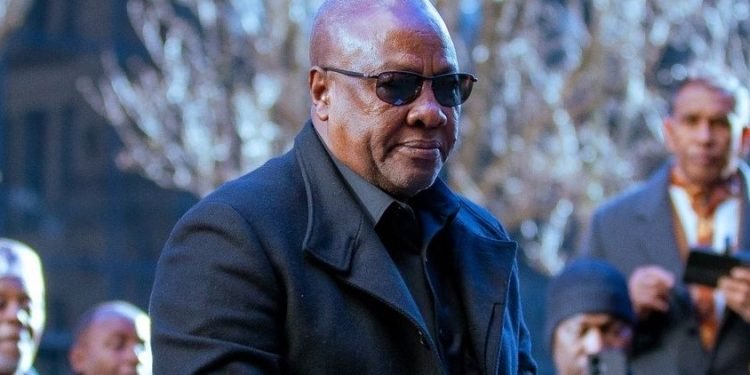
President John Dramani Mahama has said the United Nations’ approval of a motion on slavery reparations is not the end, as it is only the beginning of the fight for justice on slave reparations.
John Dramani Mahama at the United Nations General Assembly on Wednesday, March 25, 2026, tabled a resolution calling on the UN to recognise the Trans-Atlantic Slave Trade as the gravest crime ever committed against humanity.

Following a massive debate, the motion was adopted with 123 countries voting in favour of the slavery reparations motion tabled.
The United States, Argentina, and Israel voted against it, while 52 European Nations 52 abstained.
Speaking after the General Assembly session on Wednesday, March 25, 2026, President Mahama labelled the slavery reparations as a significant milestone.
President Mahama stressed that the outcome, while historic, must transform into sustained global action.
Speaking after the General Assembly session, Mahama stated, “This is not the end. This is the beginning. What we’ve achieved today creates a platform for the struggle for reparative justice”.
“We must take this success and begin to work so that those who denied our ancestors their humanity, those who denied our ancestors their dignity, can accept the truth that this is what happened,” he said.
He added, “Today we’ve accepted that this was a grave crime against humanity — the gravest indeed”.
“This victory is not for Ghana. We did it for the whole of Africa and all people of African descent. If we keep this coalition, we will take the next steps together,” he said.
“Today’s victory is to ensure that we do not forget, and will never forget. As long as this resolution has been passed, our ancestors will never, ever be forgotten,” he concluded.
However, the US, they acknowledge the horrors of the past, but do not accept this resolution, as they do not support legal claims for reparations.
The US representative during the 80th United Nations General Assembly argued that the US government, led by President Donald Trump, opposed the resolution.
They argued that the calls for reparations cannot hold because slavery was legal during the era of the transatlantic slave trade.
“The United States has defined long-standing objectives to the framing of reparatory justice and the duty of reparation for historical wrongs. While we acknowledge the horrors of the past, we do not accept this resolution’s assertion that historical facts from the 15th through 19th centuries constitute violations of jus cogens, as the term is understood in contemporary international law.
“The United States also does not recognise a legal right to reparations for historical wrongs that were not illegal under international law at the time they occurred. In addition to its obvious legal problems, this resolution is also unclear as to who the recipients of reparatory justice would be. The drafters and supporters of this resolution seem to believe it is them,” he said.
The US representative also stated that the resolution goes against the main objective of the United Nations, which is the maintenance of world peace and security.
“We regret that the United States must once again remind this body that the United Nations exists to maintain international peace and security. It was not founded to advance narrow, specific interests and agendas, to establish niche international days, or to create new costly meeting and reporting mandates. This resolution does all three,” he added.
Meanwhile, award-winning investigative journalist Manasseh Azure Awuni has opposed President John Dramani Mahama’s calls for reparations to Africa for the transatlantic slave trade.
According to Manasseh, if reparations are to be paid, countries such as Ghana should also be required to pay them for their role in the slave trade.
He highlighted that it will not be right to pay reparations to those who took part and benefited from the slave trade, even though the benefits and exploitation of the enslaved people were disproportional.
Manasseh detailed that descendants of the slaves in America, the Caribbean and elsewhere rightfully deserve reparations, not African countries whose people captured and sold slaves.
He, however, labelled African countries that captured and sold slaves as ‘accomplices’, not victims.