

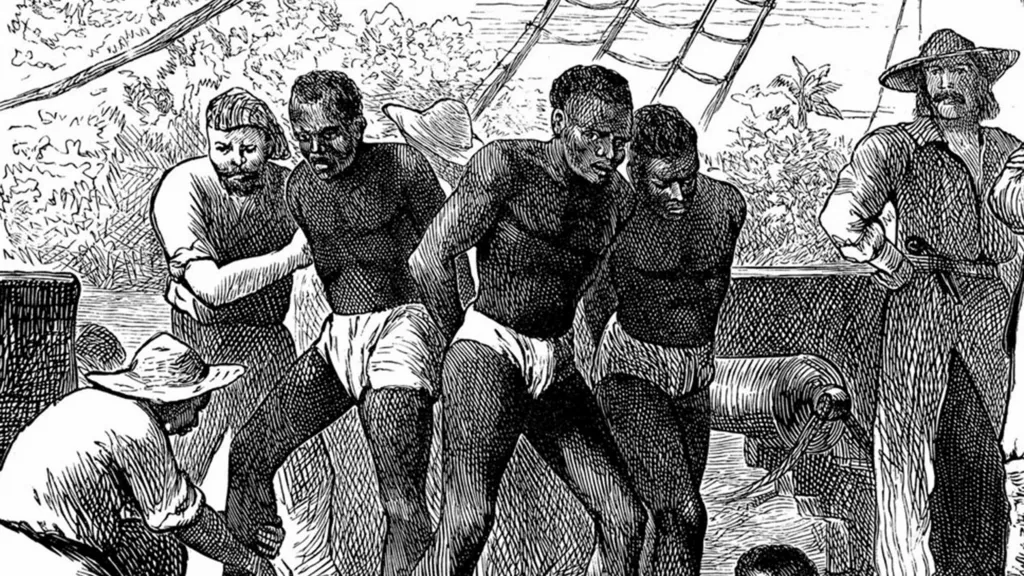
Award-winning Ghanaian investigative journalist Manasseh Azure Awuni has shared details of the breakdown of estimated Slave trade exports from 1400 to 1900 by country.
Reports suggest that between the 15th and 19th centuries, an estimated 12.5 million Africans were forcibly taken and sold into slavery.

The reparations debate has since gained renewed global attention; however, critics argue that present-day states and institutions should not be held responsible for actions carried out centuries ago.
Manasseh, in a post on X, on March 26, 2026, stated, “Estimated slave exports from 1400 to 1900 by country.
Source: “Shackled to the Past: The Causes and Consequences of Africa’s Slave Trades” by Nathan Nunn, August 2008”
The estimated slave exports from 1400 to 1900 by country featured African countries like Angola, Nigeria and Ghana, with the largest slave export.
The breakdown shows the estimated slave exports from 1400 to 1900 by country, featuring the Trans-Atlantic trade, Indian Ocean, Trans-Saharan, and the Red Sea.
Meanwhile, President John Dramani Mahama has said the United Nations’ approval of a motion on slavery reparations is not the end, as it is only the beginning of the Fight for justice on slave reparations.
John Dramani Mahama at the United Nations General Assembly on Wednesday, March 25, 2026, tabled a resolution calling on the UN to recognise the Trans-Atlantic Slave Trade as the gravest crime ever committed against humanity.
Following a massive debate, the motion was adopted with 123 countries voting in favour of the slavery reparations motion tabled.
The United States, Argentina, and Israel voted against it, while 52 European Nations 52 abstained.
Speaking after the General Assembly session on Wednesday, March 25, 2026, President Mahama labelled the slavery reparations as a significant milestone.
President Mahama stressed that the outcome, while historic, must transform into sustained global action.
Speaking after the General Assembly session, Mahama stated, “This is not the end. This is the beginning. What we’ve achieved today creates a platform for the struggle for reparative justice”.
“We must take this success and begin to work so that those who denied our ancestors their humanity, those who denied our ancestors their dignity, can accept the truth that this is what happened,” he said.
He added, “Today we’ve accepted that this was a grave crime against humanity — the gravest indeed”.
“This victory is not for Ghana. We did it for the whole of Africa and all people of African descent. If we keep this coalition, we will take the next steps together,” he said.
“Today’s victory is to ensure that we do not forget, and will never forget. As long as this resolution has been passed, our ancestors will never, ever be forgotten,” he concluded.
However, Manasseh Azure Awuni has opposed President John Dramani Mahama’s calls for reparations to Africa for the transatlantic slave trade.
According to Manasseh, if reparations are to be paid, countries such as Ghana should also be required to pay them for their role in the slave trade.
He highlighted that it will not be right to pay reparations to those who took part and benefited from the slave trade, even though the benefits and exploitation of the enslaved people were disproportional.
Manasseh detailed that descendants of the slaves in America, the Caribbean and elsewhere rightfully deserve reparations, not African countries whose people captured and sold slaves.
He, however, labelled African countries that captured and sold slaves as ‘accomplices’, not victims.
See the post below:
Estimated slave exports from 1400 to 1900 by country
— Manasseh Azure Awuni (@Manasseh_Azure) March 26, 2026
Source: "Shackled to the Past: The Causes and Consequences of Africa’s Slave Trades" by Nathan Nunn, August 2008 pic.twitter.com/ZK184FRSm0