

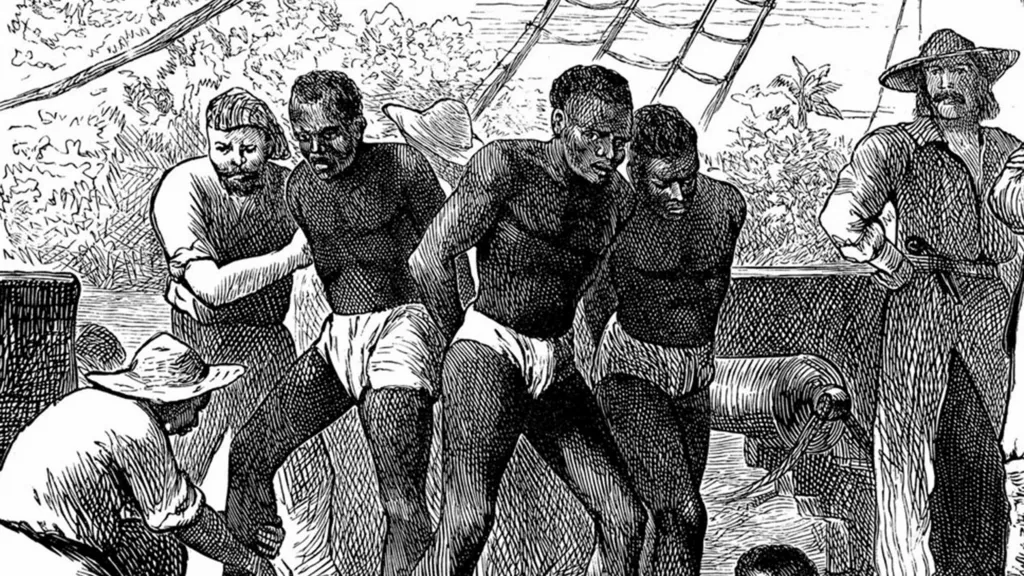
Alexander Kwamina Afenyo-Markin, the Minority Leader in Parliament, has punched holes in Ghana’s demand for reparatory justice following the UN General Assembly’s adoption of a resolution recognising the trafficking of enslaved Africans as the “gravest crime against humanity.
According to Afenyo-Markin, historical accounts of the transatlantic slave trade fail to reflect the role played by local actors.

Afenyo-Markin highlighted that local actors chase their strongest among their own people, then, after 100 years, Africans are demanding that they should be compensated.
The minority leader quizzed who should compensate whom following the role played by the indigenous people who subjected their people to inhumane treatment.
Speaking on the Floor of Parliament on Friday, March 27, 2026, “When somebody berths a vessel at Cape Coast, and you decide to go to the North, Bono area, get to the Ashanti area, to the Assin area, and you are chasing your strongest among your own people, then after 100 years, you say I should be compensated. Who should compensate whom? We maltreated our own and told the white man that he should also maltreat our own. The story must be told and must be put in its proper context.
“It is also a fact that the inhumane treatment, the unfortunate humiliation, the marginalisation, injustice and abuse of our ancestors who became victims of this slave trade must be condemned,” he said.
Also, Award-winning investigative journalist Manasseh Azure Awuni has opposed President John Dramani Mahama’s calls for reparations to Africa for the transatlantic slave trade.
According to Manasseh, if reparations are to be paid, countries such as Ghana should also be required to pay them for their role in the slave trade.
He highlighted that it will not be right to pay reparations to those who took part and benefited from the slave trade, even though the benefits and exploitation of the enslaved people were disproportional.
Manasseh detailed that descendants of the slaves in America, the Caribbean and elsewhere rightfully deserve reparations, not African countries whose people captured and sold slaves.
He, however, labelled African countries that captured and sold slaves as ‘accomplices’, not victims.
Parts of Manasseh’s post on shared on Facebook wrote, “The slave trade boomed whenever there were wars among African ethnic groups. Some wars were waged for the purpose of capturing and selling slaves. The powerful kingdoms got money from selling slaves, with which they bought powerful weapons to fight and capture more slaves.
When the British abolished the slave trade, some powerful African kings, including some in Ghana, were unhappy that their source of wealth was being stifled.
I also read that some African countries, such as Benin, have formally apologised for their role in capturing and selling their own people into slavery.
Ghana subtly acknowledged its role when it launched the Joseph Project during the celebration of Ghana’s 50th independence anniversary. (In the Bible, Joseph was sold by his own brothers.)
That brings us to the second part of the push, which is the payment of reparations. If reparations are to be paid, countries such as Ghana should also be required to pay them for their role in the slave trade.
It will not be right to pay reparations to those who took part and benefited from the slave trade, even though the benefits and exploitation of the enslaved people were disproportional.
The descendants of the slaves in America, the Carribean and elsewhere legitimately deserve reparations, but the African countries whose people captured and sold slaves are accomplices, not victims.
In 100 years, it will be untenable for Ghana to demand reparations from China for destroying our forests in the illegal mining scourge. Without tacit support in fronting for the Chinese illegal miners (sometimes providing state security protection), they would not have succeeded in destroying our forests.
We need to tell ourselves the hard truth and learn from how we have hurt ourselves through selfishness and greed”.