

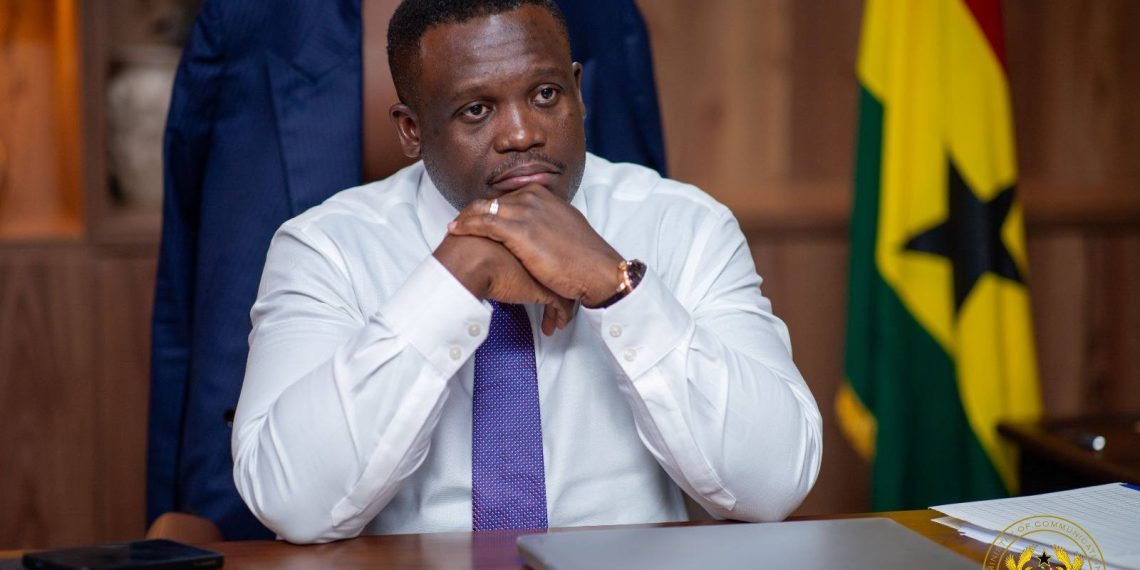
Fiifi Boafo, the former Head of Corporate Affairs at the Ghana Cocoa Board (COCOBOD), has questioned Member of Parliament for Ningo-Prampram and now Minister of Communication, Digital Technology and Innovations, Sam George, following the delay on the Anti-LGBTQ+ Bill.
It will be recalled that Samuel Nartey George had earlier stated in 2024, while the National Democratic Congress (NDC) was in opposition, that if they won power and the Mahama failed to assent to the Anti-LGBTQ+ Bill, he would have “no peace.”

Speaking on a panel discussion on Peace FM’s Kokrokoo on March 28, 2026, Fiifi Boafo quizzed, “Is the President having his peace? I am asking this question because Sam George said he will make sure the President will have no peace if he doesn’t assent to the anti-LGBTQ bill, and I haven’t heard it has been signed…
What action has the government taken? So, I am asking that the person who said the President will have no peace, what has he done?” he said.
Meanwhile, President John Dramani Mahama has said Ghana is still grappling with the provisions of basic needs of education, health care, jobs, food, clothing, and shelter, which is his government’s main focus and not the Anti-LGBTQ Bill.
According to John Mahama, the Anti-LGBTQ Bill, while important, is not Ghana’s most urgent concern at this time.
Speaking during a Presidential Dialogue with Civil Society Organisations at Jubilee House in Accra on Monday, March 30, Mahama stated, “We are still grappling with the provisions of basic needs of education, health care, jobs, food, clothing, and shelter”.
“While there are strong and differing views within our society, we believe that issues must be addressed through democratic processes, our core values, dialogue, and the rule of law,” he said.
Earlier, President John Mahama called on international partners to respect Ghana’s position on LGBTQ issues.
Mahama stressed that public policy is shaped by the country’s legal traditions, cultural values, and societal consensus.
According to John Mahama, Ghana’s democratic processes are actively at work to ensure that any outcome of the anti-LGBTQ bill reflects the views of the people.
President Mahama made these known when he received the ‘International Statesperson Award’ from the World Affairs Council of Philadelphia.
He stated, “The issue of LGBTQ rights is emotive, and they are not completely settled in terms of their nuances and arguments, not only in Ghana but all over the world.
Even in the United States, you still have discourse on LGBTQ rights. There are still 26 states in America that have legislation that restricts LGBTQ rights.
For a country like Ghana, our democracy is playing in respect to what those rights are. The bill in parliament is not a government bill, it is a private members’ bill, and so parliament hold that bill for now.
What the eventual nature of the bill would be, nobody can second-guess Parliament, and I, as President, cannot anticipate Parliament in respect of that bill. But I believe that our democracy will work out. Memoranda are being accepted from people from all walks of life.
“Civil Society Organisations are presenting their papers to Parliament, and I believe that the representatives of the people will make the will of Ghanaians reflect in whatever eventually comes out,” he said.
I swore an oath to uphold the Constitution, and so the representatives of the people will discuss the bill once they pass it, and then it comes to the presidency.
I believe that our international partners should understand that public policy is grounded in our legal traditions, in our cultural context, and in our social consensus, and all those issues are playing out as we speak.”
Watch the video below: