

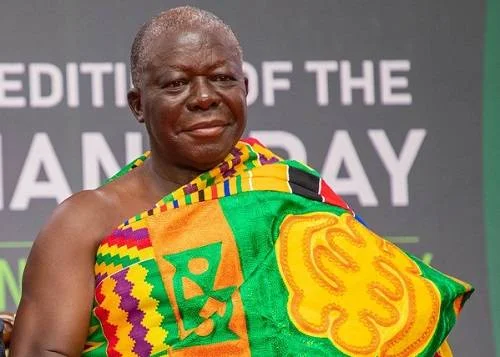
Frank Annoh-Dompreh, the Minority Chief Whip and Member of Parliament for Nsawam-Adoagyiri, has threatened to petition the Asantehene, Otumfuo Osei Tutu II, over the government’s decision to reduce cocoa prices.
According to the Minority Chief Whip, during his visits to Tano North, Asutifi North, and Asutifi South, he warned that if the government under John Dramani Mahama does not address the concerns raised, the Minority will not hesitate to seek the intervention of the Asantehene to help resolve the matter.

“Without action, this administration will have shown that they do not truly care for the cocoa farmers, despite all the promises made during the 2024 election campaign,” he stated.
In related news, President John Dramani Mahama has said the recent International Cocoa price drop must be a wake-up call for Ghana.
According to John Mahama, almost 70 years after Ghana gained independence, the country is still exporting raw beans to the world.
President Mahama stated, “The recent incident with cocoa, with the prices plummeting, and you see all the videos of ‘Mahama wo de y3 ka’ of cocoa farmers protesting in the cocoa farms, is because for almost 70 years after we gained independence, we’re still exporting raw beans to the world”.
“I believe that what has happened in the international market should be a wake-up call for us, and that we must allocate more of our beans, and we’re taking the first step to doing that,” he indicated.
President Mahama added, “We’re changing the financing model. Before, we got the traders and others who buy the cocoa to advance the money for us to buy the cocoa from our farmers. Now, we say we’re going to raise the money ourselves and buy our own cocoa,” he stated.
“While we’re taking the money from the traders to buy the cocoa from our farmers, the collateral for the money they were advancing us was the cocoa beans. And so once you bought the cocoa beans, it was collateral for the financing they gave you.
“So, now if we raise our money, we buy our own cocoa. Our cocoa is not collateral to anybody, and so we can decide what to do with it, and we’re saying that we’re going to allocate the bulk of our cocoa to the local processors to process that cocoa before we export it,” he concluded.
Meanwhile, Otumfuo Osei Tutu II, the Asantehene, has said Cocoa alone can no longer shoulder Ghana’s economic ambitions.
The Asantehene asserted that cocoa has long been the backbone of Ghana’s economy, symbolising discipline, sacrifice, and resilience.
Otumfuo Osei Tutu II also warned that cocoa faces growing threats, including pollution from illegal mining and climate change, altering rainfall patterns.
He further commended the government’s efforts to diversify the tree crop sector, emphasising cashew, coconut, oil palm, rubber, mango, and shea as potential drivers of growth.
The Asantehene highlighted that if cocoa currently generates approximately two billion dollars annually, the other six major tree crops could collectively generate 12 billion dollars or more for Ghana in the future.
The Asantehene, in a speech read on his behalf by the Nkoranza Manhene, Nana Kwame Baffoe IV, at the 2026 Ghana Tree Crops Investment Summit and Exhibition, stated, “It has educated our children, built our communities, sustained rural livelihoods, and earned Ghana global recognition as a dependable agricultural producer”.
“This vision is not speculative. It is firmly grounded in economic logic, ecological necessity and global market demand. As such, it deserves sustained attention and full national support and investment,” the Asantehene said.
He added, “The combined strength of Ghana’s diverse tree crops can become a powerful engine of sustainable growth. This journey will, however, require patience, long-term capital, discipline and effective coordination. Tree crops are far more than commercial commodities”.
“So, I therefore issue a clarion call to all traditional authorities across Ghana. Let us deliberately make land available for large-scale, responsible tree crop development,” he urged.
See the post below:
Minority to Petition Asantehene Over Government's Cocoa Price Cut.
— Metro TV Ghana (@metrotvgh) April 8, 2026
Click here for more stories 👇https://t.co/16U08GbiVZ #MetroNews #metrotvonline pic.twitter.com/joMPoS8SMw