

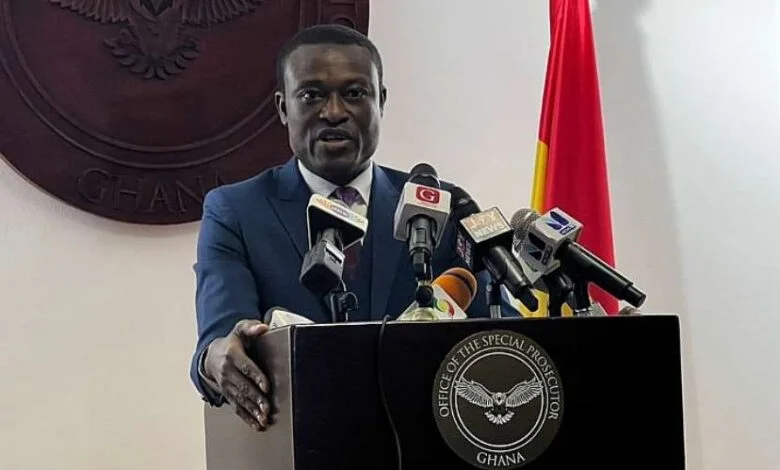
A High Court in Accra has ruled that the Office of the Special Prosecutor (OSP) has no authority to prosecute cases.
The High Court ruling stripped the Office of the Special Prosecutor (OSP) of its prosecutorial powers, handing them to the Attorney General (AG) to take over all criminal prosecutions.

On Wednesday, April 15, the High Court ruling was delivered, representing a significant development in Ghana’s legal and anti-corruption landscape.
Also, the court declared that all ongoing prosecutions initiated by the OSP are null and void, a decision that immediately halts multiple high-profile and ongoing cases being tried in various courts across the country.
Reports suggest the presiding judge, John Nyante Nyadu, further awarded costs of GH₵15,000 against the OSP, underscoring the Court’s position on the matter and the procedural concerns raised in the case.
Earlier, Professor Stephen Kwaku Asare, a legal practitioner and scholar, disclosed that in most constitutional systems, prosecutorial power is vested in a public authority, usually the Attorney-General.
In a write-up he wrote, “In most constitutional systems, prosecutorial power is vested in a public authority, usually the Attorney-General.
But does that mean one office must control all prosecutions?
Let us travel.
In Morrison v. Olson, the U.S. Supreme Court upheld the appointment of an independent counsel with full prosecutorial powers. Not under the Attorney-General’s daily control. Not within the usual chain. Still constitutional. The monopoly theory failed.
In Vineet Narain v. Union of India, the Indian Supreme Court went further. Independence was not optional. It was required. Because the executive cannot be trusted to investigate itself. The answer was structural insulation.
In Glenister v. President of South Africa, the Court confirmed that Parliament may create and relocate anti-corruption and prosecutorial functions. The Constitution does not freeze power in one office. What matters is independence and effectiveness.
Across constitutional democracies, prosecutorial power is vested. It is not monopolised. It is structured. It is adapted. It is insulated where necessary.
Now return home.
We are told Article 88 creates an imperial AG. That all prosecution must pass through one political office.
That Parliament is powerless to design independent institutions to fight corruption.
Even if it is obvious that a political AG cannot effectively prosecute political corruption, we are urged to interpret the Constitution as an instrument of paralysis, tying our hands and sentencing us to spectatorship while corruption thrives.
No serious constitutional system ties the fight against corruption to the discretion of a single political office.
Certainly, in light of its emphasis on probity and accountability, it takes extraordinary chutzpah to suggest that the Constitution was written to protect corruption by disabling the State”.
See the post below:
High Court orders AG Ayine to take over all OSP's cases until prosecutorial authorization is granted…#GHOneNews #EIBNetwork #GHOneTV #NewsAlert pic.twitter.com/Rg6UlswQr5
— GHOne TV (@ghonetv) April 15, 2026