

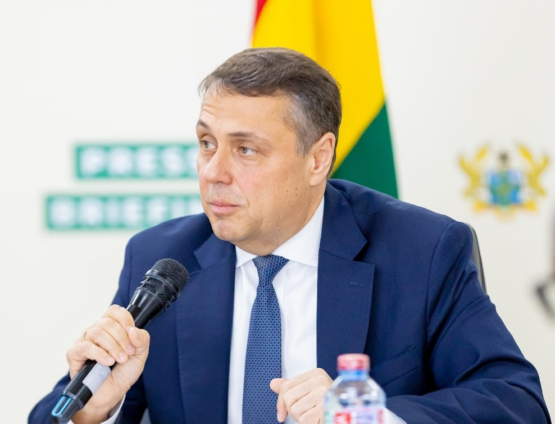
Ruben Atoyan, the International Monetary Fund (IMF) Mission Chief for Ghana, has clarified that Ghana’s IMF Programme has not concluded.
He revealed that Ghana’s Extended Credit Facility (ECF) programme has not officially ended yet, despite the recent staff-level agreement last week.

In a yet-to-be aired JoyNews’ PM Express, Ruben Atoyan disclosed that the IMF is expected to present Ghana’s sixth and final programme review.
According to Ruben Atoyan, the IMF board will decide Ghana’s final review and new PCI deal on July 27.
He disclosed that once the Board approves the report, the final tranche of more than $318 million under Ghana’s bailout programme will hit the account of the Bank of Ghana.
Speaking in the yet-to-be aired JoyNews’ PM Express, the IMF Mission Chief for Ghana stated, “What happened in Accra was a staff-level agreement, and not a programme conclusion”.
“This should mean the IMF team and Government of Ghana have reached an understanding on policies needed to complete this review,” he added.
“We had the opportunity to engage cocoa farmers, power producers and some gold refinery as well,” he said.
“We are hopeful that by July 27, all commitments have been undertaken by the Government, so we can secure the necessary approvals,” he stated.
He further highlighted the IMF mission to Ghana as “very fruitful”.
His comments follow, the Government of Ghana, led by President John Dramani Mahama, has announced the successful conclusion of Ghana’s Extended Credit Facility programme with the International Monetary Fund (IMF).
According to the Government of Ghana, the country’s plans are to transition away from a financial bailout arrangement toward a non-financing policy support framework.
In a statement issued by Presidential Spokesperson and Minister for Government Communications, Felix Kwakye Ofosu read, “1. The Government of Ghana announces the successful conclusion of its Extended Credit Facility (ECF) financial bailout programme with the International Monetary Fund.
2. This milestone represents the restoration of macroeconomic stability and debt sustainability. well ahead of the original timeline.
3. Following the derailment of the IMF financial bailout programme at the end of 2024, the government of President John Mahama in 2025 acted decisively to bring it back on track and to recalibrate it by implementing a frontloaded fiscal consolidation, bold expenditure rationalisation, and strong structural reforms.
4. These efforts have delivered tangible results: inflation has reduced significantly, the cedi has strengthened markedly, public debt as a share of GDP has declined sharply, and economic growth has rebounded strongly
5. Ghana’s sovereign credit ratings have improved significantly from restricted default (Junk Status) to ‘B’ with a positive outlook, representing five distinct rating levels upgrades.
6. This reflects improved fiscal performance, normalised creditor relations, stronger external buffers, and renewed market confidence
7. Ghana’s gross international reserves have risen to an all-time high, reaching approximately US$14.5 billion by February 2026, almost 6-months of import cover.
8. These foreign exchange reserve buffers provide Ghana with the capacity to withstand external shocks and stand on its own feet
9. This announcement marks the definitive end of Ghana’s financial bailout relationship with the IMF.
10. Government is exceedingly grateful to the people of Ghana for their sacrifices, resilience and forbearance.
11. The Government also expresses deep gratitude to its bilateral creditors, the Official Creditor Committee (OCC) and external and domestic investors for their collective sacrifice.
12. Going forward, Ghana will engage with the IMF Policy Coordination Instrument (PCI)
13. The PCI is a form of Technical Assistance engagement with the IMF. It is a non-financing instrument designed to help countries implement economic reforms, signal commitment to policies, and unlock financing from private investors and other development partners.
14. For the avoidance of doubt, the PCI does not provide a financial bailout, but will offer continuous tapacity development, confidence boost to the market, and deliver a catalytic effect for fresh financing to Ghana.
15. This Non-bailout Technical Assistance Policy Coordination Instrument (PCI) will complement the government’s effort to achieve an Investment Grade rating.
16. Achieving an Investment Grade rating will significantly lower sovereign and private sector borrowing costs, attract long-term institutional investors, increase foreign direct investment, and unlock cheaper financing for critical infrastructure development and private sector growth
17. Ultimately, this engagement will support the government’s effort to accelerate sustainable development, create jobs and raise living standards for all Ghanaians
18. President John Mahama and his administration remain fully committed to good governance, prudent economic management, fiscal discipline, and creating an attractive environment for both domestic and international investment”, the statement concluded.