
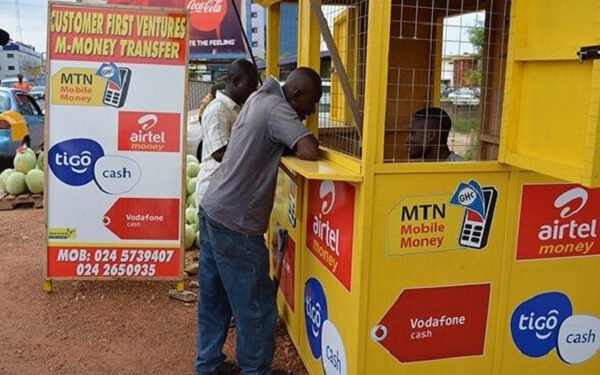
A new study conducted by the ReFinD Research Initiative, ISSER, has unearthed that nearly 1 in 2 mobile money (MoMo) agents in Accra, Ghana, are battling mental health issues.
The survey conducted targeted over 800 mobile money agents in Greater Accra, Ghana, in 2025 found 48% screened positive for at least one common mental disorder, including 38% for depression, 32% for anxiety, and 30% for psychological distress rates exceeding the general population average.
The survey detailed that the primary stressors include liquidity pressures, fraud risks, customer conflicts, and long hours in the mobile money business, relating to reduced on-the-job performance, errors, and coping with painkillers or energy drinks.
Parts of the research findings published by Edem Klobodu, an assistant professor of marketing at the Smith School of Business, Queen’s University, read, “From June to July 2025, we surveyed over 800 mobile money agents across Greater Accra using clinically validated screening tools. The results were sobering: 48% met screening thresholds for at least one common mental disorder: 38% for depression, 32% for anxiety, and 30% for high psychological distress.
These rates exceed Ghana’s general population, where depression prevalence is approximately 25% (Amu et al., 2021). But perhaps more striking was what agents didn’t do: they didn’t stay home”.
The report further added. “Most agents are self-employed or work on commission, where no work means no income. So they show up every day, even when struggling. This phenomenon, known as presenteeism, creates a different cost. Agents with higher distress scores showed lower on-the-job performance: more errors, slower service, and reduced ability to handle difficult customers.
We also found that about 30% of agents spend significant sums on painkillers, energy drinks, and herbal remedies just to get through the workday — survival tactics rather than health investments.
The research also added that the driving cause of agents’ distress across the life mobile money business was constantly dominated by “liquidity pressures, fraud risks, customer conflicts, and long hours with little time for recovery. Agents operating mobile money only reported higher distress than those with diversified businesses, suggesting income diversification may buffer against stress”.
The ReFinD Research Initiative, ISSER research, called for targeted psychological and financial support interventions to improve mobile money agent well-being.
It highlighted the sustainability risks to digital finance networks if human costs remain unaddressed.
In other news, The Bank of Ghana (BoG) has announced that they have directed Mobile Money Fintech Limited (MMFL) to suspend the implementation of its proposed 0.75% fee on direct wallet-to-bank transfers.
According to the BoG press release, the suspension is to allow further consultations.
In a press release issued on Tuesday, May 26, 2026, the Bank of Ghana wrote, “The Bank of Ghana informs the public that Mobile Money Fintech Limited MMFL, has been directed to pause the implementation of its proposed 0.75 per cent fee on direct wallet-to-bank transfers. The fee was scheduled to take effect on 1 June 2026, but is now on hold to allow for further consultation.
This decision reflects our commitment to ensuring that any changes to charges in the mobile financial services ecosystem are introduced fairly, protect consumers, and support their financial well-being”.
BoG press release follows MTN Ghana, which earlier announced that Mobile Money wallets to bank accounts transfer will attract 0.75% fee per transaction.
According to MTN Ghana, the new charge on transfers from Mobile Money wallets to bank accounts takes effect on June 1, 2026.
The notice added that the charge will be capped at GH¢5 per transaction regardless of the amount transferred.
MTN Ghana stressed that the adjustment is aimed at helping improve its services to customers.
In a message sent to customers on Monday, May 25, MTN Ghana stated, “Y’ello Valued Customer, From 1 June 2026, transfers from your MoMo Wallet to bank accounts will attract a fee of 0.75% per transaction, capped at GHS 5. This will help us continue to serve you better. Thank you for choosing MoMo”.
See the post below:
Nearly half of mobile money agents surveyed in Greater Accra screened positive for depression, anxiety, or psychological distress. Our latest ReFinD study uncovers the hidden human costs of digital finance in Ghana.
— ReFinD Research Initiative, ISSER (@ReFinD_ISSER) June 1, 2026
👉 Read more: https://t.co/WymtVaZf7r#ReFinD pic.twitter.com/6Px2wVE4bG