

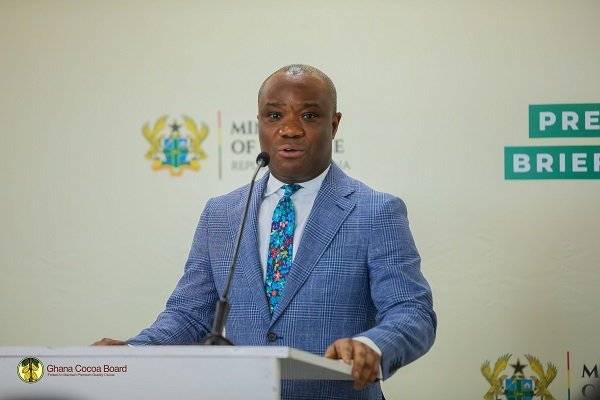
Felix Kwakye Ofosu, the Minister for Government Communications, has disclosed that Ghana’s relationship with South Africa remains cordial despite concerns surrounding recent xenophobic attacks.
According to Kwakye Ofosu, Ghana have not done anything to muddy the relationship with South Africa; adding that the government is only taking steps to protect Ghanaians from attacks.

Speaking on the Midday News on Joy FM on Tuesday, July 7, Kwakye Ofosu stated, “Our relations remain cordial, as you have seen. We in Ghana have not done anything to muddy the relationship; we only had to take a step to protect our citizens from the attacks, and so we know that we have made an arrangement to bring a number of them back home, and arrangements are ongoing to bring more back home. Beyond that, we don’t think that our relations have been damaged”.
“Of course, we have indicated our displeasure about what is happening in South Africa; we hold the view that the South African government could have done more to guarantee the safety and security of Ghanaians in particular and other foreigners in South Africa in general. But we continue to hold the South African government and its people in high esteem. And we are willing and able to maintain a healthy relationship that will result in mutual benefits for both countries”, he added.
His comment follows the government of Ghana’s rejection of a planned state visit by South African President Cyril Ramaphosa.
The information gathered from reports detailed that the South African President’s visit was declined due to the killing of a Ghanaian national and reported xenophobic attacks targeting Ghanaians in South Africa.
According to sources within the corridors of power, the decision was taken amid growing concerns over the safety of Ghanaians living in South Africa.
Reports revealed President Ramaphosa was expected to visit Ghana in the first week of August, providing an opportunity for both countries to strengthen bilateral relations.
Nonetheless, the Ghanaian government indicated that the current situation requires serious attention before such high-level diplomatic engagements could proceed.
Meanwhile, South African authorities have contested Ghana’s account of the incident, labelling the claims surrounding the killing as “factually incorrect” and “not based on fact.”
According to the South African government, no deaths were recorded during the June 30 demonstrations, which attracted thousands of protesters in parts of the country.
Mmamoloko Kubayi, South Africa’s Justice Minister, stressed that Ghana’s characterisation of the incident was misleading and risked creating a negative picture of South Africa.
“It is concerning that Ghanaian authorities continue to communicate false information about South Africa regarding developments on irregular migration,” she was quoted as saying in a statement.
“The spread of false information to perpetuate the false narrative that South Africa is xenophobic is unacceptable,” she added.
It will be recalled that Cyril Ramaphosa, the South African President, has pleaded with President John Dramani Mahama to help rally other African heads of state in support of South Africa over the ongoing xenophobic attacks on foreign nationals.
According to the SA president, the ongoing attacks on foreign nationals are an African problem, not only a South African one, and require African solutions.
Speaking to the press, the SA president expressed appreciation for Mahama’s willingness to champion South Africa’s cause among fellow African leaders.
He disclosed that the move has influenced South Africa’s decision to dispatch diplomatic envoys across the continent.
Cyril Ramaphosa, the South African President, stated, “This time around, we are saying we want to work together; work with us. And I’m rather pleased that President Mahama of Ghana has been saying he would like to make a call on other African countries to work with South Africa, and that is precisely what has triggered our intention to send envoys, so that they go and explain the initiative that we have taken.
“In the end, this is an African problem; it is not only a South African problem, but we are all involved in this. Various countries on the continent experience precisely what we are going through”.
He further recognised the severe social pressures, including unemployment, insecurity, and poor service delivery, that have powered anti-immigrant tensions but contended that the solution must be collective, as it is an African problem.
This is an African problem that requires African solutions,” he stated.
Meanwhile, Ghana’s High Commissioner to South Africa, Benjamin Quashie has said a witness in the murder of a Ghanaian national in South Africa has gone into hiding.
According to Benjamin Quashie, the witness to the murder has gone into hiding over fears for his life.
He disclosed that the witness, who is a Zimbabwean national, was working alongside the deceased when the incident occurred, but has refused to make himself available to investigators.
Speaking on The Key Points on TV3 on July 4, 2026, Benjamin Quashie stated, “Fortunately, one gentleman, a Zimbabwean who was working with the deceased, was in the shop when the incident happened. We have been told that he is the person we are looking for to become a state witness in the case”, Quashie said.
“He has also absconded. We’ve tried reaching him, and he has told us that if he comes to testify, he knows his life will be in danger”, he said.
Ghana’s High Commissioner to South Africa added, “The lawyers from the High Commission are working hard with the courts in South Africa so that he can be placed under witness protection and be able to corroborate what happened on that very day”.
“When the murder happened, because the High Commission is in Pretoria, we quickly dispatched officers to establish the facts. We found it difficult to get information because many Ghanaians in Cape Town were afraid to come forward”, he said.
@ghnow_ 🇬🇭 I used just one idea to create over 800,000 jobs. #GHNow #fyp ♬ original sound – GHnow