

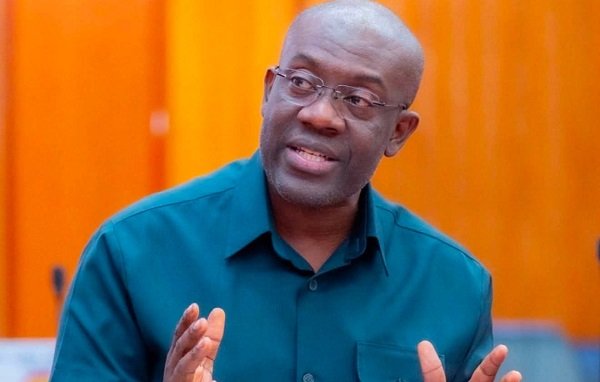
The Supreme Court has thrown out an injunction application filed by Ofoase-Ayirebi Member of Parliament, Kojo Oppong Nkrumah, who was seeking to suspend proceedings pending the final determination of a case challenging the constitutionality of a warrant allowing some High Court judges to conduct criminal trials during the legal vacation.
According to the Supreme Court, the applicant had failed to establish a sufficiently strong case to warrant the grant of an injunction against the Chief Justice’s exercise of his constitutional and administrative powers.

Oppong Nkrumah was represented by private legal practitioner Frank Davies, who asked the apex court to suspend the operation of the warrant issued by the Chief Justice.
The Chief Justice was also represented by the Attorney General.
The Supreme Court, in its ruling, explained the reasons for allowing the Attorney-General to represent the Chief Justice, citing that the Supreme Court had previously held in the Republic vrs Tsatsu Tsikata that the Chief Justice, being a public official, could be represented by the Attorney-General in proceedings brought against him.
The Court further observed that the applicant himself had acknowledged that the Chief Justice had discretion to issue warrants assigning judges to conduct cases.
“I am unable to see how the directive assigning cases to be heard during the legal vacation can be said to be discriminatory,” the Court held.
According to the Court, the warrants were clear on their face that the judges were expected to conduct cases pending before their respective courts.
Oppong Nkrumah’s legal team argued that the injunction was necessary to preserve the status quo while the court considers the broader constitutional questions surrounding the Chief Justice’s decision.
Justice Gabriel Scott Pwamang, presiding as a solo judge, thus dismissed the interlocutory injunction application on Friday, August 21, 2026.
The substantive challenge to the constitutionality of the Chief Justice’s warrants will therefore proceed separately from the unsuccessful application for interlocutory relief.
The Supreme Court’s dismissal means the warrant remains in operation while the substantive constitutional challenge proceeds; affected courts can continue sitting under administrative warrants issued by the Chief Justice.
Earlier, Kojo Oppong Nkrumah sued the Chief Justice, Paul Baffoe-Bonnie, at the Supreme Court.
In his suit, Oppong Nkrumah names Chief Justice Paul Baffoe-Bonnie as the first defendant and the Attorney-General and Minister for Justice, Dominic Ayine, as the second defendant.
In the writ, filed on Friday, August 14, 2026, the MP is challenging the constitutionality of administrative warrants issued by the Chief Justice directing selected High Court judges to sit and conduct criminal trials during the legal vacation.
Mr Oppong Nkrumah is invoking the original jurisdiction of the Supreme Court under Articles 2(1) and 130(1) of the 1992 Constitution.
He is seeking declarations that the administrative warrants issued by the Chief Justice are inconsistent with the Constitution and are therefore null and void.
Parts of the writ stated, “A declaration that the action of the Honourable Chief Justice to promote and facilitate the hearing of “special criminal cases” in the legal vacation to the total neglect of other criminal cases is tantamount to selective justice which contravenes the letter and spirit of Article 17(1) of the Constitution 1992 and therefore unconstitutional, null and void.”
“The Plaintiff readily acknowledges that the office of the Chief Justice occupies a unique constitutional position as the head of the Judiciary and is entrusted with broad administrative responsibilities for the effective and efficient functioning of the courts,” the statement said.
“It is a cardinal principle of Ghana’s constitutional order that every constitutional power, however extensive, is subject to the supremacy of the Constitution,” he said.
“The Constitution does not recognise absolute or unreviewable discretionary power. Every public authority, including the Chief Justice, must exercise administrative and discretionary powers in a manner that is fair, reasonable, transparent, non-arbitrary and consistent with the Constitution,” the statement added.
According to him, “The impugned warrants have the practical effect of according priority to selected criminal cases while other pending criminal cases remain outside the scope of the warrants.”
@ghnow_ Community Police officers have advised the youth to stay away from drug abuse and make responsible choices to protect their health, future and communities. 🚫💊 #GHnow #Fyp ♬ Breaking News – Voxie
@ghnow_ Did you ever hear Afenyo Markin talking about the government from 2017 to 2024? – Raph #GHnow #Fyp ♬ original sound – GHnow