

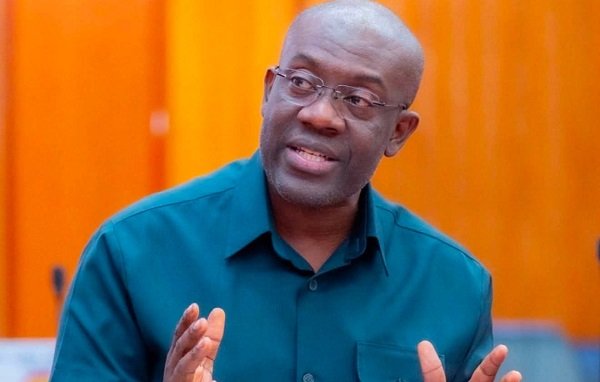
Kojo Oppong Nkrumah, a Member of Parliament for Ofoase Ayirebi, has run back to the Supreme Court seeking a review of its decision to dismiss his request to stop selected High Court judges from sitting during the legal vacation.
The MP is now asking a three-member panel of the Supreme Court to overturn that ruling and grant the injunction he previously sought.

Oppong Nkrumah, in his application, argues that Justice Pwamang made several errors in dismissing the earlier injunction application.
He argued that Justice Pwamang erred in dismissing his preliminary objection on the issue, contending that Justice Pwamang went beyond the permissible scope of an interlocutory application.
Parts of his affidavit shared by thelawplatform. online stated, “23. In the course of his ruling, the learned judge made the following definite pronouncements and redeterminations on the substantive constitutional matters pending before the Supreme Court:
(i) At page 7 of Exhibit G :
I am unable to see how priority of hearing of cases even during legal vacation can amount to inequality before the law.”
It is factually inaccurate to say that the warrants required the Judges to conduct trials in ‘selected cases’.
It is plain on the face of the warrants that the Judges have been given authorisation to conduct hearings in all cases pending in their courts.”
It is differences in treatment on account of the grounds stated in clause (2) of article 17 that the Constitution is concerned with.”
(ii) At pages 7 to 8 of Exhibit G:
The plaintiff in his statement of case has not alleged that the Chief Justice’s conduct in selecting the two Courts to give warrants to conduct hearings in the legal vacation was influenced by the gender, race, colour, ethnic origin, religion, creed or social or economic standing of the accused persons in those cases or their witnesses.”
(iii) At page 8 of Exhibit G :
It would be difficult to impeach the Chief Justice’s exercise of discretion pursuant to articles 23 and 296(a) and (b) without any evidence of ill will.”
(iv)At page 9 of Exhibit G :
These statements plainly fail to take account of the existing standard practice where judges who sit during legal vacation take their leave when the rest of the courts resume work. As for the Court staff, their leave from work is not in any way affected by legal vacation sitting. For the lawyers, they are independent service providers in Court proceedings who are free to plan their leave at any time of the year.
C.I.47 regulates civil cases, and the subject matter of the plaintiff’s complaint here is criminal trials.
(V) At page 10 of Exhibit G:
In my understanding, the warrants issued by the Chief Justice that the plaintiff has complained about are an effort to afford opportunity for more criminal cases to be tried expeditiously”.
Earlier, the Supreme Court had thrown out an injunction application filed by Ofoase-Ayirebi Member of Parliament, Kojo Oppong Nkrumah, who was seeking to suspend proceedings pending the final determination of a case challenging the constitutionality of a warrant allowing some High Court judges to conduct criminal trials during the legal vacation.
According to the Supreme Court, the applicant had failed to establish a sufficiently strong case to warrant the grant of an injunction against the Chief Justice’s exercise of his constitutional and administrative powers.
Oppong Nkrumah was represented by private legal practitioner Frank Davies, who asked the apex court to suspend the operation of the warrant issued by the Chief Justice.
The Chief Justice was also represented by the Attorney General.
The Supreme Court, in its ruling, explained the reasons for allowing the Attorney-General to represent the Chief Justice, citing that the Supreme Court had previously held in the Republic vrs Tsatsu Tsikata that the Chief Justice, being a public official, could be represented by the Attorney-General in proceedings brought against him.
The Court further observed that the applicant himself had acknowledged that the Chief Justice had discretion to issue warrants assigning judges to conduct cases.
“I am unable to see how the directive assigning cases to be heard during the legal vacation can be said to be discriminatory,” the Court held.
According to the Court, the warrants were clear on their face that the judges were expected to conduct cases pending before their respective courts.
Oppong Nkrumah’s legal team argued that the injunction was necessary to preserve the status quo while the court considers the broader constitutional questions surrounding the Chief Justice’s decision.
Justice Gabriel Scott Pwamang, presiding as a solo judge, thus dismissed the interlocutory injunction application on Friday, August 21, 2026.
The substantive challenge to the constitutionality of the Chief Justice’s warrants will therefore proceed separately from the unsuccessful application for interlocutory relief.
The Supreme Court’s dismissal means the warrant remains in operation while the substantive constitutional challenge proceeds; affected courts can continue sitting under administrative warrants issued by the Chief Justice.
@ghnow_ Afenyo-Markin sues Sammy Gyamfi over extortion allegations #GHnow #fyp ♬ original sound – Official M/C_Foreigner
@ghnow_ Construction continues on the drainage system at Darkunman junction #GHnow #fyp ♬ original sound – Nacee Music