

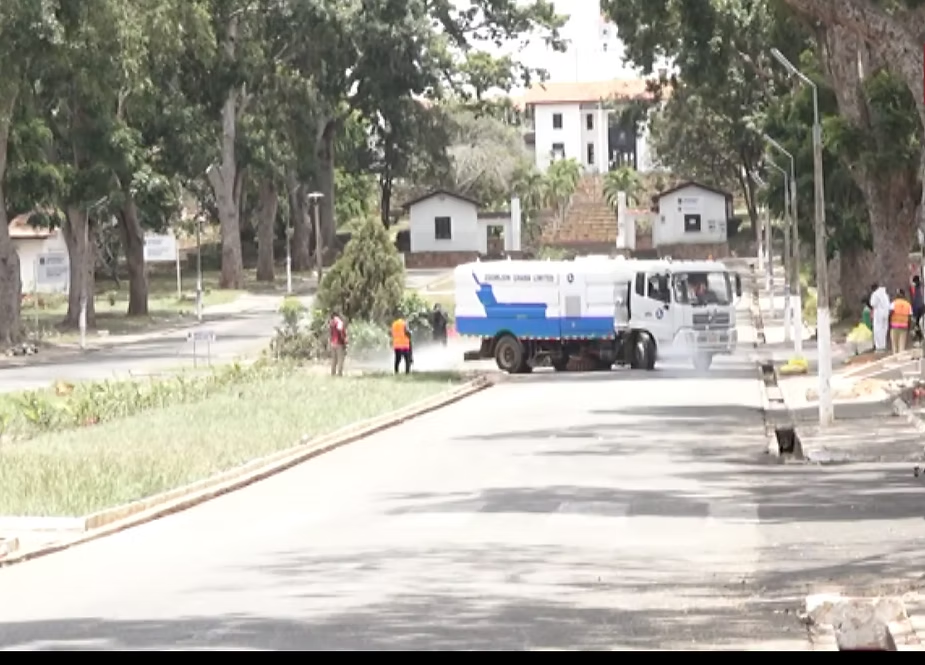
Investigative journalist Manasseh Azure Awuni has revealed that Ghana under the Akufo-Addo government spent approximately GH¢780 million on fumigation exercises during the COVID-19 pandemic in an effort to curb the spread of the virus.
However, questions have since emerged over the scientific basis, effectiveness and necessity of the exercise, particularly amid evidence that COVID-19 was primarily transmitted through respiratory droplets and airborne particles rather than contaminated outdoor surfaces.

In his latest investigative article, Manasseh highlighted that evidence gathered points to approximately GH¢780 million spent on COVID-19 fumigation expenditure and not GH¢96m.
The expenditure has therefore sparked renewed debate over the justification of the intervention, the use of public funds and the accountability of authorities who approved the initiative.
According to experts, the fumigation exercise had no scientific basis.
Excerpts from his investigative article published on pacgh.org detailed how the GH¢780m on COVID-19 fumigation was needless and not backed by science, read, “Ghana’s fumigation exercises, for which hundreds of millions of cedis were spent, were not backed by science, according to information from Ghana’s scientific community and international COVID-19 guidelines published in the early days of the pandemic.
The government of Ghana shut down all schools and educational facilities four days after the first COVID-19 case was recorded in the country. At the time, no school in Ghana had recorded a COVID-19 case. When schools were due to be opened, more than three months later, the president announced that all schools in the country would be fumigated before students returned.
“If it [a school] was shut for three months, who went in there and introduced the virus? And is the virus going to stay for three months? From all that we have read, it’s [the lifespan of the virus on surfaces] from two hours to nine days,” said Dr J.H. Kofi Bonney, a senior research fellow at the Noguchi Memorial Institute for Medical Research, the institution that led Ghana’s testing and research during the COVID-19 pandemic.
“They [the coronaviruses] don’t have life. They only get life when they get into a living cell… So if this room has been locked for three months, and you decide to disinfect it, you may not be targeting the virus,” said Dr Agustina Angelina Siverkern, Clinical Microbiologist and Research Fellow, at the Kumasi Centre for Collaborative Research in Tropical Medicine.
Professor Gordon Awandare, the Director, West Africa Centre for Cell Biology of Infectious Pathogens, said, “If you’re sure that the place has not been encroached by anybody, you can pretty much assume that if there was any virus there and the place has been closed for three months, then the virus is likely dead.”
According to Dr J.H. Kofi Bonney, even if fumigation had been necessary, it should have targeted places with infections.
Asked about Ghana’s COVID-19 trends, the Director General of the Ghana Health Service at the time of the pandemic, Dr Patrick Kumah Aboagye, confirmed that COVID-19 cases in Ghana were confined to a few areas.
“Broadly, we had more of a cluster-based spread. There were many areas where there was not generalised spread. You could have a region where just about three or four districts are reporting cases. And even in those towns, there are certain locations where you had cases; in others, you don’t have,” Dr Aboagye said.
The Local Government Ministry awarded contracts for the fumigation of all markets across Ghana, including towns and districts that never recorded COVID-19 cases. When this reporter asked the ministry to name the persons or institutions that advised it to carry out the fumigation, the ministry said:
“The information you seek is denied because the information you require is internal working information of a public institution, hence exempt from disclosure.”
What the WHO said about Ghana’s kind of fumigation
The Government of Ghana claimed that its COVID-19 fight was backed by science and recommendations by international bodies, especially the World Health Organisation (WHO). In May 2020, when only the first fumigation contract had been awarded, the WHO published guidance discouraging both indoor and outdoor mass spraying or fumigation, the kind carried out in Ghana in 2020, 2021, and 2022.
Zoomlion executed its fumigation contracts by spraying chlorine solution on streets, open markets and school compounds, including tarred streets.
On indoor fumigation, the WHO guidelines said:
“In indoor spaces, routine application of disinfectants to environmental surfaces by spraying or fogging (also known as fumigation or misting) is not recommended for COVID-19. One study has shown that spraying as a primary disinfection strategy is ineffective in removing contaminants outside of direct spray zones. Moreover, spraying disinfectants can result in risks to the eyes, respiratory or skin irritation and the resulting health effects. Spraying or fogging of certain chemicals, such as formaldehyde, chlorine based agents or quaternary ammonium compounds, is not recommended due to adverse health effects on workers in facilities where these methods have been utilised.”
Regarding outdoor fumigation, the WHO guidelines said:
“Spraying or fumigation of outdoor spaces, such as streets or marketplaces, is also not recommended to kill the COVID-19 virus or other pathogens because disinfectant is inactivated by dirt and debris and it is not feasible to manually clean and remove all organic matter from such spaces. Moreover, spraying porous surfaces, such as sidewalks and unpaved walkways, would be even less effective. Even in the absence of organic matter, chemical spraying is unlikely to adequately cover all surfaces for the duration of the required contact time needed to inactivate pathogens. Furthermore, streets and sidewalks are not considered to be reservoirs of infection for COVID-19. In addition, spraying disinfectants, even outdoors, can be harmful for human health.”
@ghnow_ Hon. Nii Comey has donated 500 chop boxes and mattresses to residents of the Domeabra Obom Constituency. The items are being distributed today at Ashalaja School Park. #GHnow #fyp ♬ original sound – GHnow
@ghnow_ Hon. Ashai Odamtten present School items to over 1000 students in Tema East #GHnow #fyp ♬ original sound – NDCMUSICHQ