

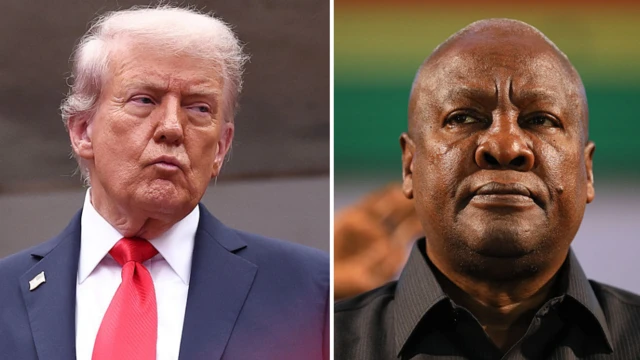
The US Embassy in Ghana has defended its request for access to Ghana’s health data under a proposed bilateral health compact, following President John Dramani Mahama’s description of the agreement as “humiliating” after Ghana rejected the proposed deal.
Speaking on behalf of the US Embassy in Ghana, Commanding Officer, Major General Matthew W Brown, claimed that the agreement was intended to strengthen Ghana’s capacity to manage its own health programmes rather than undermine the country’s sovereignty.

According to the US Embassy, the arrangement was consistent with international best practices and would not involve the disclosure of patients’ personally identifiable information.
Major General Matthew W Brown stated, “Our intention has always been to strengthen our partners’ sovereignty. Contrary to some reporting, we did not immediately pull the plug and cut off all health assistance in one fell swoop”.
He disclosed that the US request was not for information that would identify individual patients.
Major General Matthew W Brown clarified that the proposed US Global Health MOUs sought aggregate health data, meaning information compiled at a broader level for purposes such as assessing health programmes and measuring their impact.
He stated, “Unfortunately, we did not conclude a bilateral health MOU with Ghana this year. As such, we are now in the process of phasing out our support for existing programmes in alignment with the government of Ghana’s push for health sovereignty and country-led global health reform.
“Consistent with long-standing global best practices for measuring the impact of health interventions, the United States Global Health MOUs requested aggregate health data without any personally identifiable information, similar to data sharing that has been done with the PEPFAR programme and many other international health partners over the years,” he stated.
He further compared the proposed data-sharing arrangement to existing practices under the US-funded President’s Emergency Plan for AIDS Relief (PEPFAR) programme and other international health partnerships, highlighting that similar forms of data sharing have taken place between the United States and international health partners over the years.
Major General Brown said the MOUs included provisions for sharing such specimens as part of broader international cooperation on disease surveillance and response.
He added, “The MOUs also include provisions for the sharing of pathogen specimens, which is similar to coordination efforts in the fight against Ebola”.
“We are proud of what our multibillion-dollar investment has been able to achieve, and the number is multibillion. Just since 2012, we have invested $2.2 billion in Ghana in these areas”.
“But more than that, we think about the thousands of lives saved, people who are now able to contribute to Ghana’s economic development and our strong people-to-people ties,” he added.
“Part of the process of discussing the draft MOU was a period of negotiations, which we engaged in here quite robustly and quite, I think, in good faith on both sides over a period of months to work out those particular details,” he stated.
“We’re always open to discussion with our good partners in the government of Ghana. And so the door is always open in that regard to discuss topics of mutual interest,” he noted.
The United States Embassy in Ghana defends President John Dramani Mahama explaination of Ghana’s decision to reject a proposed health compact from the United States.
Mahama described some of the US health deal conditions as humiliating and unacceptable.
According to John Mahama, the compact was presented as a replacement for health funding previously provided through the United States Agency for International Development (USAID).
He disclosed that the $100m US health compact was thrown out of Cabinet after a review by the Ministry of Health.
Mahama detailed that the Ministry of Health prepared a Cabinet Information Paper after examining the agreement and flagged several provisions.
He disclosed that the proposed compact required Ghana to provide the United States with its pathogen profile and medical records, which President Mahama said raised concerns about the country’s health data.
Speaking at the Council on Foreign Relations in New York, President Mahama explained, “We received the Health Compact from the US to replace USAID funding, and Ghana is a sovereign nation, and we have our processes. We’re a democratic country, and so when the compact was received, the Health Ministry studied it and did what we call a cabinet information paper”.
“And so, the compact was brought to cabinet, and we flagged several things in the compact. One, it says that we shall give the United States our pathogen profile. It means what diseases are endemic in Ghana; what is the pathogen profile of a country,” Mahama added.
“They also say we should give our medical records. I mean, who takes another country’s medical records? And so that was strange,” he added.
“And then it also says we would have to put up a certain amount of money as part of the program into healthcare,” he said.
“And then it also says that any medications or any medical products that shall be brought into our country, our Food and Drugs Administration has absolutely no rights to inspect. I mean, it was humiliating and so it was the compact that was thrown out in record time in our cabinet,” he added.
“We asked the health minister to inform the US ambassador that we didn’t need it, we’ll manage ourselves, and for a pittance, a hundred and something million dollars, and so we said, no, we didn’t want it, and we’re doing fine,” he noted.
It will be recalled earlier. In 2026, the government of Ghana rejected a bilateral health deal with the United States over “unhealthy concerns” about the terms.
Reports suggest Ghana declined the deal primarily because of the conditions attached to it.
The information gathered suggests the proposed agreement required Ghana to share health records with the United States for a period of 25 years, while the aid program was for five years.
Also, an MoU also reportedly included provisions that would allow drugs approved by the U.S. Food and Drug Administration to enter the Ghanaian market without undergoing the country’s standard approval process by Ghana’s FDA.
JoyNews in a post stated, “US health aid: JoyNews sources confirm in November 2025, the US chargé d’affaires presented Ghana’s Ministry of Health with an MoU unilaterally by the US requesting it be signed within one week”.
Another post stated, “US health aid deal: US required Ghana to share health records for 25 years while aid was for only 5 years – JoyNews sources say”.
@ghnow_ Three suspects, Philip Dzifa Kofi Tefe, Sarah Osei Adams and Josiah Obodai, involved in the abduction and murder of 33-year-old Circle phone dealer Nana Yaw Kyere, popularly known as Terry or Dinero, have appeared before the Teshie-Nungua District Court, with the case adjourned to October 16, 2026. #GHNow #fyp ♬ original sound – ADAAMAINA
@ghnow_ Demolition at Malata Market to make way for 24 hour Market Construction #GHNow #fyp ♬ original sound – NDCMUSICHQ