
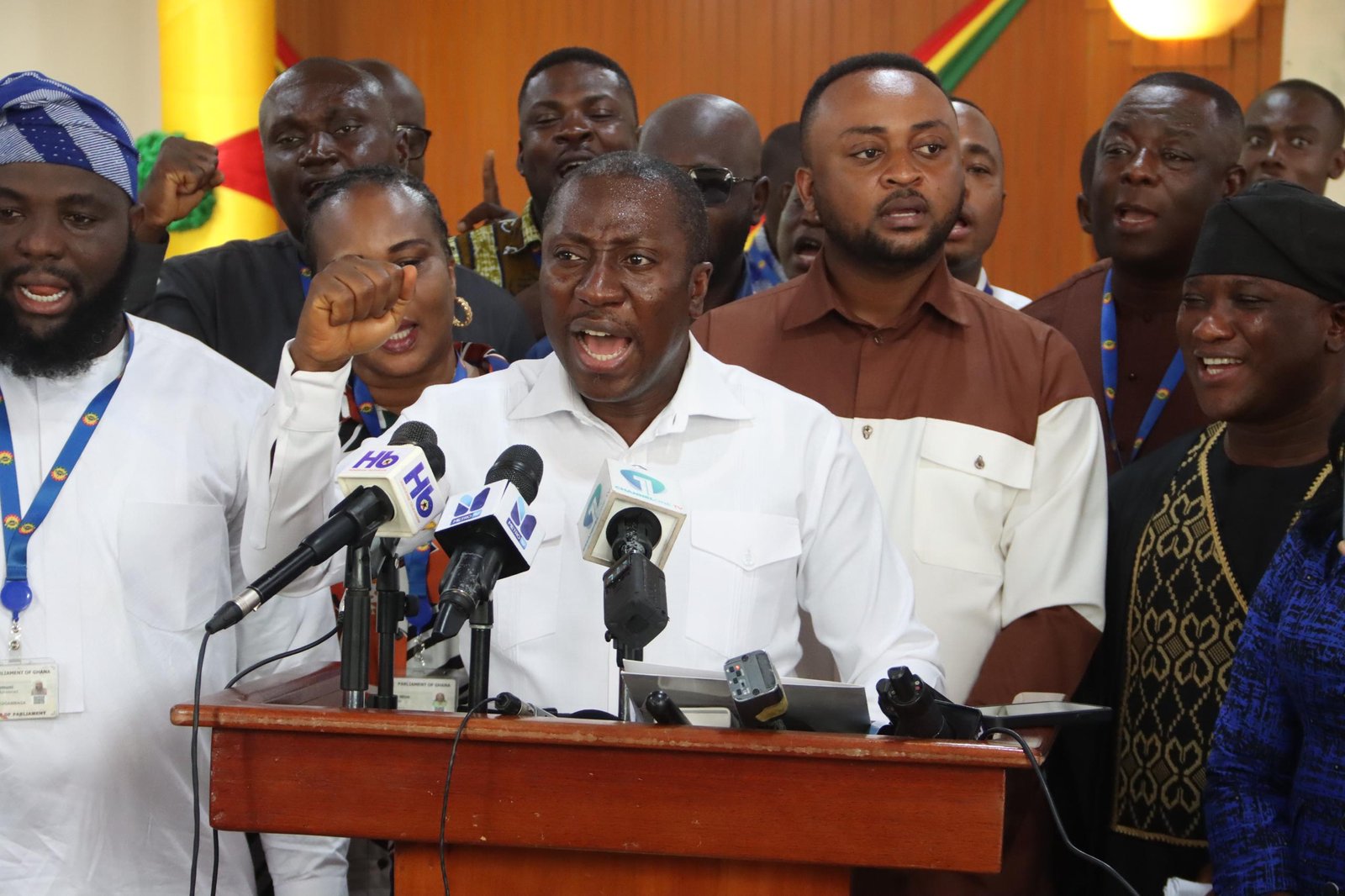
The NPP Minority in Parliament has rejected the 9 per cent salary increase agreed for public sector workers in 2027.
According to the Minority, the agreement is an insult to workers whose incomes are struggling to keep pace with rising utility bills, transport fares, rent and other household expenses.

They argued that the salary adjustments do not adequately reflect the rising cost of living, particularly the cumulative increases in electricity and water tariffs, transport fares, rent and other essential household expenses.
The Minority Caucus also questioned the role of Organised Labour in the negotiations, accusing union leaders of accepting an inadequate deal despite earlier assurances that they would push for a more substantial increase in workers’ base pay.
In a statement signed by its Ranking Member, Mavis Nkansah Boadu, and issued on October 30, 2026, parts of the statement stated, “The Minority Caucus on Employment, Labour Relations and Pensions in Parliament has received with utter shock and dismay the details of the newly signed Multi-Year Public Service Remuneration Agreement for 2027 and 2028, finalised on October 28, 2026.
To offer Ghanaian public sector workers a meagre 9% total remuneration increase for 2027 (8% base pay and 1% conditions of service) and 10% for 2028 is nothing short of an insult. This miserly adjustment is a direct assault on the dignity of workers, especially when juxtaposed with the compounding burden of utility tariff increases imposed on citizens across 2025 and 2026.
While public sector workers are shackled with sub-inflationary salary increments, following 10% in 2025 and 9% in 2026, the cost of living has skyrocketed under relentless compounding adjustments administered by the Public Utilities Regulatory Commission (PURC)”.
The NPP Minority also raised some key concerns, saying, “Disregard for Cost of Living: While Ghanaian workers grapple with skyrocketing electricity bills, transport fares, and essential goods, the government hides behind optimistic inflation projections of 8% ± 2% to justify impoverishing public sector employees.
Bad Faith in Negotiations: Forcing a restrictive two-year framework under the guise of providing predictability for the transition of the Fair Wages and Salaries Commission (FWSC) to the Independent Public Emoluments Commission (IPEC) is a clear tactic to tie the hands of workers. Economic Hypocrisy: Expecting workers to tighten their belts with a 9% pay deal while utility tariffs compound quarterly is economic wickedness that the Minority Caucus will fiercely resist”.
They further demanded an immediate reconvening of the Public Services Joint Standing Negotiating Committee (PSJSNC) to establish what it describes as a living wage that takes into account the actual cost of living.
The statement added, “The Minority Caucus accordingly demands:
a) Immediate Review of the Remuneration Framework: An immediate reconvening of the Public Services Joint Standing Negotiating Committee (PSJSNC) to establish a living wage that accounts for real compounding utility and commodity price inflation;
b) Holistic Cost-of-Living Protection: Wage negotiations can no longer be conducted in a vacuum while utility regulators greenlight constant tariff increases that wipe out nominal pay adjustments;
c) True Respect for Organised Labour: We urge the government to cease using institutional transitions (such as the IPEC switch) as leverage to impose poverty wages on Ghanaian workers; and; d) Accountability to the Rank and File: The leadership of Organised Labour must publish the proposals it tabled and explain to its members the basis on which it accepted a two-year deal opening at a mere 9%”.
They further concluded saying, “The Minority Caucus stands in absolute solidarity with the rank and file of Organised Labour and the suffering workers of Ghana. We reject this insulting 9% pay deal in the face of relentless electricity tariff hikes. The Ghanaian worker deserves dignity, economic justice, and a fair share of national prosperity”.
Their comment follows the Public sector workers in Ghana who are expected to benefit from a 9 per cent increase in total remuneration in 2027, followed by a 10 per cent rise in base salaries in 2028, under a new agreement between the government and organised labour.
The agreement was reached through negotiations at the Public Services Joint Standing Negotiating Committee, which brings together representatives of the government and labour unions to discuss workers’ remuneration and conditions of service.
According to the Secretary-General of the Trades Union Congress (TUC), Joshua Ansah, the 2027 adjustment will consist of an 8 per cent increase in base pay and an additional 1 per cent allocation to address concerns relating to other conditions of service.
For 2028, the agreement provides for a 10 per cent increase in base salaries across the public sector.
Mr Ansah explained that the additional allocation for 2027 is intended to correct disparities in allowances and other employment benefits that have contributed to unequal remuneration among public sector employees.
He said particular attention would be given to lower-income earners and vulnerable workers to ensure that the implementation of the agreement promotes fairness.
“Beyond the percentage increases, fairness in the allowances remains a central concern. The additional one per cent provision is intended to help address existing distortions and inequalities in conditions of service, with particular attention to protecting lower-paid and vulnerable workers,” he said.
Mr Ansah emphasised that improving workers’ welfare would require more than general salary increases, noting that existing inequalities in allowances must also be addressed.
He stated that the additional 1 per cent provision would help tackle these imbalances and ensure that workers who are more vulnerable receive appropriate consideration.
While acknowledging that the agreement might fall short of some workers’ expectations, the TUC Secretary-General described it as an important step towards maintaining employees’ purchasing power amid prevailing economic conditions.
“This agreement may not meet every expectation. It represents progress in our efforts to protect workers’ purchasing power,” he added.
See the statement below:
@ghnow_ Media personality Nana Ama McBrown heaps praises on blogger Kobby Kyei for his impressive career and achievements in the media industry at the Content with Purpose event at the French Embassy. #GHNow #fyp ♬ original sound – GHnow
@ghnow_ Media personality Nana Ama McBrown advises content creators and online journalists to be genuine in their pursuit of money as she speaks at the Content with Purpose training event at the French Embassy. #GHNow #fyp ♬ original sound – GHnow