

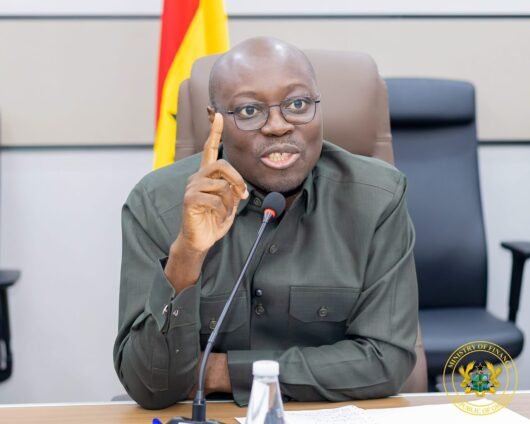
Dr Cassiel Ato Forson, the Minister of Finance, has assured Ghanaians that the government will not borrow loans to finance its proposed New Economy Programme.
The Finance Minister disclosed that the initiative will be funded through domestic revenue and savings from fiscal consolidation.

According to Ato Forson, the government plans to commit 1.5 per cent of Gross Domestic Product (GDP) annually between 2027 and 2030 to the programme without adding to the country’s public debt.
He made this known while responding to concerns about the source of funding for the programme during an interactive engagement with students and members of the university community at the Kwame Nkrumah University of Science and Technology (KNUST).
Ato Forson detailed that the funding would come from two main sources: an allocation of 0.5 per cent of GDP from government revenue and a reduction in the primary surplus target from 1.5 per cent to 0.5 per cent of GDP.
He revealed that the two sources would create the fiscal space needed to invest in the programme, with the total allocation potentially reaching at least US$13 billion over four years.
Ato Forson also clarified that GoldBod does not generate revenue for the Ministry of Finance or the government, adding that state finances are primarily supported by direct taxes, indirect taxes and non-tax revenue.
The Finance Minister also disclosed that the government would continue to honour its debt sustainability commitments by reducing public debt to 45 per cent of GDP by 2028.
Dr Ato Forson said improvements in Ghana’s primary balance demonstrate the government’s commitment to reducing public debt adding that the country recorded a primary surplus of 2.5 per cent of GDP in 2025, with a further surplus of 1.5 per cent projected for 2026.
According to Ato Forson, the two surpluses are expected to contribute to a cumulative debt reduction equivalent to approximately 4 per cent of GDP.
He detailed that from 2027, the government plans to moderate the pace of debt reduction to 0.5 per cent of GDP annually to create additional fiscal space for investments under the New Economy Programme.
He highlighted that the approach would allow the government to finance its economic transformation agenda while ensuring that public debt continues on a downward trajectory.
Meanwhile, Professor Isaac Boadi, Executive Director of the Institute of Economic Research and Public Policy (IERPP), has told John Mahama’s government to account for the $4 billion 24-Hour Economy programme before seeking public support for its proposed $10 billion New Economy initiative.
Prof Boadi said the Mahama government must provide verifiable evidence of the funds mobilised, projects undertaken and jobs created under the original programme before introducing another ambitious economic agenda.
Speaking at a press conference on October 27, 2026, Prof Boadi questioned the government’s ability to deliver on its economic promises, arguing that the absence of clear performance figures had raised concerns about transparency, accountability and the use of public resources.
Prof Boadi maintained that the government must demonstrate what it has achieved with the 24-Hour Economy programme before asking Ghanaians to embrace a new initiative involving an even larger financial commitment.
Regarding the proposed $10 billion New Economy initiative, Prof Boadi insisted that the government should disclose its financing arrangements, investment criteria, sector allocations, implementation schedule and accountability measures.
He proposed a publicly accessible dashboard, backed by periodic independent audits, to enable Ghanaians to track financial commitments, project progress and employment outcomes.
Prof Boadi questioned what lessons the government had learnt from the 24-Hour Economy programme and what safeguards would prevent similar accountability concerns from affecting the proposed New Economy initiative.
He stressed that Ghanaians deserved evidence of results rather than repeated announcements of large financial commitments, stressing that “The era of announcing numbers must end. The era of accounting for results must begin”.