
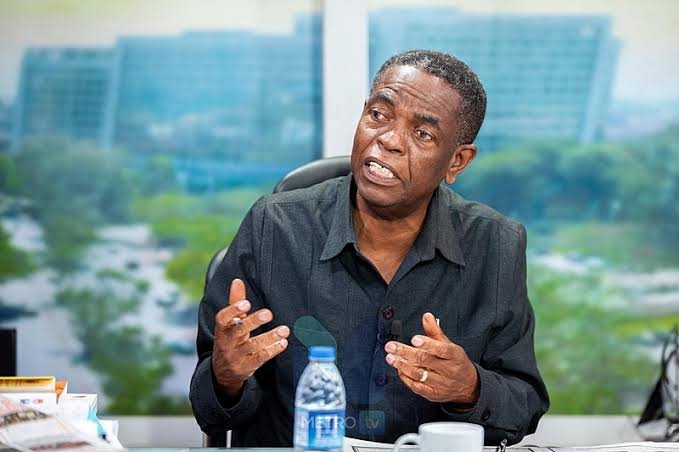
Kwesi Pratt, a veteran journalist, has questioned whether the government’s proposed ‘new economy’ agenda signals a departure from its flagship 24-hour economy policy.
The veteran journalist demanded clarity on what the ‘new economy’ concept means and how it relates to the promises made ahead of the 2024 general elections.

Kwesi Pratt expressed concern over the introduction of the new economic agenda, particularly if it meant the government was moving away from commitments made to Ghanaians during the election campaign.
Speaking on Metro TV’s Good Morning Ghana on November 11, 2026, Kwesi Pratt stated, “What he (Ato Forson) is bringing tomorrow is something called the new economy. And I’m wondering, what is that? The new economy, what is that? Is that a departure from the promises which were made before the 2024 elections?”.
Kwesi Pratt argued that if the government had realised that some of its campaign promises were no longer achievable, it had a responsibility to return to Ghanaians and explain the reasons for changing course rather than introducing a new agenda without adequately clarifying its implications.
He added, “If at any point the government realises that those promises cannot be fulfilled, government needs to come back to us and say, ‘Look, you gave us a mandate to do this.’ We’ve been in office, we’ve seen that the promises we made were not realistic. We are abandoning it and going for something called the new economy”.
The Veteran journalist further suggested that the term ‘new economy’ could be another catchy political expression introduced ahead of a budget presentation.
He, however, insisted that Ghanaians deserved to know whether it represented a fundamental shift in the government’s economic policy.
Kwesi Pratt argued that after two years in office, the government should be using its budget presentation to account for the progress made towards fulfilling its campaign promises, particularly the establishment of the 24-hour economy.
According to Kwesi Pratt, the policy was presented as a major vehicle for creating employment, and the government should therefore provide an update on the steps taken to make it a reality.
He added, “We want the mandate to establish the 24-hour economy. That was supposed to be the main vehicle for generating employment. We’ve been in power for two years. These are the things that we have done to make sure that the 24-hour economy promise, which was a game-changer, is on course”.
Kwesi Pratt stressed that the government’s economic direction must be assessed against the commitments it made to voters in the 2024 election, adding that any decision to abandon or significantly alter those promises should be clearly explained to the public.
Meanwhile, the New Economy Programme is a framework designed to transition the country from post-IMF economic stability to private-sector-led job creation and industrial growth, with its focus on employment-generating priority areas.
In related news, Dr Cassiel Ato Forson, the Minister of Finance, has assured Ghanaians that the government will not borrow loans to finance its proposed New Economy Programme.
The Finance Minister disclosed that the initiative will be funded through domestic revenue and savings from fiscal consolidation.
According to Ato Forson, the government plans to commit 1.5 per cent of Gross Domestic Product (GDP) annually between 2027 and 2030 to the programme without adding to the country’s public debt.
He made this known while responding to concerns about the source of funding for the programme during an interactive engagement with students and members of the university community at the Kwame Nkrumah University of Science and Technology (KNUST).
Ato Forson detailed that the funding would come from two main sources: an allocation of 0.5 per cent of GDP from government revenue and a reduction in the primary surplus target from 1.5 per cent to 0.5 per cent of GDP.
He revealed that the two sources would create the fiscal space needed to invest in the programme, with the total allocation potentially reaching at least US$13 billion over four years.
Hon. Fiifi Kwetey has arrived at the NDC headquarters for vetting as the party’s National Secretary aspirant. He is going unopposed for the position. https://t.co/zIqOVPIQ6n
— GHnow (@ghnow_) November 11, 2026