
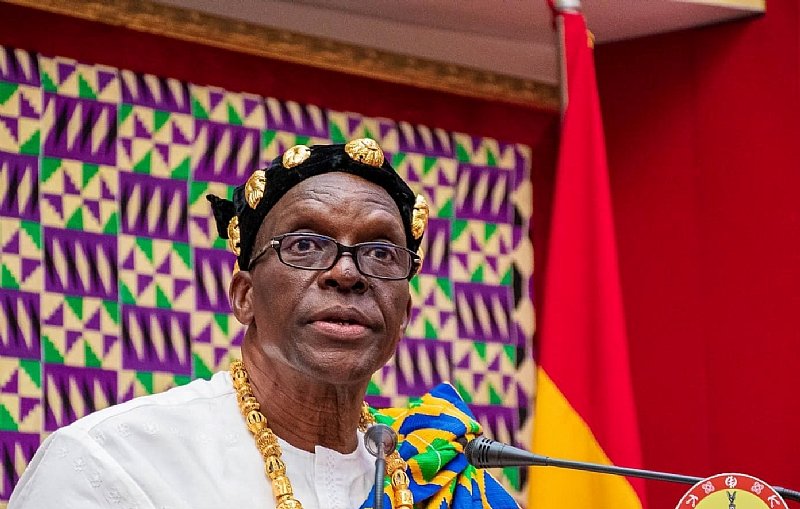
Speaker of Parliament, Alban Bagbin, has disclosed that Parliament has found no evidence that any MP or officer of the Parliamentary Service received the alleged $46,000 bribe to influence the approval of the 2015 AKSA emergency power agreement.
According to reports, the finding follows an administrative review commissioned by Speaker Bagbin to investigate allegations that money was paid to individuals associated with the House in connection with the agreement.

Speaking in Parliament on Wednesday, Speaker Bagbin said the review, which examined parliamentary records and included interviews with serving and former officials, did not establish that any legislator or parliamentary officer received the alleged payments.
Speaker Bagbin, however, cautioned that the findings did not prove that no bribes were paid or clear anyone who may have benefited from the alleged scheme.
He further disclosed that the report and supporting documents would be forwarded to the Office of the Special Prosecutor (OSP) and other relevant investigative agencies for further examination.
Bagbin explained that the review was administrative, not criminal, and lacked the authority to compel witnesses, take evidence under oath or access bank records and private communications.
He said the exercise could therefore not establish the guilt or innocence of anyone implicated, adding that investigating the alleged financial transactions remained the responsibility of law enforcement agencies.
The referral of the report to the OSP, he noted, would enable investigators to pursue further inquiries using the information gathered by Parliament.
The allegations are linked to the US conviction of former Goldman Sachs employee Asante Kwaku Berko for facilitating bribe payments to Ghanaian officials in connection with a power generation project developed by Turkish energy company AKSA.
Asante Berko was convicted by a federal jury in the United States over a bribery and money laundering scheme linked to a power plant project in Ghana.
According to information gathered, Asante Berko and others conspired to pay more than US$1 million in bribes to Ghanaian government officials to help secure a multimillion-dollar power plant deal for Turkish energy company Aksa Enerji Uretim A.S.
The shady deal centres on a power plant deal that was under development and financing between December 2014 and July 2015.
Asante Berko, who was then an executive director in the investment banking division of Goldman Sachs at the time, was involved in managing the transaction between the bank’s client, Aksa Enerji, and the Republic of Ghana.
According to US court text, bribes were also paid to five Ghanaian officials during an all-expenses-paid trip to Turkey to view equipment for the power plant.
The three former Members of Parliament who served on Parliament’s Select Committee on Mines and Energy have been caught up for their alleged role. Dr Kwabena Donkor, Alhaji Sorogho and KT Hammond are among those alleged to have travelled to Turkey to inspect equipment for the AKSA project.
Later, the OSP named former Power Minister Kwabena Donkor and four other Ghanaian officials as persons of interest in the AKSA bribery scandal.
The Special Prosecutor identified former Power Minister Kwabena Donkor; Francis Walkson Kwasi Dzafa, a former Technical Adviser to the Minister of Power; Solomon Adjetey Sowah, a Deputy Director; Lyndon Nii Mettle, Director of Tricorp Group Limited; and Baffour Ankomah Brobbey, an employee of Tricorp Group Limited as persons of interest.
However, Martin Amidu, Ghana’s former Special Prosecutor, has said nothing meaningful will come out of Ghana’s investigation into the Asante Berko–AKSA bribery scandal.
The former Special Prosecutor expressed grave doubts about Ghana’s ability to produce meaningful criminal evidence, adding that the case could end without any prosecutions.
According to Martin Amidu, nothing useful by way of evidential results will come from Ghana’s investigation into the alleged corruption, corruption-related offences and money laundering connected to the AKSA deal.
Martin Amidu believe that any evidence uncovered in Ghana could be suppressed.
In a strongly worded article, Martin Amidu stated, “I sincerely believe and conclude from the bottom of my heart that nothing useful by way of evidential results would come out of any Ghanaian investigation into the Asante-AKSA-Ghana corruption, corruption-related and other criminal offences such as money laundering deals that were consummated between 2014 and 2017, leading to the conviction of the principal facilitator of the corruption transactions, Asante Kwaku Berko, by the United States District Court for the Eastern District of New York on August 6, 2026. The evidence will be suppressed”.
“The Asante Berko-AKSA-Ghana bribery deal for which Asante Berko was convicted in the US on August 6, 2026, relates only to the bribery and corruption of public officials of the John Mahama government between 2014 and the early part of 2017, after Berko had resigned from Goldman Sachs in December 2016 to enable investigations into his conduct,” he said.
A heartwarming display of religious tolerance and unity as Muslims are seen praying at the entrance of a Pentecost Church in Daboya, Ghana, highlighting peaceful coexistence between people of different faiths. #GHnow https://t.co/0odmIjHoug
— GHnow (@ghnow_) November 11, 2026