

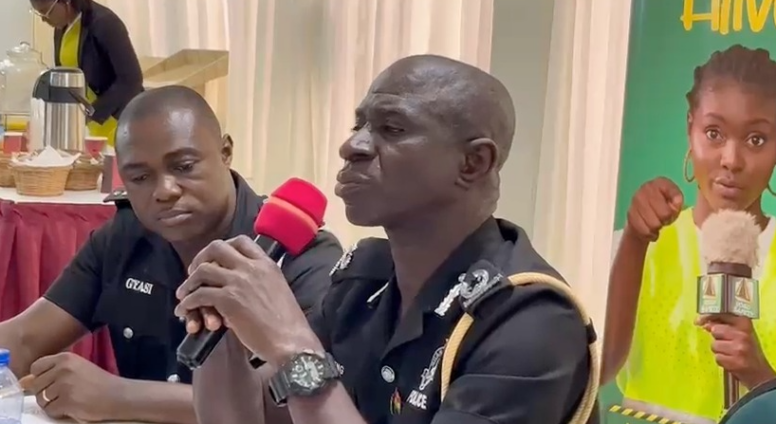
The Ghana Police Service has begun investigations into a suspected fraud network targeting motorists through fake traffic violation messages issued in the name of the Service under the TraffiTech-GH system.
ACP Alexander Kwaku Obeng, the Director of Education, Research and Training at the Motor Traffic and Transport Department (MTTD), disclosed that the Police Cybercrime Unit was gathering intelligence to identify those behind the scheme and dismantle their operations.

He warned that anyone found impersonating the Police Service to extort money from motorists would be arrested and prosecuted.
He said, “The police are doing what we can; the cybercrime team is also gathering intel and is on the lookout for these criminals to dismantle their networks, arrest them and put them before a court of competent jurisdiction”.
ACP Obeng disclosed this during a media interaction on the sidelines of a stakeholder sensitisation exercise in the Ashanti Region.
The programme, organised by the Ministry of Transport, focused on the Road Traffic Amendment Act, 2025 (Act 1153), and the Road Traffic Regulations, 2026 (L.I. 2519).
ACP Obeng also dismissed claims that the TraffiTech-GH system was not operational in the Ashanti Region, assuring motorists that the technology was functioning across the region.
According to ACP Obeng, mobile tripod cameras had been positioned at selected locations to detect traffic offences, while camera-equipped vehicles were being deployed to monitor compliance on other roads.
In related news, Bright Simons, a Vice President of IMANI Africa, has warned that Ghana’s automated traffic enforcement system, TraffiTech, could trigger widespread non-compliance and number plate fraud if authorities fail to address concerns about the affordability and fairness of its fines.
Mr Simons, in a commentary examining the anti-fraud implications of the system, argued that the GH¢240 base fine is disproportionately high relative to the earnings of many Ghanaian workers, particularly minimum-wage earners and commercial drivers.
He noted that the fine is more than 11 times the daily minimum wage, meaning minimum-wage earners would need approximately 11 days of work to pay a single penalty.
He argued that affordability must be considered when designing enforcement policies, warning that motorists who cannot afford penalties may simply refuse to pay them.
Bright Simons stated, “If people simply can’t pay, they will not pay. As the fines pile up, the ability to pay worsen”.
He further cited Kenya’s automated traffic enforcement scheme, which reportedly recorded a compliance rate of just 16 per cent before its suspension. He also referenced Côte d’Ivoire, where authorities introduced instalment payments to help motorists settle fines.
These figures contrast with reported compliance rates of 75 per cent in Berlin, 67 per cent in Chicago and 70 per cent in New South Wales, Australia.
Beyond affordability, he identified public perceptions of fairness as another important factor, arguing that unclear speed limits and seemingly arbitrary enforcement could discourage compliance.
Mr Simons further warned that widespread dissatisfaction could encourage motorists to use fraudulent methods to evade traffic cameras.
He cited the UK’s Operation Phantom, which targeted vehicles using deliberately altered number plates. According to him, special cameras deployed during the exercise detected 4,335 ghost plates within two weeks.
He also referenced research from the University of Texas at Austin, which reportedly showed that a device costing about US$100 could reduce the effectiveness of advanced traffic cameras by as much as 60 per cent.
He warned that the growing availability of evasion technologies could force authorities and TraffiTech’s provider, Sensys Gatso, to invest in increasingly expensive cameras, potentially affecting revenue and the system’s expansion.
Mr Simons argued that maintaining high fines as a deterrent may not necessarily improve road discipline, insisting that affordability, fairness and clearly displayed speed limits are essential to achieving compliance.
Boxing legend Floyd “Money” Mayweather Jr. has arrived in Ghana. 🇬🇭🥊 #GHNow https://t.co/cZsIqEsAKH
— GHnow (@ghnow_) November 18, 2026