
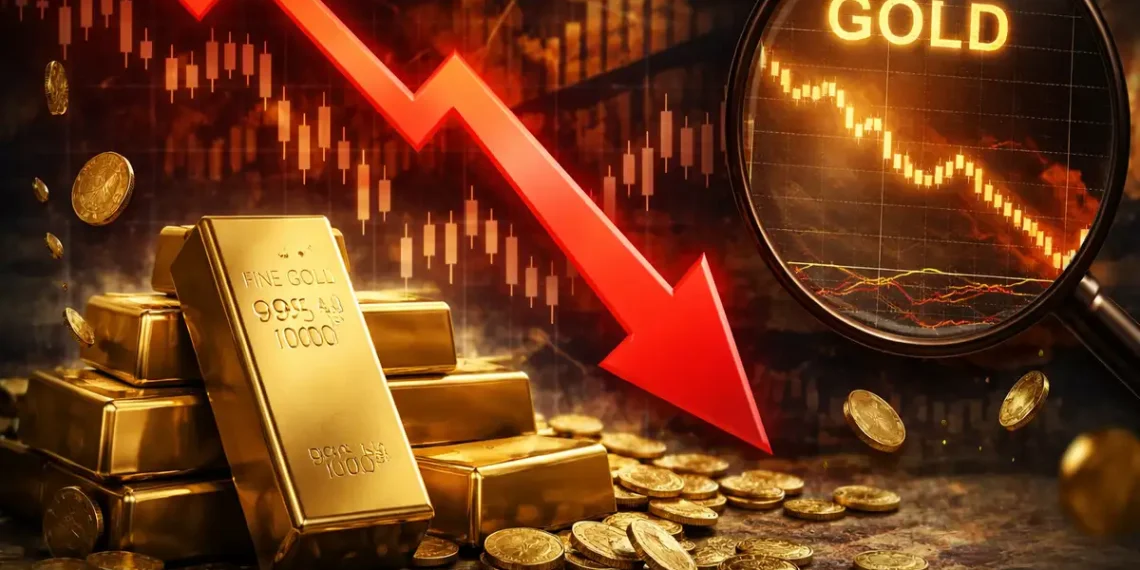
Dr Johnson Asiama, the Governor of the Bank of Ghana (BoG), has warned that declining international gold prices could significantly affect Ghana’s foreign exchange earnings, given the country’s heavy dependence on the precious metal.
According to reports Ghana earns more than 60 per cent of its export revenue from gold, leaving the economy vulnerable to fluctuations in global commodity prices.

Estimates based on BoG data suggest the recent decline could reduce the country’s monthly foreign exchange receipts by nearly US$300 million.
Speaking at a press briefing following the 133rd Monetary Policy Committee (MPC) meeting in Accra last Wednesday, Dr Asiama said the development highlights the urgent need to diversify the country’s export base.
“It is true that gold prices are falling, whereas gold still constitutes over 60 per cent of our exports. So it is an issue. The country is still exposed to commodity price shocks,” he said. “So it is something all of us have to work on, and the answer is greater diversification of our exports.”
Gold prices have dropped considerably from their January peak of US$5,594.82 an ounce, falling approximately 31.5 per cent by November 16, according to Reuters data. On November 18, spot gold declined to US$3,770.12, after touching its lowest level since September 2025.
The decline comes as gold accounts for about 67 per cent of Ghana’s export earnings between January and October 2026, contributing significantly to the country’s US$13 billion trade surplus.
However, gross international reserves have weakened from US$13.8 billion at the end of December 2025 to US$12.1 billion as of November 17, representing approximately 4.4 months of import cover.
The impact on export receipts could be substantial. Ghana’s monthly gold exports have averaged about US$2 billion this year. At current prices, the country earns roughly 14.5 per cent less for the same volume compared with August’s average price of US$4,408 an ounce.
The decline has also reduced the estimated value of the Bank’s gold holdings, with 25.2 tonnes now worth approximately US$3.05 billion at prevailing prices.
Dr Asiama said gold prices remain an important factor in the Bank’s economic outlook.
“Gold price is a big part of it, and so to the extent that gold prices are going down, that is a factor that needs to be watched,” he said.
He called for greater investment in processing oil, gold and cocoa locally, alongside efforts to expand non-traditional exports.
“We need to focus more on some of our non-traditional exports. We need to do greater processing of even the major commodities that we export currently: oil, gold, cocoa,” he said.
“If we can process more of those commodities, that will help us when it comes to resilience in the face of falling commodity prices.”
He added that the 2027 Budget contains measures aimed at advancing this objective.
Meanwhile, the Vice President of IMANI Africa, Bright Simons, has renewed concerns over the sustainability of Ghana’s GoldBod model, detailing that the country’s gold gamble is one price drop away from economic crisis.
Bright Simons argued that the GoldBod model continues to impose high structural costs on the economy despite government efforts to reduce the cost of acquiring foreign exchange through gold purchases.
Mr Simons, in his post, cited findings from a recent International Monetary Fund (IMF) report, which he said confirmed his longstanding concerns about the economic implications of GoldBod’s operating model.
According to Bright Simons, Ghana is heavily dependent, macro-fiscally speaking, on the price of gold staying at record highs, which is undeniable.
He detailed that Ghana’s dependency on gold could well be the biggest risk to the country’s recovery from a disastrous debt crisis in 2022.
Bright Simons detailed that a gold price shock scenario suggests that a 30% correction would wipe out roughly $1.65 billion from the BoG’s gold holdings and stretch the GoldBod operational model to breaking point.
He noted that the IMF’s stress test shows that at a 45% decline (to $2,283/oz), with gold at 50% of reserves, BoG’s equity will fall to -9.0% of GDP.
Bright Simons highlighted that for all of Ghanaians’ sake, gold prices had better hang up there in the skies.
18 Ghanaian Football Talents Arrive at Kotoka Airport Ahead of Spain Trip for Surf Cup International 2026 #GHNow https://t.co/dTZ1DdIlY5
— GHnow (@ghnow_) November 23, 2026