
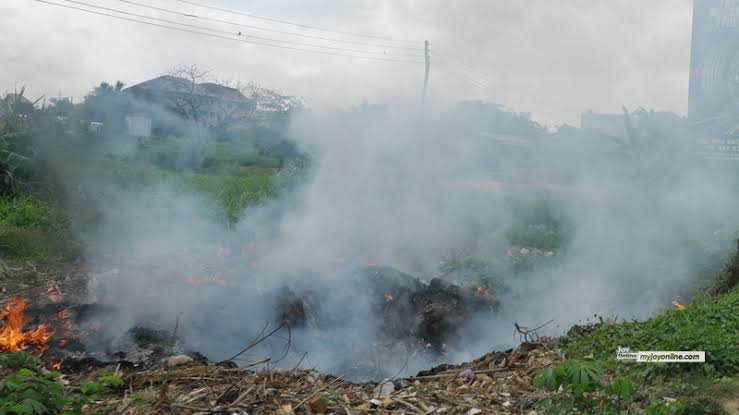
Residents and businesses that violate new air pollution control regulations in Accra could face fines of between GH¢1,200 and GH¢3,000, jail terms ranging from 30 days to six months, or both under the Air Quality Control Bye-law 2025.
The penalties are contained in the Air Quality Control Bye-law 2025, a new regulation expected to be enforced by the Accra Metropolitan Assembly(AMA) and 12 other municipal assemblies across the Greater Accra Region.

The Greater Accra Regional Coordinating Council (GARCC) officially launched the regulation at a media event on Thursday, November 26, calling on the assemblies to ensure strict compliance and enforcement.
The Air Quality Control Bye-law 2025 prohibits activities that contribute to air pollution within the jurisdiction of the implementing assemblies, including the open burning of waste and other materials.
It also introduces permit requirements for businesses whose operations could generate significant air pollution. These include vehicle body repairs and spraying, carpentry and woodwork, metal fabrication and welding, artisanal block-making, as well as commercial food operations.
Operators in these sectors will be required to secure permits from their respective assemblies and the Environmental Protection Authority (EPA) before conducting business.
Also, they must operate from locations approved by the assemblies, away from sensitive areas such as residential communities, schools, hospitals, water bodies and wetlands.
Speaking at the launch, Deputy Director at the Ministry of Local Government, Chieftaincy and Religious Affairs, Charlotte Akwaah-Adjei Marfo, warned that air pollution posed a serious threat to public health.
Charlotte Akwaah-Adjei Marfo noted that children, older persons and individuals with pre-existing health conditions were particularly vulnerable to the harmful effects of polluted air.
She further cited a World Health Organisation (WHO) assessment which put Accra’s annual average concentration of fine particulate matter (PM2.5) at nearly 50 micrograms per cubic metre.
This is approximately 10 times higher than the WHO’s recommended annual guideline of five micrograms per cubic metre.
She urged the implementing assemblies to educate residents and business operators about the new requirements, stressing the importance of communicating the provisions in simple and accessible language.
Charlotte Akwaah-Adjei Marfo also called for improvements in waste management services, explaining that reliable waste collection and disposal systems would help discourage residents from resorting to open burning.
Meanwhile, the 13 assemblies mandated to implement the bye-law are the Accra Metropolitan Assembly, Okaikwei North, La Nkwantanang-Madina, La Dade-Kotopon, Adentan, Korle Klottey, Ayawaso West, Ayawaso North, Ayawaso East, Ayawaso Central, Ablekuma North, Ablekuma Central and Ablekuma West.
In related news, the Minister for Environment, Science and Technology, Dr Zanetor Agyeman-Rawlings, has announced that the government will prohibit the open burning of rubbish from January 2027 as part of efforts to curb pollution and improve environmental protection across the country.
Dr Zanetor announced the planned prohibition at the launch of the National Water Restoration and Rehabilitation Framework in Ho on Thursday, November 26.
She called on residents who dispose of household waste by burning it in their backyards to abandon the practice before the new measure takes effect.
“So those of you who still burn rubbish in your backyards, please take note. Come January, this will not be allowed. So please stop doing it now,” she cautioned.
According to Dr Zanetor, the restriction is one of four major environmental interventions that the Ministry, together with the Environmental Protection Authority (EPA), plans to implement in 2027.
The other interventions will focus on restoring degraded rivers and lands, enforcing air quality regulations and introducing a ban on styrofoam products.
Dr Zanetor said the initiatives reflect the government’s determination to intensify efforts to address environmental pollution, announcing 2027 as the Year of Pollution Control.
The planned measures are expected to strengthen pollution management and promote more sustainable environmental practices across the country.
Ghanaian dancehall star Stonebwoy arrives at the airport to welcome the team as they return to Ghana. #GHNow https://t.co/clif3q0dp4
— GHnow (@ghnow_) November 26, 2026