

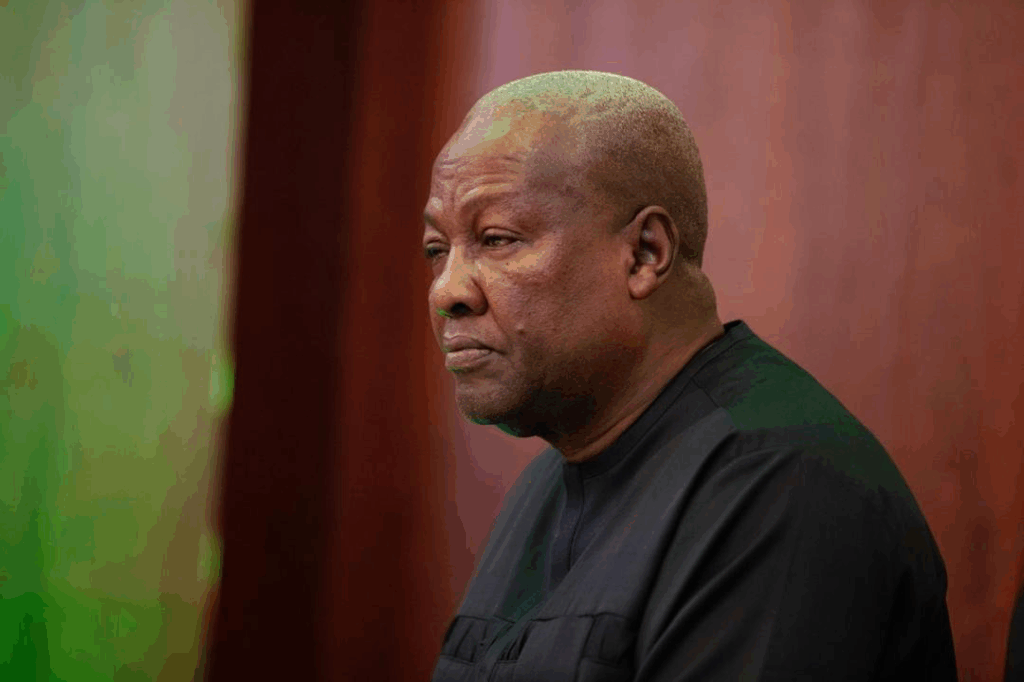
Alhassan Sayibu Suhuyini, the Member of Parliament for Tamale North and Deputy Roads Minister, has questioned the commitment of some National Democratic Congress (NDC) executives to supporting President John Mahama’s administration, suggesting that some would rather take control of the government than work with its appointees.
According to Suhuyini, the growing tension between the governing NDC and the Mahama-led administration could be partly attributed to the conduct of party officials who opted to remain at the party level instead of taking up government appointments.

In a Facebook post, Suhuyini acknowledged concerns among some NDC members about an apparent disconnect between the party and the government, noting that he had also observed the situation in his constituency.
However, Suhuyini challenged party executives to examine their own contribution to the problem rather than placing the responsibility entirely on government appointees.
He recalled that, at the beginning of the Mahama administration, the party leadership pushed for a role in selecting some government officials.
He disclosed that the arrangement resulted in the NDC being given the responsibility of nominating Metropolitan, Municipal and District Chief Executives (MMDCEs) and regional ministers.
According to Suhuyini, the party relied largely on constituency and regional executives to fill these positions, accounting for 216 district-level appointments and 16 regional ministerial positions, with President Mahama primarily responsible for appointing fewer than 40 ministers, alongside chief executive officers of state institutions and members of governing boards.
The Tamale North MP also highlighted what he described as a significant increase in financial allocations to local government under the current administration, citing figures showing that district assemblies received GH¢390 million for the entire 2024 year, compared with GH¢987 million in the first quarter of 2025.
Suhuyini detailed that by the end of 2025, the assemblies had received more than GH¢6 billion, while allocations for the first three quarters of 2026 stood at approximately GH¢5.7 billion.
He argued that the figures demonstrated the government’s commitment to adequately resourcing local authorities, which he considers the foundation of the party’s grassroots structure.
Suhuyini consequently questioned whether the NDC leadership had put in place mechanisms to ensure that the party-appointed officials at the local level were properly oriented, monitored and supported to use the resources effectively while maintaining strong relationships with party supporters.
He argued that party leadership should take responsibility for ensuring that those it helped secure appointments for are able to deliver on their governance responsibilities while advancing the party’s interests.
Read his full post below:
“PARTY AND GOVERNMENT DISCONNECT!!
It’s been a long time since I stirred an unpopular intellectual conversation in our party. The last time I did so in opposition, I received an invitation to our party’s FEC meeting. My younger brother did the same this year and was invited too. So this should surprise no one; it’s in our genes to be unconventional sometimes, regardless of the circumstances.
I have read and heard comrades say that our government is doing very well, and data on the economy and infrastructure expansion supports that. Their concern, however, is that there’s a growing disconnect between the government and the party that brought it to power. There’s some merit to that claim; I feel it in my constituency too. But whose responsibility is it to fix that?
At the inception of this government, party leadership rightly argued that it should have a hand in choosing some members of the government. That was granted, and the party became responsible for choosing MDCEs and regional ministers. The party settled on constituency and regional executives to form the base of this government (216 plus 16). The president was largely responsible for appointing only less than 40 ministers, some CEOs, and board members. Fortunately, the government allocated resources as never before to the local government level, the base the party was responsible for forming. As the data show, unlike in 2024, when the entire-year allocation for district assemblies was Ghc 390 million, the first-quarter allocation last year was Ghc 987 million. By the end of 2025, district assemblies had received a total of over Ghc 6 billion. This year, by the third quarter, district assemblies had received about Ghc 5.7 billion. So, in two years, local government has been resourced by over Ghc 11 billion.
Now to my thesis: after party leadership rightly argued for and supervised the appointment of party people at the local government level, how have they ensured that these appointees have used these unprecedented resources to carry the party along, alongside their foremost responsibility of nation-building?
Shouldn’t party leadership have designed a system for orienting and monitoring those they secured appointments for at the local level, to ensure the proper use of the resources the government puts at their disposal, and to bridge the so-called historical disconnect that always seems to exist between the government and the party? Did the party ever organize an orientation for the appointees it selected? After all, all politics is local.
Would I be wrong, therefore, to conclude that the seeming disconnect may be because some who chose to remain and serve at the party level subtly wish to take over the government, instead of truly working with the comrades they appointed at the local level, who have been so well resourced by the government, to advance the cause of the party through effective and efficient governance? I mean well, but I fear it may come across as war”.
See the post below:
Ghanaian dancehall star Stonebwoy arrives at the airport to welcome the team as they return to Ghana. #GHNow https://t.co/clif3q0dp4
— GHnow (@ghnow_) November 26, 2026