

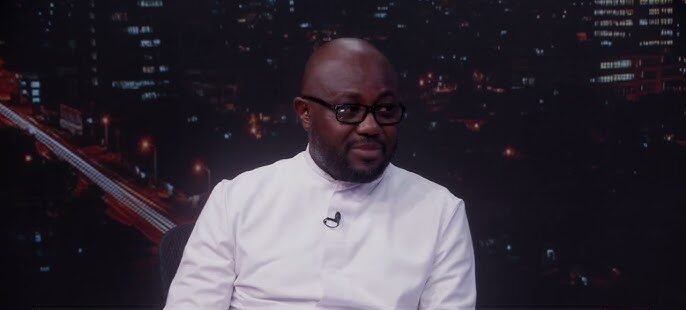
Rev. Fr. Michael Quaicoe, the Director of Governance, Justice and Peace at the Ghana Catholic Bishops’ Conference, has said a truly prosperous nation is the combination of economic excellence and moral values.
According to Rev. Fr. Michael Quaicoe, Ghana cannot treat moral values and economic development as competing priorities in the ongoing national debate over the Human Sexual Rights and Family Values bill, commonly known as the Anti-LGBTQ+ bill.
Rev. Fr. Michael Quaicoe argued that both economic development and the anti-LGBTQ+ bill must be pursued together.
Speaking on JOY NEWS Top Story, Rev. Fr. Michael Quaicoe stated, “A nation truly prosperous is the combination of the pursuit of both economic excellence and the upholding of moral values”.
“So it is not one over the other. It is not a question of this or that. It is more a question of this and that,” he stressed.
His comments follow the Ghana Catholic Bishops’ Conference (GCBC) has issued a public statement following recent remarks made by President John Dramani Mahama and the Minister of State in charge of Government Communications, Felix Kwakye Ofosu, regarding the anti-LGBTQ+ bill.
The Bishops referenced public comments reportedly made by President Mahama at the World Affairs Council, in which he described LGBTQ+ matters as “not the most important issue we face as a nation.”
They also cited remarks by the Communications Minister suggesting the issue was “not a major priority for Ghanaians” and a “waste of time.”
According to the Catholic Bishops, although they acknowledge the weight of Ghana’s present challenges, it is analytically unsound to frame a choice between economic progress and moral coherence.
In the statement signed by the Bishop of Sunyani and President of the Ghana Catholic Bishops’ Conference, Most Rev Matthew Kwasi Gyamfi and dated Friday, April 10, 2026 read, “We have taken notice of reports that the President, speaking at the World Affairs Council, described LGBTQ+ matters as ‘not the most important issue we face as a nation’,” portions of their statement read.
“The Minister, in subsequent commentary, suggested that such matters are ‘not a major priority for Ghanaians,’ and further characterised the debate as a ‘waste of time’,” the GCBC stressed.
“We readily acknowledge the weight of Ghana’s present challenges. Inflationary pressures strain households. Youth unemployment remains stubborn. Gaps in healthcare and education demand urgent reform.
“On these matters, the Church has spoken consistently and will continue to advocate policies that promote equity, opportunity, and human development. However, it is analytically unsound to frame a choice between economic progress and moral coherence,” it stated.
“The two are not rivals but companions. Empirical social research across contexts shows that stable family structures correlate with improved educational outcomes, reduced crime rates, and greater economic mobility. The family, in quiet ways, is a nation’s most efficient social welfare system. To weaken the moral ecology of the family is to erode the very conditions that make sustainable development possible,” the group cautioned.
Catholic Bishops’ statement added, “By ‘family values,’ we refer to the understanding of marriage as a lifelong union between one man and one woman, ordered toward mutual good and the procreation and formation of children,” it stated.
“No individual, regardless of sexual orientation or identity, may be subjected to violence, hatred, or unjust discrimination. Such acts are moral failures and social wounds. We condemn them without reservation.
“Second, the legitimate responsibility of society to uphold and protect the institution of the family, founded upon the union of a man and a woman. This is not an act of exclusion but a recognition of a unique anthropological and social reality,” it added.
“To affirm dignity does not require the redefinition of marriage. To defend marriage does not require hostility. Where either principle is isolated, distortion follows,” the statement continued.
They further called for a serious national dialogue on issues relating to family values and LGBTQ matters.
“We therefore call upon all stakeholders, the executive, the legislature, religious leaders, traditional authorities, and civil society, to engage in dialogue marked by intellectual seriousness, mutual respect, and moral clarity. The tone of our discourse matters as much as its content. Words can either build a republic of trust or fracture it into suspicion,” it indicated.