

Ghana’s colonial masters, the United Kingdom and the Kingdom of the Netherlands, have issued a statement following their decision to abstain from the slavery motion to recognise slavery as the “greatest crime against humanity.”
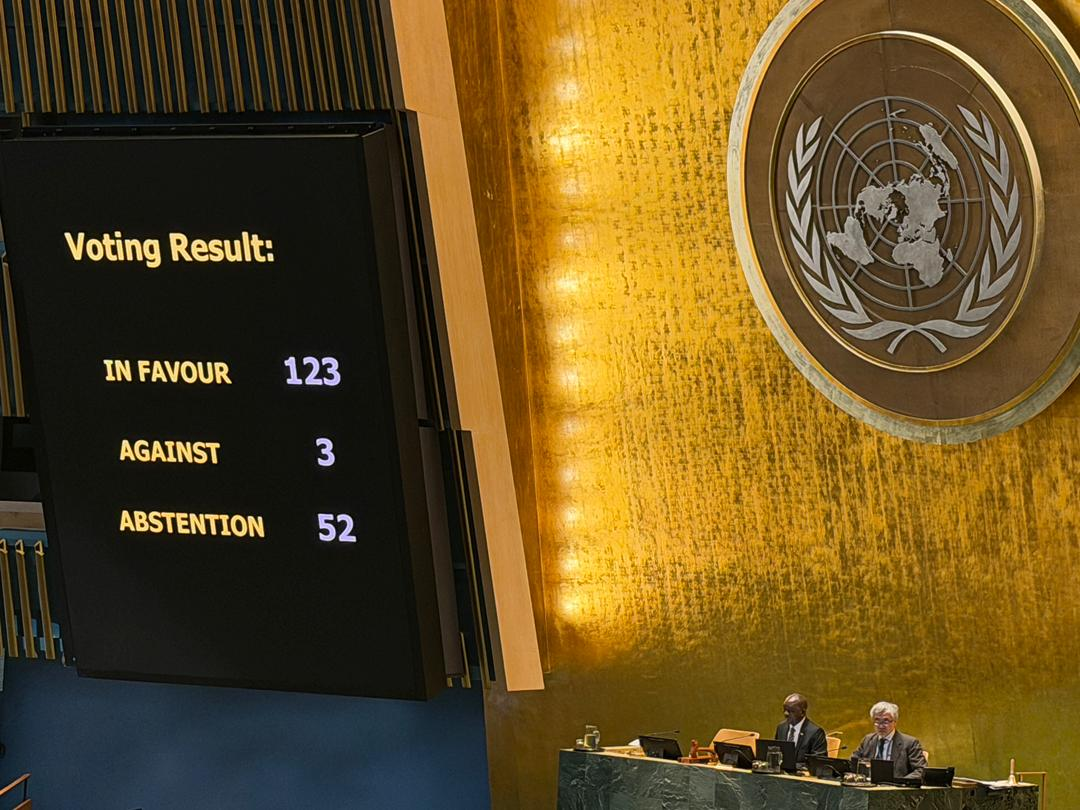
It will be recalled that almost all the countries in the European continent abstained from the slavery motion during the debate on the resolution at the 80th session of the United Nations General Assembly on Wednesday, March 25, 2026.
According to the UK government, it could not support the resolution because at the time of the transatlantic slave trade, slavery was not illegal, and it objected to the assertion that slavery was the “greatest crime against humanity”.
The UK further explained that no single set of atrocities should be regarded as more or less significant than another.
The UK statement read:
“The United Kingdom recognises the gravity of the issues addressed in this resolution and welcomes the opportunity to set out its position. We have repeatedly recognised the abhorrent nature of slavery and the transatlantic slave trade, which inflicted untold harm and misery on millions of people over many decades. Its horrors were profound, and its legacy continues to leave deep scars today. The UK also believes that only by acknowledging and discussing collectively the most painful elements of the history that we share with other nations, including the transatlantic slave trade, can we come together in a spirit of solidarity and mutual respect to respond to the challenges that we all face today.
“The UK remains committed to that goal. That is why we engaged constructively throughout the negotiations on this resolution in the hope of reaching a consensual base text. However, despite our efforts, our concerns have not been taken on board. The UK continues to disagree with fundamental propositions of the text, and therefore, regrettably, could not vote in favour of it.
“Firstly, the UK is firmly of the view that we must not create a hierarchy of historical atrocities. Doing so simplifies the complexity and vast scale of suffering endured in different contexts. It risks diminishing the experiences of communities whose trauma and suffering were felt just as strongly. No single set of atrocities should be regarded as more or less significant than another. We should approach all historical injustices with the same seriousness, empathy and respect, to ensure that no one group is made to feel that their suffering is being overshadowed or treated as secondary.
“Furthermore, it’s essential and integral to the rule of law that the formation and evolution of international law is governed by clear and well-defined principles. The principles of intertemporality and non-retroactivity are long-standing tenets of international law. They are essential to ensuring legal stability. According to the intertemporal rule, the applicable law is the law of the relevant time. International courts and tribunals have routinely upheld these principles.
“There was equally no duty to provide reparation for historical acts that were not, at the time those acts were committed, violations of international law. These principles cannot be circumvented by recourse to the concept of continuing harms. The UK
welcomes that states have developed international law such that today’s slavery and the slave trade are rightly prohibited by treaties and under customary international law, and enslavement is now recognised as a constituent element of a crime against humanity. Nonetheless, it’s important to acknowledge with deep regret that the prohibitions on slavery, the slave trade, and what are now considered crimes against humanity had not yet been established in international law at the time of the transatlantic slave trade. None of the recognised sources of international law, as set out in Article 38 of the Statute of the International Court of Justice, identify a prohibition on slavery and the slave trade until the 20th century.
“The United Kingdom appreciates that Ghana, on behalf of the African Union, consistently stressed that this resolution was not to be read as a legal document. This was restated by the drafters at every informal consultation. In this context, the UK and others offered specific language to move the text from legal to political discourse, while still reflecting the sheer gravity and horror of the acts. Member states also suggested the text should be considered by the (sic) committee. Again, this was met with the response that this was a political declaration. The United Kingdom is keen to underscore this point on the AU’s intention, while we continue to regret the failure to accept language that would have put the matter beyond doubt. I thank you.”
The Netherlands statement also stated,
“The Kingdom of the Netherlands remains firmly committed to addressing racism and discrimination. We share the importance that the African group attaches to the lasting consequences of slavery and the transatlantic slave trade. We fully recognise the profound injustice of this history and its continued impact today.
“In December 2022, the Prime Minister of the Kingdom of the Netherlands offered formal apologies for the actions of the Dutch state towards enslaved people in the past who suffered as a consequence of those actions everywhere in the world, as well as to all their descendants up to the present day. In July 2023, His Majesty King Willem-Alexander apologised for the Netherlands’ slavery past.
“As a member of the European Union, we engage constructively in the negotiations on this resolution, and we greatly appreciate the efforts by Ghana and the African Union to bring forward this important initiative. In this vein, I would like to also say that we align ourselves with the statement delivered by the EU, and we sincerely regret that no consensus could be reached on a formulation that addresses key legal and substantive concerns.
“Having said that, the Kingdom of the Netherlands cannot support references that suggest the retroactive application of international law, including the implication of a legal obligation to provide reparations for acts that were not a violation of international law at the time they were committed. We also cannot agree to the introduction of a hierarchy among crimes against humanity, including the designation of one as the gravest, nor to references related to the non-applicability of statutory limitations. For these reasons, Mr Chair, and despite the importance we attach to this very subject matter, my delegation has abstained on this resolution. Thank you.”