

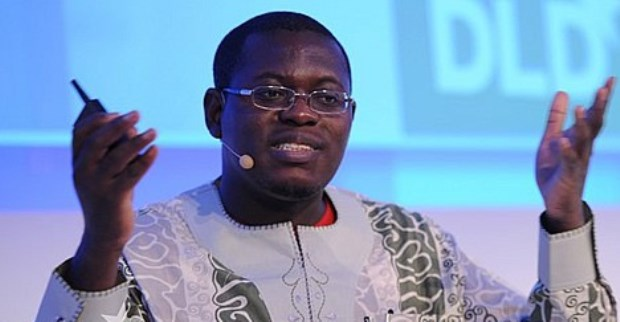
Bright Simons, IMANI Africa’s Honorary Vice President, shared a write-up on social media explaining how Ghana’s Gold has been trapped by constipation of imagination.
Mr Simons detailed that Ghana in the Primitive world was part of the West African belt, supplying 60% of the world’s gold.
However, in the Renaissance, Ghana’s share declined to 10% range, which he asserted was still mighty.
Bright Simons added that in the modern era, share has dropped from a peak near 5% to less than 3%, adding that gold is a special commodity subject to value addition constraint that African countries like Ghana have been totally confused.
The IMANI President in his post wrote, “ The story of gold in Ghana (once the “Gold Coast”) is the story of missed opportunities. Opportunities missed due to a constipation of imagination. In the Mediaeval world, Ghana was part of the West African belt supplying 60% of the world’s gold. When gold was the source of global wealth. By the Renaissance, Ghana’s share was in the 10% range, still mighty.
In the modern era, it has dropped from a peak near 5% to less than 3% and, due to record-high prices, is climbing back up.
Though gold is a special commodity, it is still subject to the same value addition constraint that African countries have been grappling with for decades. Except that African countries like Ghana have “value addition” here, totally confused”.
According to Bright Simons, Ghana has been pushing bullion refineries for decades, but noted that refining doesn’t save one’s country.
Bright Simons called for a value transformation if Ghana really want to hit the big leagues.
His post added, “Bright Simon further explained, “As we in the school of katanomics (http://katanomics.org) like to say: it is not the vision or ambition that endures. It is the detail and stamina of policy.
Ghana has been pushing bullion refineries for decades, starting in the 1st Republic. At one point, it had nearly a dozen. But in the gold sector, value addition through refining doesn’t save your country. At best, you get a 4% markup.
What you need is “value transformation” if you really want to hit the big leagues. So, jewellery. But jewellery is all about brand equity. Value can’t be imposed by fiat.
He, however, noted GoldBod rebranding the PMMC Jewellery to GoldBod Jewellery saying, “True transformation goes beyond brand equity. It sits in a high-knowledge, enriched brand equity. A Swiss Watch embodies a whole legacy and ecosystem of knowledge. Gold’s value contribution is less than 5%. It is good that Ghana has kept faith with the ancient plan to turn gold to jewelry. Recently, GoldBod rebranded PMMC Jewellery to GoldBod Jewellery. But the policy aspects can be improved massively. There is a need for deep brand equity and a knowledge-ecosystem strategy”.
Mr Simon added, “For years, Ghana’s state-owned jeweller couldn’t find 2 kilograms a month for craft. Yet the country exports 2500 kilograms and almost 4000 kilograms a month raw. There are weeks when the craftsmen in the 74-person-strong workforce are just literally idle.
Should Ghana look at countries like the Philippines that have used a public-private partnership model to enhance jewellery output? Where the state focuses on investing in knowledge and capacity and leaves the private sector to focus on brand development and marketing?
In Ghana, the state-owned GoldBod competes with the private sector as a jeweller and is also responsible for licensing them. So far, it appears to have licensed less than 10% of the sector.
Yet the companies that seem to be pushing forward most aggressively in brand development, like Morgan Touch, are private.
As I said, the devil is in the details. Overcoming the constipation of imagination that has afflicted Ghana for decades, where gold is concerned, would require the laxative of anti-katanomic critical thinking”.
See the post below:
**Ghana’s Gold is trapped by the Constipation of Imagination**
— Bright Simons (@BBSimons) February 2, 2026
1. The story of gold in Ghana (once the “Gold Coast”) is the story of missed opportunities.
2. Opportunities missed due to a constipation of imagination.
3. In the Mediaeval world, Ghana was part of the World… pic.twitter.com/qkZpZZarFr