

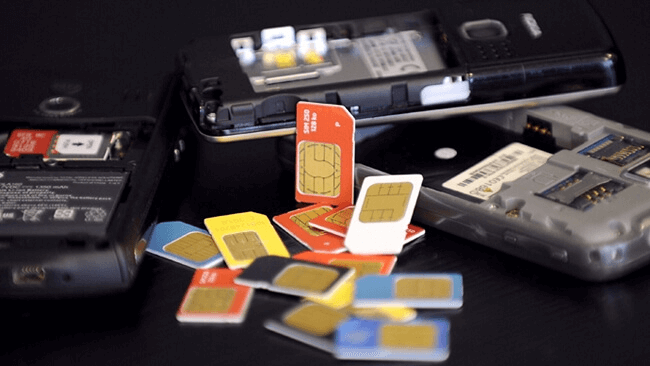
Edmund Yirenkyi Fianko, the Director-General of the National Communications Authority (NCA), has disclosed that the SIM registration exercise is intended to correct flaws identified during previous registrations.
The NCA Director-General asserted that the exercise would be the third official SIM registration process undertaken in Ghana.
He, however, disclosed that the first registration exercise conducted in 2011 was done without an effective system to verify identification documents, adding that the second registration sought subscribers to register their SIM cards using the national identification card.
The NCA noted that the second registration was not fully completed, as the planned biometric verification phase was never implemented.
Speaking in an interview with Channel One TV on Monday, March 9, Edmund Yirenkyi Fianko explained, “This will be the third official registration process. The first one was done in 2011. The challenge with it is that there was no verification at all of the IDs. What we did was a manual verification of some limited cases along the way”.
“There was supposed to be verification of the ID card; we did one part of it, but the second part didn’t happen. The policymaker, NIA, couldn’t get alignment to do the second phase, which was the validation of the biometric,” he explained.
He added, “There are cases, including fake photos, where the same name is used by a different person. We saw fake IDs used to register”.
“What we want to do is to have a single source of truth. We want to ensure the ID details are correct and that the person who brought the ID is indeed the person,” he said.
Meanwhile, Sylvia Owusu-Ankomah, the Chief Executive Officer of the Ghana Chamber of Telecommunications, has said the planned SIM registration is not going to be a silver bullet that stops fraud.
The Telecoms Chamber CEO highlighted that consumer awareness and protection of personal identification numbers are critical in stopping the growing threat of mobile-related frauds.
She stressed that most of the mobile related fruad are driven by social engineering schemes where fraudsters impersonate trusted individuals or institutions to scam persons from disclosing sensitive information.
Speaking in an interview on Citi Business News, Sylvia Owusu-Ankomah explained, “SIM registration is not going to be a silver bullet that stops fraud. The nature of fraud that we are currently experiencing as a country is mostly on a social engineering scheme.
When I say social engineering, these are legitimate individuals who would call you and pretend to be somebody else and, you know, seek information from you and fraudulently, you know, lead you into releasing your personal identity, your personal identity number.
“Your PIN is sacred. So to the extent that you protect your PIN, there shouldn’t be room for someone to defraud you,” she said.
She added, “What the SIM registration will do, however, is to ensure that for every subscriber, your number is biometrically linked to the national ID database, which means that if you are not the user, if I acquire a SIM card, which was acquired by someone else, and I use it, I purchase that SIM and I do not register it directly, any crime that is committed with that particular number will be linked back to me as a user.
“So I do think that there is the need for a lot of consumer education around protecting our SIM, around ensuring that the numbers that we register are authentically ours and that you do not go and purchase a SIM card that has been pre-registered, because it means that if any fraudulent activities undertaken with that number, you will be tracked and you will have to bear the consequences of it,” she added.