

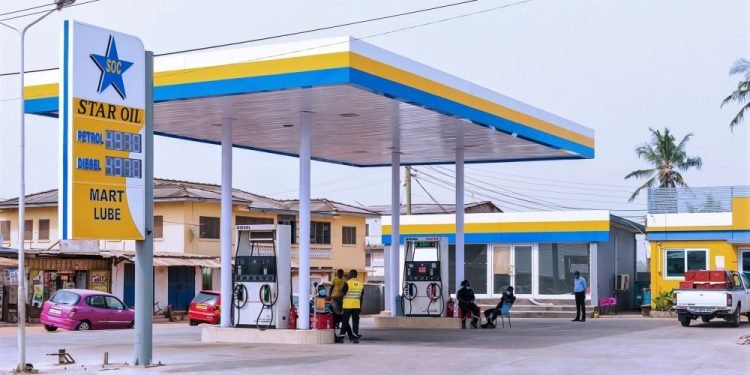
Star Oil, one of Ghana’s leading oil marketing companies, has rejected claims of hoarding fuel in anticipation of a price increase.
According to Star Oil, ICUMS of the Ghana Revenue Authority have been down since Saturday, March 7, 2026, which has led to a shortage of fuel.
In atstement shared on social media, Star Oil stated, “You may have noticed that some of our fuel stations have begun running out of fuel. We would like to assure you that this is not due to any hoarding in anticipation of a price increase.
Unfortunately, Friday was a public holiday, and although we planned to lift petroleum products on Saturday, the GRA ICUMS system was down throughout the day, preventing all OMCs from processing the necessary documentation to load products.
We had hoped the issue would be resolved by Monday, 9th March 2026. But the technical difficulties with ICUMS are still ongoing, and this is affecting the entire industry”.
The statement further added, “Because Star Oil stations record some of the highest sales per location relative to underground tank capacity, situations like this tend to affect us more quickly than others.
We are closely monitoring the situation, and once the ICUMS system is restored, we will immediately resume lifting and restocking all affected stations.
Thank you for your continued understanding and support”.
Meanwhile, Dr Yussif Sulemana, the Technical Advisor at the Ministry of Energy and Green Transition, has announced that Ghana’s immediate threat amid the escalating Middle East crisis is crude oil prices.
According to Dr Yussif Sulemana, Ghana is not facing an immediate fuel supply shortage despite rising tensions in the Middle East, as the country has sufficient fuel stocks to meet demand in the short term.
Speaking on the Citi Breakfast Show on Monday, March 9, 2026, Dr Sulemana stated, “We are not immediately threatened by the supply or the availability of the product. What we are immediately threatened with is the price. Are we able to maintain the price? That is a big question that we are looking at”.
“We have only to ensure that we maintain the availability of supply. After we made the announcement, we have been working closely with the NPA, and they have given us the assurance that we can go beyond the five weeks,” he stated.
He further announced that additional fuel shipments are already in the country’s ports.
“We have some ships that have been docked at the harbour, ready to discharge. So, if these ships are discharged, we can go up to 10 weeks,” he added.
In related news, Global oil prices have hit $110 (£82.74) a barrel, with the stock markets slumping following the escalating US-Israeli war with Iran.
Reports suggest the increasing US-Israeli war with Iran has fueled fears of long-term disruption to shipments through the Strait of Hormuz.
The BBC in a news story stated, “The US and Israel launched fresh waves of airstrikes across Iran over the weekend, hitting multiple targets, including oil depots.
Major disruption to energy supplies from the region threatens to push up prices for consumers and businesses worldwide.
On Monday morning in Asia, Brent crude was almost 24% higher at $114.74, while Nymex light sweet was up by more than 26% at $114.78.
Stock markets in the Asia-Pacific region fell sharply in morning trade, with Japan’s Nikkei 225 index down by more than 7%, the Hang Seng in Hong Kong losing over 3%, and the ASX 200 in Australia more than 4% lower.
South Korea’s Kospi index, which has been hit especially hard since the conflict began, slipped by more than 8%, triggering a 20-minute halt to trading.
The so-called circuit breaker is a mechanism designed to curb panic selling. It also came into effect on Wednesday, when the Kospi slumped by 12%.
About a fifth of the world’s oil supply is usually shipped through the Strait of Hormuz. But traffic through the narrow passage has all but halted since the war started a week ago”.
See the post below:
𝐈𝐌𝐏𝐎𝐑𝐓𝐀𝐍𝐓 𝐍𝐎𝐓𝐈𝐂𝐄! ⚠ pic.twitter.com/Y6bAC6FkDP
— StarOil Ghana (@staroilghana) March 9, 2026