

President John Dramani Mahama has fired shots at critics against Ghana’s call for reparations to African countries over slavery, which was championed by him at the United Nations.
According to John Mahama, some critics are making Infantile arguments, suggesting that Africans were involved, so they shouldn’t talk about reparations.
Mahama highlighted that those arguments by critics are just trying to whittle down slavery, which has now been recognised as the gravest crime.
President Mahama detailed that, even when reparations were paid to slave owners for letting the slaves go, adding that even when the slave trade was abolished, slavemasters were compensated for letting their slaves go.
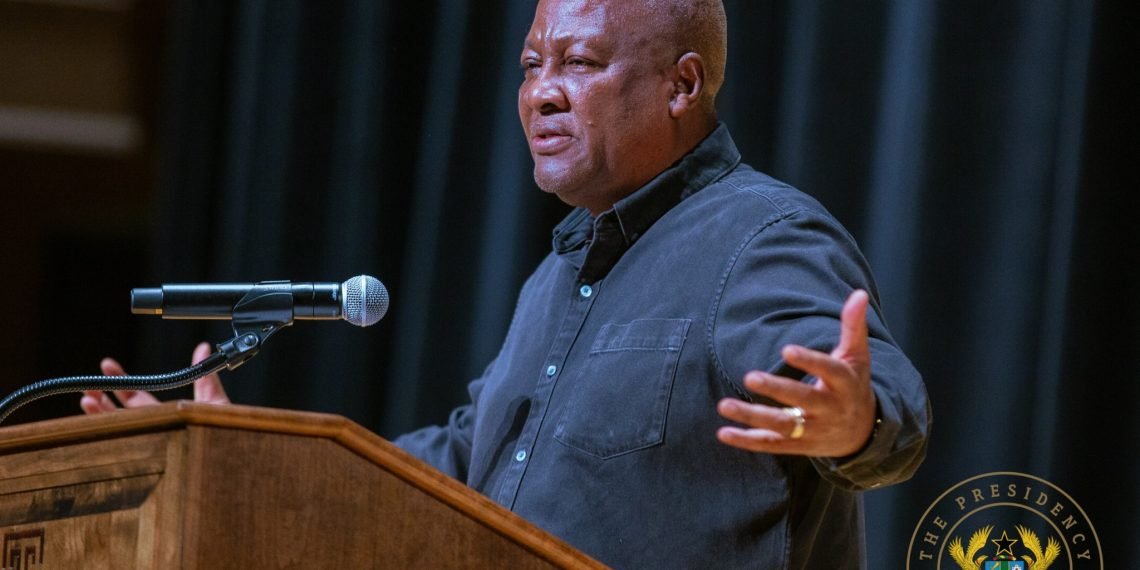
Speaking during the Presidential Dialogue with Civil Society Organisations (CSOs), President Mahama stated, “A few of our people, I don’t know whether for attention or popularity, criticised their achievement and tried to belittle it, and they made all kinds of infantile arguments. They say so, but Africans were involved… The crime was systematic. The ships that carried the slaves were insured by reputable insurance companies that are some of the richest in the world today because they profited from the slave trade. The ship owners made money.
“And listen to the important one, reparations were paid to slave owners for letting the slaves go. When they abolished the slave trade and said the slaves could go, they compensated the person who had enslaved somebody for loss of property. As recently as 2015, compensation was paid to people for losing their slaves… Slavery is recognised as the gravest crime, and you say, ‘oh, but Africans were involved’,” he fumed.
He added, “This was a whole system. They built ships, and they built the ships with measurements to make sure that the cargo could take the maximum amount of slaves. And you tell me that, you know, Africans were involved, so we shouldn’t talk about reparations… some people just want to whittle down what happened.”
President Mahama further highlighted, “If you know what happened to the slaves, nothing compares to it in everything that has happened in this world, to the 15 million people who were sent away, those who died. I’ll give you one example: a ship captain threw 134 slaves overboard to go and claim insurance, because your ancestors were cargo, and so if the ship lost cargo, there was insurance that compensated for the loss of cargo. And 134 slaves, he threw them overboard and went and filed an insurance claim for loss of cargo”.
Mahama further noted, “In the record of the Holocaust, there were Jews who were prison guards, the Jews who pointed out where other Jews were hiding. And yet the Holocaust is recognised as genocide and a crime against humanity. So why not the slave trade? Because some Africans were involved. It doesn’t absolve those who built the system and financed it, and so we’ll call them out. I don’t care what anybody says, we’ll call them out”
Mahama’s comment follows that of award-winning investigative journalist Manasseh Azure Awuni, who opposed his calls for reparations to Africa for the transatlantic slave trade.
According to Manasseh, if reparations are to be paid, countries such as Ghana should also be required to pay them for their role in the slave trade.
He highlighted that it will not be right to pay reparations to those who took part and benefited from the slave trade, even though the benefits and exploitation of the enslaved people were disproportional.
Manasseh detailed that descendants of the slaves in America, the Caribbean and elsewhere rightfully deserve reparations, not African countries whose people captured and sold slaves.
He, however, labelled African countries that captured and sold slaves as ‘accomplices’, not victims.
Also, Alexander Kwamina Afenyo-Markin, the Minority Leader in Parliament, has punched holes in Ghana’s demand for reparatory justice following the UN General Assembly’s adoption of a resolution recognising the trafficking of enslaved Africans as the “gravest crime against humanity.
According to Afenyo-Markin, historical accounts of the transatlantic slave trade fail to reflect the role played by local actors.
Afenyo-Markin highlighted that local actors chase their strongest among their own people, then, after 100 years, Africans are demanding that they should be compensated.
The minority leader quizzed who should compensate whom following the role played by the indigenous people who subjected their people to inhumane treatment.
Speaking on the Floor of Parliament on Friday, March 27, 2026, “When somebody berths a vessel at Cape Coast, and you decide to go to the North, Bono area, get to the Ashanti area, to the Assin area, and you are chasing your strongest among your own people, then after 100 years, you say I should be compensated. Who should compensate whom? We maltreated our own and told the white man that he should also maltreat our own. The story must be told and must be put in its proper context.
“It is also a fact that the inhumane treatment, the unfortunate humiliation, the marginalisation, injustice and abuse of our ancestors who became victims of this slave trade must be condemned,” he said.