

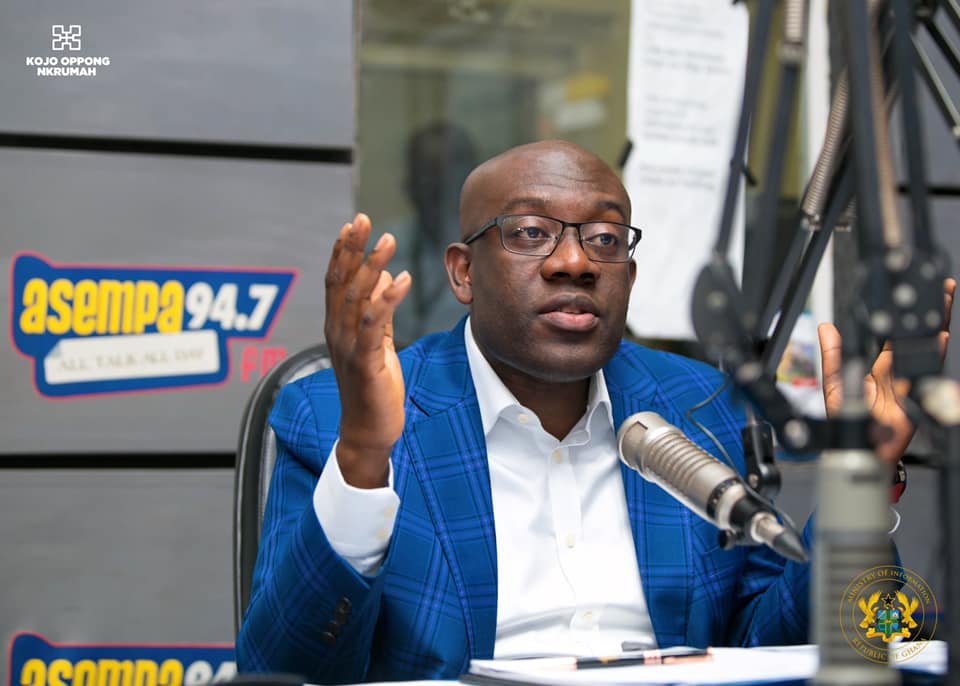
Kojo Oppong Nkrumah, the Member of Parliament (MP) for Ofoase-Ayirebi and Ranking Member of Parliament’s Economy and Development Committee, has said Ghana’s recent decline in inflation may be short-lived.
According to Oppong Nkrumah, there’s very little money for people to spend, which has led to many goods remaining unsold simply because buyers cannot afford them.
Oppong Nkrumah stressed that if the government fails to address rising production costs, particularly electricity tariffs, Ghana’s decline in inflation could prove temporary.
He highlighted that the recent inflation figures are not due to stronger productivity or lower business costs, noting that it is due to tight monetary policies by the Bank of Ghana (BoG).
Oppong Nkrumah noted that the central bank’s aggressive liquidity controls have weakened Ghanaian consumers’ purchasing power.
Speaking to Joy News, Oppong Nkrumah stated, “So there’s very little money for people to spend”.
Oppong Nkrumah further added that the method being used should be disclosed and interrogated.
He welcomed the drop in Ghana’s inflation but warned that it may not reflect genuine economic stability, highlighting that inflation is driven not only by demand but also by the cost of production.
His comments follow, Ghana’s inflation has declined for the 14th straight month, with the February rate falling to 3.3 per cent.
The 3.3 per cent inflation drop marks Ghana’s lowest inflation rate since 2021.
According to the latest Consumer Price Index (CPI) data released by the Ghana Statistical Service (GSS), February 2026 inflation now stands at 3.3 per cent from 3.8 per cent in January 2026.
“The CPI for February 2026 stood at 264.4, up from 255.9 in February 2025, translating into a year-on-year inflation rate of 3.3 per cent. On a month-on-month basis, inflation was 0.8 per cent, indicating that the general price level increased by 0.8 per cent between January and February 2026”.
“A breakdown of the data shows a significant easing in food inflation, while non-food inflation edged up slightly. Food inflation (including non-alcoholic beverages), which carries a weight of 42.7 per cent in the CPI basket, slowed to 2.4 per cent in February 2026 from 3.9 per cent in January 2026 — a 1.5 percentage point decline,” the report by Citinews stated.
Meanwhile, Minority Leader Alexander Afenyo-Markin has quizzed the John Mahama government whether Ghanaians are going to eat inflation.
Afenyo-Markin highlighted that what is inflation on paper when it has no effect on the pocket of the ordinary Ghanaian.
According to him, macroeconomic stability can be achieved on paper for the IMF and World Bank, but the real stability is when the Ghanaian people go to the market and experience lower prices.
Speaking to the media after President John Mahama delivered the 2026 State of the Nation Address, Afenyo-Markin stated, “He talks about inflation having come down. Are we going to eat inflation? What is inflation on paper when it does not affect the pocket of the ordinary Ghanaian?”
“If the President is talking about Macroeconomic stability, you can achieve stability on paper for the IMF and World Bank, but the real stability is when the Ghanaian people go to the market and experience lower prices on foodstuffs.
But when they are complaining, you cannot use paper inflation to claim credit and ask us to applaud you. We will not applaud the government, we are not interested”.
Watch the video below:
Inflation drops to 3.3%: The method being used should be disclosed and interrogated – Kojo Oppong Nkrumah, MP, Ofoase-Ayirebi. #JoyNews #ThePulse pic.twitter.com/xyvWuzAUTp
— Joy 99.7 FM (@Joy997FM) March 4, 2026