

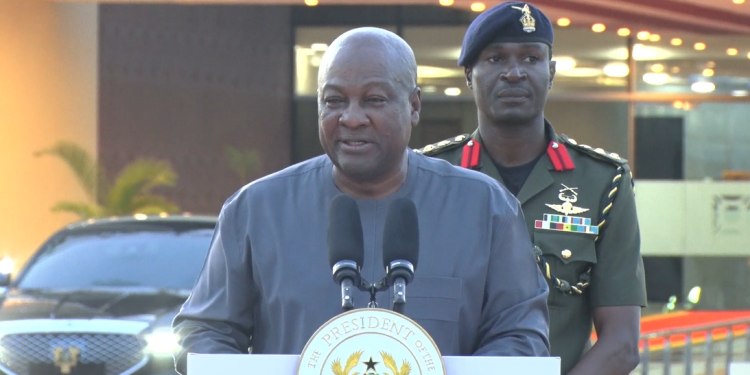
President John Dramani Mahama has said the escalating conflict between the United States, Israel and Iran is not only affecting the Middle East, but the whole world.
According to President Mahama, tensions in the Middle East are troubling, calling for prayers and renewed efforts toward peace.
Speaking on Monday, March 16, during an Iftar with members of the Muslim community at the Jubilee House, President Mahama stated, “We are all concerned about what is happening in the Middle East. The conflict involving the United States, Israel and Iran is not only affecting the Middle East, but the whole world. We pray that Allah will touch the hearts of everyone involved in this conflict and bring peace to the region”
“If you say you are a true Muslim or a true Christian and you are unforgiving, wicked, and kill your fellow man, you cannot call yourself a true Christian or a true Muslim. At a time when many parts of the world are faced with conflict and uncertainty, we must continue to protect the peace Ghana enjoys,” he said.
He added, “I humbly ask for your prayers during this Ramadan for our country, for our leaders, and for other parts of the world affected by conflict, especially in the Middle East”.
Earlier, President John Dramani Mahama has warned that the escalating conflict in the Middle East could have serious economic consequences for Africa.
According to John Mahama, hostilities involving the United States, Israel, and Iran would hurt African economies.
Mahama argued that the Middle East is the epicentre of global oil supplies, adding that African economies must brace for inevitable shocks.
President Mahama made this known while speaking during a bilateral meeting with Tanzanian President Samia Suluhu Hassan at the State House in Arusha on March 2, 2026.
He expressed alarm over the intensifying exchanges between the U.S., Israel, and Iran, as well as the counter-attacks, stressing that the tensions would trigger the rise of crude oil prices, which would impact African countries.
Meanwhile, Dr Johnson Asiama, the Governor of the Bank of Ghana (BoG), has cautioned that the Middle East conflict poses fresh inflation risks for Ghana.
The BoG governor disclosed that the escalating tensions in the Middle East could threaten Ghana’s improving inflation.
Dr Asiama highlighted that the Middle East tension is disrupting major global energy and shipping routes.
He further explained that the tension is creating an increasing volatility in global oil markets.
Speaking at the opening of the 129th Monetary Policy Committee (MPC) meeting, the BoG governor stated, “A significant external development has entered the picture, and that has to do with the escalation of the conflict in the Middle East. This conflict is disrupting key energy and shipping corridors”.
“It is increasing volatility in global oil markets, and it is introducing new uncertainty into the trajectory of global inflation,” he said.
He added, “For Ghana, the transmission channels are clear. Sustained oil price increases could raise the risk of imported inflation and could also tighten global financial conditions.”
“Geopolitical uncertainty tends to support gold prices… This could benefit our trade balance,” he added.
The BoG Governor highlighted that Ghana’s macroeconomic indicators have improved, but there is a need to carefully weigh global risks before making any decision.