

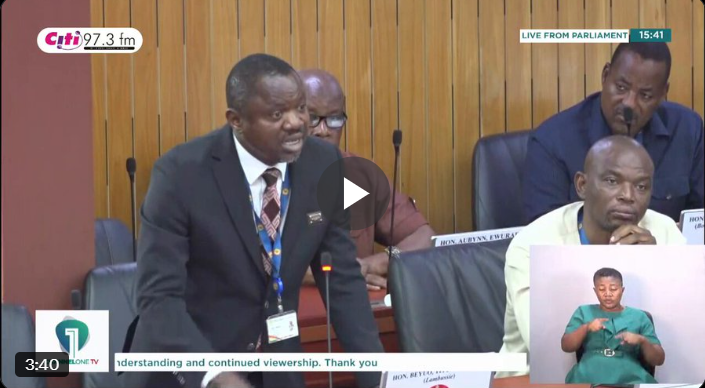
Professor Titus Beyuo, Board Chairman of Korle-Bu Teaching Hospital and Member of Parliament for Lambussie, has explained the term “no-bed syndrome”.
According to him, no-bed syndrome involves many persistent challenges in the health system and is not solely about the shortage of beds.
Speaking on the floor of parliament, Professor Titus Beyuo explained, “When we say ‘no-bed’ in the hospital, what do we actually mean? No bed could mean that there is no physical bed in the emergency unit. It could also mean that there is no blood if the managers anticipate that the patient will need it, and so they want the person to go elsewhere”>
“It could mean there is no particular skill available. For instance, an anaesthetist is not there, and they think the patient will require surgery. It could mean there is no theatre space. It could mean there is no oxygen in the hospital. There is no ICU bed, but we think this patient needs ICU care”.
“It could mean there is no stroke bed, and therefore we are telling you ‘no-bed’ because you have a stroke. There is no doctor at this moment, so there is no bed,” he added.
He further disclosed, “But the most disappointing part is that ‘no-bed’ could simply mean that staff are not willing to work, and that is the very sad part. This ‘no-bed’ could mean that a shift is about to end, and someone is not willing to admit a new patient and complete all the documentation, so they turn the patient away”.
“No-bed could mean that the doctor is afraid to work or is tired and feels that if he touches that patient and the patient dies, duty of care is established legally because he has touched the patient. So he thinks, ‘I have not touched that patient, so you cannot blame me for it,’” he stated.
“But is it really right if a patient dies within the precinct of a hospital, at the entrance of the emergency department, after waiting 30-45 minutes, and you say because you have not seen that patient, no duty of care is established? The legal brains will have to help us out,” he noted.
Also, Professor Titus Beyuo hascalled for the review of the Ambulance Service Act.
The MP argued that the current scoop and run needs to be changed for paramedics to be able to provide basic health care needs in transit.
According to Prof Beyuo, paramedics in Ghana will be able to save many lives if they can run a simple IV line to give patients fluid during transit.
The MP stated, “ I will conclude by saying our Ambulance Service, by its act and by its function, may need to be reviewed. Currently, they do scoop and run. What it means is that at an accident scene, they can pick you up, but they cannot even set a simple IV line to give you fluid, this patient who was being moved from Hospital to Hospital if a simple saline was running, this patient could have survived.
The minority leader mentioned his BP at the beginning of Korle Bu when they checked the BP in the ambulance monitor, and it had come down to 84 56, which is someone who is just about dying. So if they could at least set a line and run some fluid in transit, a lot patient will survive. The model that only allows them to scope and run must be changed, and their training must be upgraded so that we have some paramedics who can provide some basic care”.
He further appealed to Health workers to change their attitude, saying, “Attitude is our biggest problem; all of this will not change if the attitude does not change. I am standing on this to appeal to my colleague Health workers, look at that next patients it could be you, it could be your father or your mother. It does not have to be another doctor calling you before you create a bed and accept the patient”.
Moreover, Professor Titus Beyuo has announced the Health Minister, is working on a National Integrated Bed Management and Referral System that will tell the categories of beds that are available in a particular hospital in real time.
Professor Titus Beyuo added, “The current Minister of Health had already set in motion a team to solve this situation comprehensively, and they are coming out with a document that is going to look at the National Integrated Bed Management and Referral System coordinating system. This will be back with IT and will allow as at the real time be able to tell the categories of beds that are available in a particular hospital.
This work has been ongoing; it is unfortunate that, while it was in its final weeks, this incident happened, and the minister has asked the group to quicken up their work so that he can make a major announcement on this to bring a comprehensive change that would help us, and it will rope in the ambulance service so when they pick a patient they don’t ask the patient or their relatives or a doctor to tell them which hospital is willing to accept the patient”.
Watch the video below:
Watch: Lambussie MP and Board Chair of Korle-Bu Teaching Hospital, Titus Beyuo, explains the real meaning of the “no-bed syndrome” as used in health facilities.
— ChannelOne TV (@Channel1TVGHA) February 24, 2026
Watch here: https://t.co/twcknk0kCk
#ChannelOneNews #NoBedSyndrome #GhanaNews #ChannelOneTV #ProfTitusBeyuo pic.twitter.com/WIar6TJNlh