

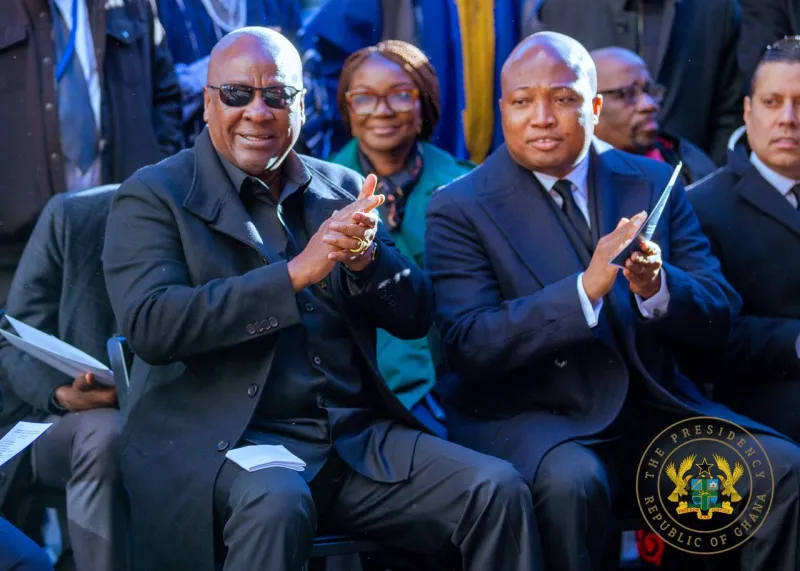
Ghana’s foreign minister, Samuel Okudzeto Ablakwa, has clarified that African leaders are not asking for money for themselves, as it goes against their conscience.
According to Ablakwa, African leaders are demanding compensation but are not asking for money for themselves.
Ablakwa highlighted that African leaders do not seek to profit from this but want justice for the victims and courses to be supported, educational and endowment funds, skills training funds.
Speaking to the media at the UN, Samuel Okudzeto Ablakwa clarified, “We have made it clear that African leaders, or Carribean leaders are not looking for money, it goes against our conscience to seek to profit from this, we don’t want any payment made to us directly, we are talking about courses to deal with the strutural inequalities and we are also talking about the return of artefacts”.
Meanwhile, President John Dramani Mahama has said the United Nations’ approval of a motion on slavery reparations is not the end, as it is only the beginning of the Fight for justice on slave reparations.
John Dramani Mahama at the United Nations General Assembly on Wednesday, March 25, 2026, tabled a resolution calling on the UN to recognise the Trans-Atlantic Slave Trade as the gravest crime ever committed against humanity.
Following a massive debate, the motion was adopted with 123 countries voting in favour of the slavery reparations motion tabled.
The United States, Argentina, and Israel voted against it, while 52 European Nations 52 abstained.
Speaking after the General Assembly session on Wednesday, March 25, 2026, President Mahama labelled the slavery reparations as a significant milestone.
President Mahama stressed that the outcome, while historic, must transform into sustained global action.
Speaking after the General Assembly session, Mahama stated, “This is not the end. This is the beginning. What we’ve achieved today creates a platform for the struggle for reparative justice”.
“We must take this success and begin to work so that those who denied our ancestors their humanity, those who denied our ancestors their dignity, can accept the truth that this is what happened,” he said.
He added, “Today we’ve accepted that this was a grave crime against humanity — the gravest indeed”.
“This victory is not for Ghana. We did it for the whole of Africa and all people of African descent. If we keep this coalition, we will take the next steps together,” he said.
“Today’s victory is to ensure that we do not forget, and will never forget. As long as this resolution has been passed, our ancestors will never, ever be forgotten,” he concluded.
However, Irina Abramova, Director of the Institute for African Studies of the Russian Academy of Sciences, has revealed that Russia is ready to help Africa calculate slavery reparations claims.
According to Irina Abramova, Russia will support African countries in calculating the total amount of reparations that Western nations could pay for crimes committed during the colonial period.
She explained that Russia will collaborate with African experts to build a strong, evidence-based case for reparations.
Speaking on Wednesday, March 25, 2026, during a press conference on the theme “The Responsibility of Western Metropolises for the Consequences of Colonisation: History and Modernity,” Irina Abramova made this known.
Madam Abramova explained, “We aim to unite the efforts of Russian scholars – mathematicians, programmers, historians, and economists – with African researchers in order to jointly substantiate the scale of these reparations and move forward with legal claims on various international platforms”.
“In addition to being an outstanding political figure, John Mahama is also a scholar. He actively promotes the reparations agenda, which is increasingly evolving from a historical and political discourse into a concrete, practical agenda,” Abramova added.
Reports suggest that between the 15th and 19th centuries, an estimated 12.5 million Africans were forcibly taken and sold into slavery.
The reparations debate has since gained renewed global attention; however, critics argue that present-day states and institutions should not be held responsible for actions carried out centuries ago.
Reports suggest that between the 15th and 19th centuries, an estimated 12.5 million Africans were forcibly taken and sold into slavery.
The reparations debate has since gained renewed global attention; however, critics argue that present-day states and institutions should not be held responsible for actions carried out centuries ago.
Watch the video below:
“We are not looking for money, it goes against our conscience, but we are looking at courses and return of artifacts”
— Ghana Chronicles (@_GhChronicles) March 26, 2026
-Ghana Foreign Minister, Samuel Okudzeto Ablakwa pic.twitter.com/AAIHAjEQTc