

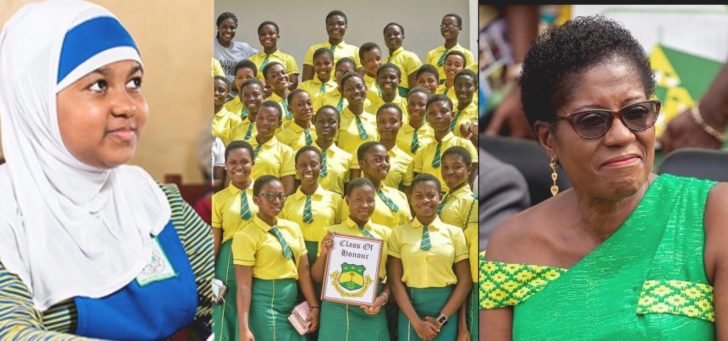
Prof Stephen Kwaku Asare, a renowned US-based Ghanaian lawyer and scholar, has weighed in on the commotion surrounding the Attorney General, Dr Dominic Ayine, defending Wesley Girls’ SHS policies in a religious freedom case.
It will be recalled that, in December 2024, Shafic Osman, a Ghanaian lawyer and PhD candidate at the London School of Economics, sued Wesley Girls’ Senior High School and the Government at the Supreme Court.
The case filed cited Wesley Girls’ restricting Muslim students from wearing the hijab, fasting during Ramadan, and practising other aspects of their faith.
Shafic Osman argued that a public school cannot lawfully restrict the religious rights of Muslim students nor compel them to practise a faith they do not subscribe to.
He grounded his case in the Constitution and international human rights principles, arguing that Wesley Girls’ rules violate Ghana’s constitutional protections for religious freedom.
However, Dominic Ayine, Attorney General and Minister for Justice, has responded to a legal challenge over religious rules at Wesley Girls’ Senior High School (SHS).
According to the Attorney General, Wesley Girls is not a public school in the ordinary sense. It is a school owned by the Methodist Church but managed and funded by the government of Ghana.
The State funds it, yes, but that funding does not strip the school of its right to preserve its ownership and Methodist character.
The AG argues that Ghana’s entire education history supports this view. Mission schools existed long before independence; they were formally recognised and classified as assisted schools under colonial ordinances, and even after independence, they were integrated into the public system without losing their foundational identity.
However, Kwaku Azar, in a Facebook post on November 15, 2025, debunks the AG’s assertion that Wesley Girls’ had every right to impose the teachings of the Methodist Church on its students.
According to Kwaku Azar, Wesley Girls is no longer a Methodist private school and cannot implement policies that are discriminatory in nature.
He argued that a public school cannot suppress the practices of minority faiths.
Prof Kwaku Asare in his post wrote, “Wesley Girls is no longer a Methodist private school. It is a public school, fully under the Government of Ghana. And once a school becomes public, the Constitution takes the front seat, not denominational tradition.
“A public school cannot: privilege one religion over others; suppress the practices of minority faiths; or enforce rules rooted in a specific religious doctrine against students who do not share that faith. That would violate Articles 17 (non-discrimination), 21(1)(c) (freedom of religion), and Article 12 (rights guaranteed to ALL persons).”
He added, “Our mission schools did not become great because they suppressed diversity. They became great because they embraced discipline, excellence, and respect for every child who walked through their gates. So if we want to invoke ‘tradition,’ let’s invoke the traditions of tolerance, dignity, and of allowing every student – Christian, Muslim, traditionalist, or none – to feel safe and valued.”
Meanwhile, the Supreme Court will now determine whether Wesley Girls’ Senior High School (SHS) policies are consistent with the Constitution.