

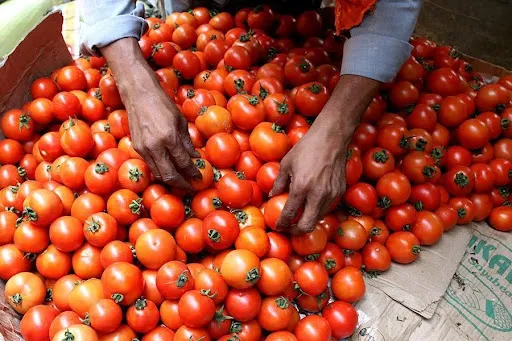
The deputy Agriculture Minister, John Dumelo, has said that within three or four years, Ghana should be self-sufficient in terms of tomato production.
John Dumelo urged the Ghanaian farmers to intensify dry-season farming to boost local production of tomatoes.
According to John Dumelo, Ghana may not immediately stop sourcing tomatoes from Burkina Faso, but it must take steps to reduce its reliance on imported tomatoes.
The Deputy Agric Minister added that sustained investment in local farming could change the situation in the medium term.
Speaking in an interview on Joy News on Thursday, March 19, 2026, John Dumelo stated, “For us, going to Burkina Faso for tomatoes might not end immediately, but once they get encouraged, within three or four years, we should be self-sufficient when it comes to tomato production”.
“I am yet to get the reason why the Burkina Faso government announced the ban and the details that come with it. But last year, I was in the Northern Region, and I urged them to produce tomatoes in the dry season. This dry season, I went back, and most of them are doing just that,” he said.
“I told them to let me know what they need to help them scale up production, especially in the next dry season… The government is committed to helping them to scale up production,” he added.
The Deputy Agric Minister’s comments come following the Burkina Faso government’s announcement of an immediate nationwide halt to tomato exports, raising concerns for Ghana.
In a joint statement issued, the Burkinabè government banned the export of fresh tomatoes.
The statement issued by the Burkinabè government in Ouagadougou says the suspension is effective immediately and will remain “until further notice,” to prioritise local supply for domestic processing industries.
The directive was signed by the Burkinabè trade and agriculture ministries, which have also halted the issuance of Special Export Authorisations (ASE).
Reports suggest traders have been given a two-week window to complete ongoing transactions.
The decision by the Burkinabè government is expected to have immediate implications for Ghana’s food supply, with Ghana heavily dependent on tomato imports from Burkina Faso to supplement local production.
It will be recalled that in February 2026, seven Ghanaian tomato traders were killed, and others were injured following a terrorist attack in the northern Burkinabè town of Titao.
The Minister for the Interior, Muntaka Mubarak, disclosed that the seven Ghanaian Tomato traders killed in a terrorist attack in Titao, northern Burkina Faso, have been laid to rest.
According to the Minister, the bodies of the deceased were burnt beyond recognition and had begun decomposing, which forced authorities to proceed with burial arrangements in Burkina Faso.
Speaking in an interview on Joy FM’s Super Morning Show on Monday, February 16, Muntaka Mubarak stated, “The seven bodies have been burnt beyond recognition. As at yesterday, we agreed they had begun decomposing and had to be buried”.
“So the Burkina Faso authorities told us [Ghanaians] that they would bury them at 10 a.m today. But our women who are not really injured can go and witness and take as many pictures as possible,” he added.
He added, “And the sad thing is that we lost seven of our men. Three of them got injured. One woman was critically injured, and others were not badly injured”.
Meanwhile, John Dumelo earlier announced that Ghana is on course to achieve large-scale domestic tomato production by the end of 2026.
According to John Dumelo, trials are underway at irrigation schemes to reduce reliance on imports from Burkina Faso.
The Deputy Minister further stressed that the Mahama government has a long-term plan to cut Ghana’s dependency on tomatoes from Burkina Faso by between 20 and 30 per cent beginning next year.
John Dumelo is quoted by a TV3 news flyer shared on social to have said, “Ghana on track for full-scale tomato production by year-end 2026”.
The Deputy Minister for Food and Agriculture, speaking on JOYFM The Pulse on Tuesday, 17 February, further detailed efforts to stabilise tomato supply and reduce Ghana’s reliance on imports.
John Dumelo stated, “I just came back from the Bono East region, but I’ll be going back to be able to interact with the traders and see how best we can help them to solve our problems, our tomato demand in Ghana.”
“When you look at some of our irrigation schemes, especially the ones in the north — when you go to Tono Dam, around the Navrongo area — currently most of the farmers are farming tomatoes, but it’s on a much smaller scale. It’s more or less like a trial stage where we want to scale it up before the year ends or next year.”
“If you also go to our irrigation schemes, there are some tomato-growing farmers there, as we speak, that would have their tomatoes maybe in about two or three months’ time. All these schemes are the ones that we want to scale up, hopefully by next year.”
He added, “We’ve distributed some solar — or we’re about to distribute some solar water pumps to vegetable farmers across the country. And then the water pumps that the Ministry of Lands and Natural Resources seized from galamsey operators — we distributed some last year, over a thousand of them, to small-scale vegetable farmers across the country.”
“Hopefully, when all these come on board, we’ll be able to mitigate our production of tomatoes and other vegetables across the country.”
“I’m very hopeful that next year, by this time, most of the trips that are going to Burkina Faso will reduce. When all these programmes come on board, hopefully we’ll be able to reduce our traders from going to Burkina Faso to get tomatoes.”
See the post below:
Burkina Faso Bans Fresh Tomato Exports, Raising Concerns for Ghanaian Tomato Traders.
— 𝕏 Ghana 🇬🇭 (@xghana_) March 19, 2026
The statement issued from the Burkinabè government in Ouagadougou says the suspension is effective immediately and will remain “until further notice,” to prioritise local supply for domestic… pic.twitter.com/TdJ0yhZkrM