

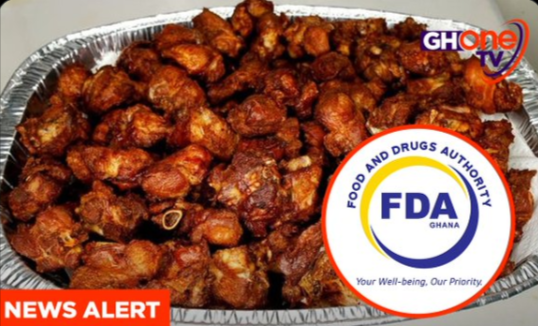
The Food and Drugs Authority (FDA) has reminded the Ghanaian public that the ban on the importation of Turkey tail, commonly known as “Chofi” in Ghana, is still in force.
According to the FDA, the ban instituted in 1999 due to turkey tail’s extremely high fat content associated with health risks, it is still available in many markets.

On Monday, May 11, 2025, the FDA issued a public notice highlighting that consumption of such products poses serious health risks, including obesity, high cholesterol, and heart-related diseases.
“Turkey tail, properly called ‘chofi’, and other poultry products with over 15% fat have been banned in Ghana since 1999 due to a serious health risk.
The FDA therefore advises the public to stay away from these products,” the Authority stated.
Some Ghanaians reacting to the news stated, “The health workers have been seeing fried yam sellers at the roadside selling this alongside the fried yam, and we’ve been practising this for decades. Do you know many people they’ve had health issues based on this?”.
One X user also added, “Ironically, several other fast foods like fried rice, pizza, shawarma, burgers, etc., which have high sodium and trans fats and are sold in our markets, won’t be banned because of people’s economic interests.
Meanwhile, studies have linked these same foods with health conditions, including certain forms of cancer, cardiovascular diseases, and diabetes”.
A netizen added, “We hear! Chofi no good. Chofi sweet pass all meat!”.
One X user added, “Oh chale I’m even eating one while reading this, with some hot Kenkey ooo … let me tell the Komi seller I don’t want it anymore so she should refund me”.
“How can people stay away when the thing is available in the market, so the simple thing to do is stop the importation of it”, a netizen added.
An X user added, “So can’t the FDA do something to prevent people from selling it to the general public? Since this thing was banned some years ago, how does it gets it way into the market? What proper sensitisation has the FDA done on it to the public”.
In other news, Roderick Kwabena Daddey-Adjei, the Deputy Chief Executive Officer of the Food and Drugs Authority (FDA), has refuted social media claims that adding plastic to fry plantain chips does make them crispier.
According to the FDA Deputy CEO, the circulating claims on social media are false and misleading, adding that such claims are not just in Ghana.
He further disclosed that the FDA are carrying out nationwide market checks, adding that there has been no evidence that plastic is being used in frying plantain chips.
Speaking on Channel One Newsroom on Wednesday, March 11, Roderick Kwabena Daddey-Adjei stated, “What is going around is purporting that if you use plastic, the plastic melts and then coats the plantain, and therefore it becomes crisp.
That is wrong, and that is something we have already put out there on social media and on YouTube, where we emphasize that these are myths, in fact not only in Ghana. There are other places in Asia where such stories and some people who want to trend come up with such stories.
“We want to assure the public that so far the FDA hasn’t had such evidence and is still conducting the market surveillance. If you put such plastics in oil, the plastic is another type of chemistry, and the oil is edible, they don’t mix so people should not come up with such information,” he said.
See the post below:
Avoid eating turkey tail ("chofi"). It has has been banned in Ghana since 1999 due to its high fat content, it poses a serious health risk… – FDA#GHOneNews #EIBNetwork #GHOneTV #NewsAlert pic.twitter.com/pWpc4kTCIS
— GHOne TV (@ghonetv) May 11, 2026