

Joana Quaye, the ex-wife of Ghanaian business mogul Richard Nii Armah Quaye (RNAQ), has rejected fresh settlement negotiations between the two parties.
Reports suggest that Ghanaian businessman Richard Nii Armah Quaye (RNAQ) reportedly made a fresh settlement offer to his ex-wife, Joana Quaye.

The information gathered suggests that on May 7, 2026, Richard Nii Armah Quaye increased the divorce alimony ordered by the High Court from an initial GH¢300,000 court payment to GH¢2 million.
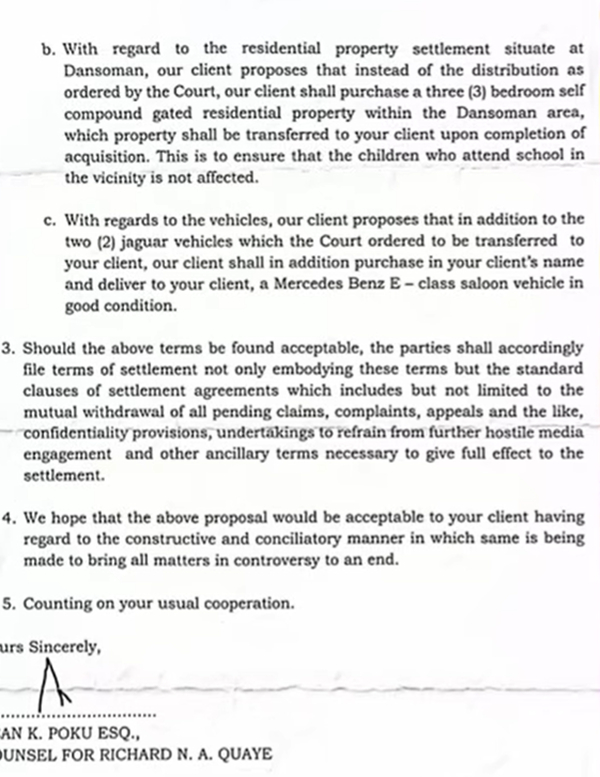
In the said document, written to lawyers of Joana Quaye, proposed completing renovations on their shared house for her full ownership and also added a three-bedroom house at Dansoman, citing the proximity to his children’s schools.
RNAQ also proposed replacing the court-assigned vehicles with brand-new ones, including a Mercedes-Benz E-Class and another car of her choice.
“With regard to the residential property settlement situated at Dansoman, our client proposes that instead of the distribution as ordered by the court, our client shall purchase a three-bedroom self-compound gated residential property within the Dansoman area, which shall be transferred to your client.
“In addition to the two Jaguar vehicles which the court ordered to be transferred to your client, our client shall also purchase and transfer to your client a Mercedes-Benz E-Class saloon vehicle in good condition,” portions of the document stated.
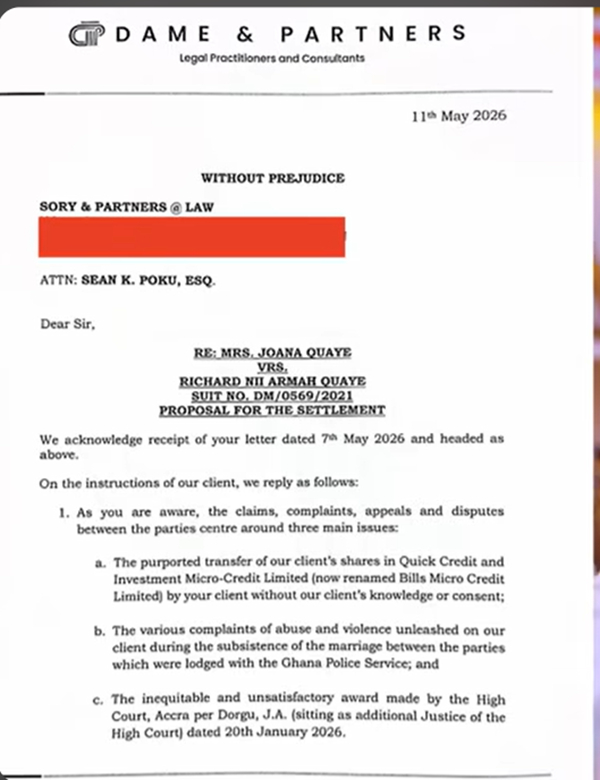
However, Joana’s legal team raised concerns over ongoing appeals, disputes surrounding the alleged transfer of her shares in Quick Credit and Investment Micro-Credit Limited, now reportedly renamed Bills Micro Credit.
“We note that your letter was completely silent on 1(a) and (b) above and focused on (c). We hereby indicate that a meaningful amicable resolution of the dispute between the parties must be comprehensive and ought to take account of 1(a) and (b),” portions of the response stated.
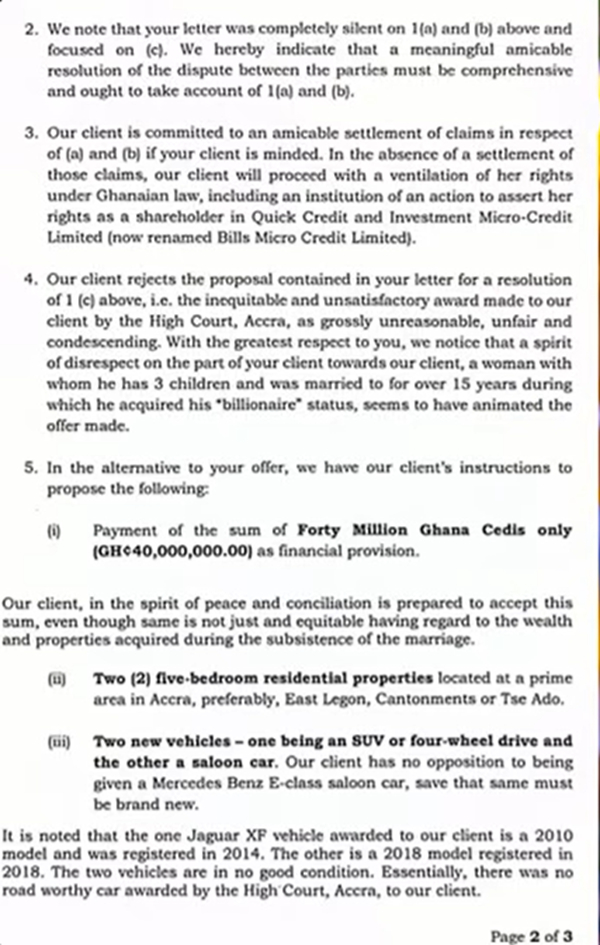
However, Joana Quaye rejected the GH¢2 million offer made by RNAQ but indicated her willingness to settle under revised terms.
According to the response, Joana is demanding GH¢40 million as a financial provision, among other things.
Joana Quaye is now demanding:
“i. Payment of the sum of Forty Million Ghana Cedis only (GH¢40,000,000.00) as financial provision.
Forgery, Shares, Directorship: Explosive details from RNAQ’s testimony in court
ii. Two five-bedroom residential properties located in prime areas in Accra, preferably East Legon, Cantonments, or Tse Addo.
iii. Two new vehicles — one being an SUV or four-wheel-drive vehicle and the other a saloon car. Our client has no objection to being given a Mercedes-Benz E-Class saloon car, provided it is brand new.
iv. Our client hereby proposes the payment of a sum of Thirty Thousand Ghana Cedis (GH¢30,000) for all three children, being GH¢10,000 per child. This amount is reasonable to cater for the many unplanned and unexpected expenses associated with raising a child in the circumstances of the current Ghanaian economy,” the document added.
Meanwhile, Mrs. Joana Quaye, the ex-wife of Ghanaian businessman and self-acclaimed billionaire Richard Nii Armah Quaye (RNAQ), has filed an application for injunction at the Divorce and Matrimonial Division of the High Court in Accra seeking to restrain him from selling, transferring, disposing of or in any way alienating shares in a long list of companies, luxury vehicles, and expensive properties until an appeal over their divorce settlement is finally determined.
Also, Amanda Clinton, a Ghanaian lawyer, Head of Chambers at Clinton Consultancy, has said the high-profile divorce battle between businessman Richard Nii Armah Quaye (RNAQ) and his ex-wife, Joana Coffie, is no longer a mere celebrity divorce story.
According to Amanda Clinton, the case has attracted significant public interest because it has parallels to the realities of many Ghanaian marriages.
She explained that the Ghanaian courts have increasingly moved away from a blanket 50/50 split of marital assets.
Amanda Clinton asserted that the RNAQ divorce case is now forcing Ghana’s legal system to confront deeper questions about marriage, wealth, and property distribution.
Speaking during an appearance on Good Evening Ghana, hosted by Paul Adom-Otchere, Amanda Clinton stated, “This case is no longer merely a celebrity divorce story. It has evolved into one of the most important modern conversations about matrimonial property, corporate ownership, and equitable contribution under Ghanaian law”.
“Many women see themselves in this story, long marriages, sacrifice, supporting a spouse during the building years, and then questioning whether the law truly recognises invisible contributions,” she noted.
She added, “The courts now increasingly ask: Was there a substantial contribution? Was there participation? Was there reliance? Was there a sacrifice? Would strict legal ownership create injustice?”
“Marriage alone may not be enough. But equally, legal title alone is not decisive either. Equity looks beyond whose name is on the document. Equity asks who helped build the reality behind the document.”
Amanda Clinton further commented on the controversy surrounding the High Court’s award of GH¢300,000 and the GH¢5,000 monthly child maintenance.
She noted, “That is one of the realities of litigation. Court outcomes are uncertain. Sometimes parties reject settlements expecting significantly higher awards, and the final judicial outcome may differ sharply from expectations”.
“Many legal analysts would argue that attractiveness should not be a determining legal standard for assessing compensation in matrimonial property distribution.”
She stressed that the stronger legal focus should be on “contribution, economic partnership, sacrifice, beneficial interest, and fairness.”
“If the appellate courts place substantial weight on founder evidence, alleged seed capital, long marriage, indirect contribution, and business partnership realities, then this case could become a landmark precedent in Ghanaian matrimonial jurisprudence,” she added.
See the statement below: