

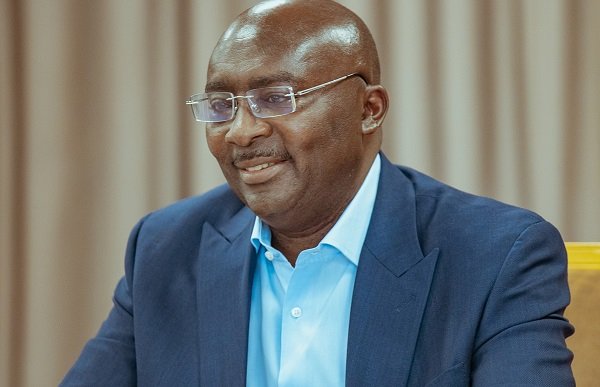
Dr Mahamudu Bawumia, the Former Vice President and NPP flagbearer for the 2028 election, has opened up on his thinking which led to the introduction of the Gold-for-Oil and Gold-for-Reserves programmes while he was in office.
According to Dr Bawumia, two interlinked challenges forced him to “think outside the box” for sustainable solutions to Ghana’s economic difficulties.

He detailed that the first was the sudden halt in external financing following the impact of the COVID-19 pandemic and the Russia-Ukraine war on the global economy.
The second was the conditions attached to Ghana’s IMF programme, revealing that one of the conditions restricted the Bank of Ghana from using a maximum of $80 million per month to intervene in the foreign exchange market.
Speaking in Accra to members of the Ghana Small-Scale Miners Association, Dr Bawumia explained. “That tap (external financing) was shut for Ghana and quite a few countries. And for us, it resulted in a balance of payments crisis”.
“You can imagine what the demand for foreign exchange for Ghana would be on a monthly basis. Significantly more than $80 million a month. And so, in that framework, there was only one result. Because when demand exceeds supply, prices would go up, isn’t it? The cedi started depreciating daily,” he said.
Dr Bawumia detailed that the Gold-for-Oil programme was conceived as a way of bypassing the dollar constraint by using gold to secure fuel supplies.
The former vice president also revealed that the idea for the Gold-for-Reserves programme came to him while he was exercising.
Dr Bawumia stated, “Why does Ghana, which mines gold every day, have to export cocoa to get dollars for its forex reserves? Why not buy the gold we already produce with cedis?”
According to Dr Bawumia, the Gold-for-Oil and Domestic Gold Purchase Programme was not a textbook idea.
“It was not a textbook idea. There’s no textbook in economics that will tell you about the Gold-for-Reserves programme,” he said.
He revealed that he presented the idea to the Bank of Ghana, which took nearly a year to conduct due diligence because of the unconventional nature of the proposal.
Dr Bawumia however disclosed that some officials were initially concerned about the potential risks of implementing a policy that had no established precedent.
“Finally, they agreed, and Ghana became the first country in Africa, and probably the world, to implement such a programme. Now, other countries are coming to learn from Ghana,” he said.
In related news, Dr Mahamudu Bawumia, has revealed that Ghana’s IMF programme under the Akufo-Addo government contributed to the rapid depreciation of the cedi between 2022 and 2024.
According to Dr Bawumia, the IMF programme capped the Bank of Ghana’s foreign exchange market interventions at a maximum of $80 million per month.
Dr Bawumia argued that the IMF cap meant the Bank of Ghana could use a maximum of $960 million a year to support the cedi.
He disclosed that amount was far below Ghana’s monthly demand for foreign exchange to finance fuel, machinery, medicine and other imports.
Speaking on Thursday during a meeting with members of the Ghana Small-Scale Miners Association in Accra, Dr Bawumia stated, “One of the restrictions for the IMF programme that we engaged in was the amount of foreign exchange that the central bank could use to intervene to support the cedi. We were given a maximum of $80 million a month”.
“So, we were really constricted in terms of availability of foreign exchange. And at the same time, the cedi was depreciating almost on a daily basis,” he said.
He further explained that the restriction formed part of the IMF’s reserve accumulation strategy but created a foreign exchange scarcity in the market.
According to Dr Bawumia, the restriction was lifted in January 2025 after Ghana had built sufficient foreign exchange reserves through the Gold for Reserves programme.
He added, “Because we had built up the foreign exchange reserves through Gold-for-Reserves, that restriction was removed. And since then, the Bank of Ghana has been able to put in at least $1 billion a month in the market”.
He further cited the current level of intervention with the previous cap, “From $80 million maximum per month, or $960 million per year, to $1 billion a month. We couldn’t even do $1 billion a year before.”
He argued that the increased availability of foreign exchange following the removal of the restriction contributed to the stability of the Ghanaian cedi.
@ghnow_ The Ablekuma North MCE, Hon. Adamu Musah Kalamu, and MP, Hon. Ewurabena Aubynn, have inspected the newly commissioned Astroturf at Dansoman as part of activities marking the completion of the project. ⚽️ #GHNow #fyp ♬ original sound – NDCMUSICHQ
@ghnow_ The MP for Ablekuma North, Hon. Ewurabena Aubynn, has kicked the first ball to officially commission the newly built Astroturf at Dansoman. ⚽️ #GHNow #fyp ♬ original sound – NDCMUSICHQ