

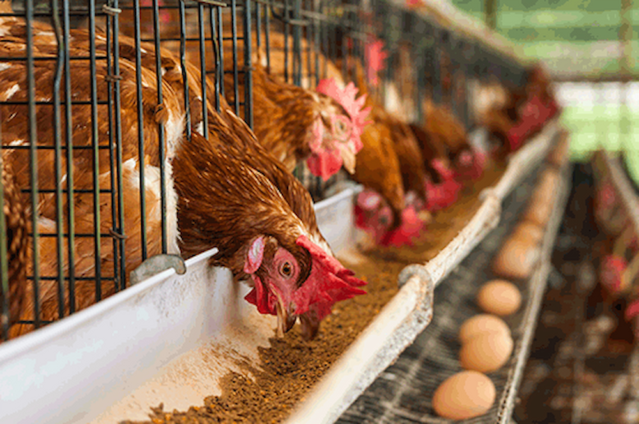
The John Mahama government’s Nkoko Nkitinkiti initiative is facing renewed calls for improved implementation as poultry farmers warn that chicken and egg prices could rise by at least 15 per cent ahead of the Christmas festivities.
Mohammed Ali, Chief Executive of the Greater Accra Poultry Farmers Association, has attributed the anticipated price increase to rising production costs, particularly the cost of animal feed and imported inputs.

Speaking to Joy Business during an outreach programme at schools in Dansoman to mark World Egg Day, Mr Ali said the rising prices of maize, soya and other feed ingredients, alongside increasing freight charges, were putting pressure on poultry farmers.
“Maybe not less than 15 per cent; we must see some price change,” he said, warning that consumers could face higher prices during the festive season.
Mr Ali stressed that improving local production of feed ingredients would be crucial to reducing costs and stabilising poultry prices.
“When we are able to have an abundance locally, the feed price will surely come down. But without them, we can’t do anything about poultry feed,” he added.
His comments have renewed attention on the Nkoko Nkitinkiti initiative, which is intended to support domestic poultry production and reduce reliance on imported poultry products.
The Poultry farmers are calling for stronger implementation measures to help increase local output and ease the cost pressures affecting the industry.
Also, beyond production costs, the Greater Accra Poultry Farmers Association is also concerned about the price differences between what farmers charge at the farm gate and what consumers pay at retail outlets, particularly for eggs.
He noted that some traders add as much as GH¢20 to the price of a crate of eggs, creating a significant gap between farm-gate and retail prices.
He disclosed that a crate currently sells for between GH¢40 and GH¢45 at the farm gate and argued that retail prices should not exceed GH¢50.
“We don’t expect an egg to go beyond 50 cedis. Take or leave,” he stressed.
The association believes that addressing these price disparities would make eggs more affordable for households while ensuring that consumers benefit from locally produced poultry products.
He urged the Mahama government to strengthen the implementation of the Nkoko Nkitinkiti initiative to ensure that local poultry farmers benefit meaningfully and that increased domestic production translates into more stable prices for consumers.
Meanwhile, with Christmas approaching, the anticipated price increase could add to household expenses, while poultry farmers continue to call for measures to reduce feed costs, improve local supply and make poultry products more affordable.
In related news, Franklin Cudjoe, the President of IMANI Africa, has warned the John Mahama government that the ‘Nkoko Nkitinkiti‘ programme. risks becoming “Flying Akonfem Version 2”.
According to Franklin Cudjoe, the ‘Nkoko Nkitinkiti’ programme risks becoming the ‘Flying Akonfem Version 2 ‘ as 3 million birds have been distributed since October 2025 without adequate processing plants or cold-chain infrastructure.
FranklIn Cudjoe questioned why Ghana imports over 80% of its poultry at $300 million annually and questioned the lack of cost-benefit analysis for the GHS 250 million expenditure plus potential $20 million more.
He argued that Ghana’s poultry sector requires more than increasing production.
In a post shared on his X page on July 22, 2026, Franklin Cudjoe detailed, “Nkoko Nkitinkiti risks becoming ‘Flying Akomfem Version 2. – Franklin Cudjoe
1. Ghana imports over 80% of its poultry at a cost of $300 million annually. The government’s new Nkoko Nkitinkiti Programme has been distributing projected 3 million birds nationwide since October 2025.
2. I have not read or seen any impact analysis justifying the spending of GHS 250 million on this policy, with an additional $20m likely to be approved for the programme.
3. Sadly, when funds are given to existing big poultry companies, they often import chicken and repackage it as locally produced. For instance, a well-known company received GHS 20 million under 1D-1F to expand operations but reportedly used the funds to import and rebrand foreign chicken as Ghanaian.
4. My dear Agric Minister, please show us a cost-benefit analysis justifying this GHS 250 million expenditure from taxpayer money. Otherwise, I fear that additional funds committed by the World Bank will be wasted.
5. IMANI warned last year that unless production is matched with processing and cold-chain infrastructure, the programme risks collapse.
6. IMANI explored the following questions and observations:
🔸 Why distributing millions of birds without processing plants will destabilise prices and create waste.
🔸 Farmers’ concern: “When the birds mature, where do we take them?”
🔸 How processing and cold storage can stabilise markets, ensure quality, and create jobs.
🔸 Why a full poultry ecosystem, from feed supply to logistics, is essential for reducing imports.
7. Producing millions of birds without processing is like building a factory with no power to run the machines”.
@ghnow_ Veteran actor Koo Ofori visibly shaken as he mourns the passing of his longtime friend and co-star, Kwame Dzokoto, who passed away yesterday. #GHNow #fyp ♬ original sound – GHnow
@ghnow_ Wendy Shay arrives in Kumasi for Rapperholic tonight at the Baba Yara Sports Stadium #GHNow #fyp #rapperholic ♬ Steeze – Mr Drew