

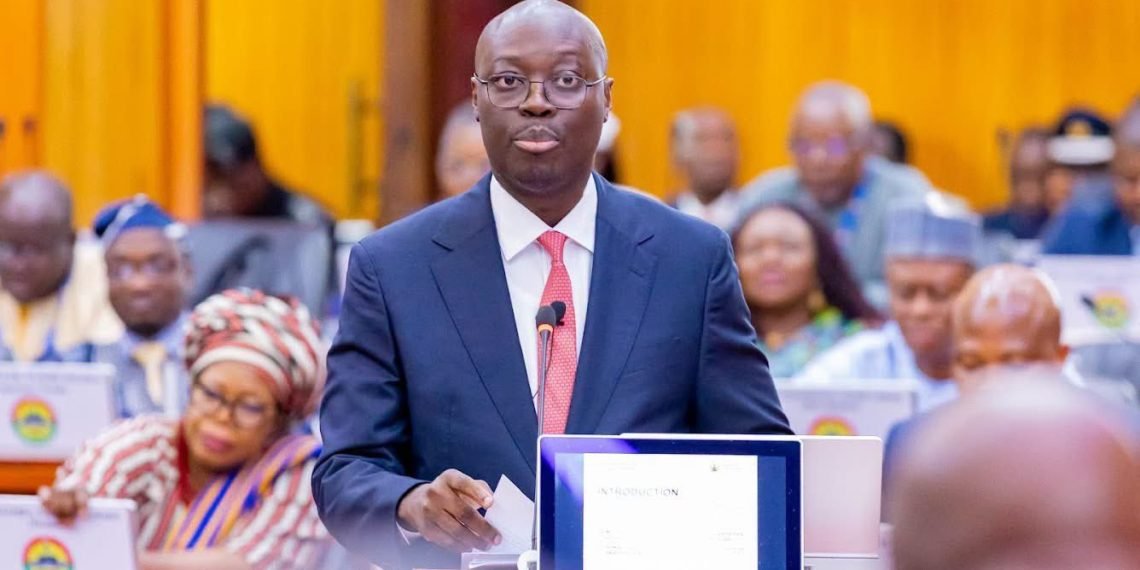
Finance Minister Dr Cassiel Ato Forson has unveiled an ambitious US$10 billion, four-year economic transformation programme, built around eight strategic pillars, aimed at reshaping Ghana’s economy under President John Dramani Mahama’s administration.
Dubbed the New Economy programme, the initiative is expected to begin in 2027 and will focus on boosting local production, accelerating industrialisation, creating jobs and reducing the country’s dependence on imported goods and raw commodity exports.

The programme will focus on agriculture, energy, mining, tourism, manufacturing, pharmaceuticals and technology as part of efforts to reduce Ghana’s dependence on imported goods and raw commodity exports.
Presenting the 2027 Budget Statement and Economic Policy to Parliament on Thursday, November 12, 2026, Dr Forson outlined eight pillars that will guide the implementation of the initiative.
He disclosed that the programme, which coincides with Ghana’s 70th independence anniversary, is also expected to consolidate macroeconomic stability and address longstanding structural weaknesses in the economy.
Among its major targets are ending commercial rice imports by 2030, processing all locally produced cocoa in Ghana, stopping raw manganese and bauxite exports by the end of 2030 and reducing electricity generation costs from 16 US cents to 8 US cents or less per kilowatt-hour.
The government also intends to increase local production of essential medicines to between 60% and 80% by 2030.
Eight pillars of the US$10 billion programme
1. Commercial Agriculture – US$3 billion
Agriculture will receive the largest allocation of US$3 billion to expand domestic food production and reduce imports.
The government plans to establish eight agro-industrial hubs covering rice, sugar, poultry, maize and soya feed, aquaculture, oil palm, vegetables and cocoa processing.
It also intends to develop 100,000 hectares of oil palm plantations, supported by US$500 million in World Bank financing. The US$1 billion Pwalugu Multipurpose Dam is expected to support the agricultural agenda.
2. Energy Infrastructure – US$2.2 billion
The energy sector will receive US$2.2 billion to improve power supply and reduce electricity generation costs.
Plans include a 1,450-megawatt thermal power plant at Kafodzidzi-Abrobeano, with construction expected to begin in December 2026, and a 600-megawatt solar facility supported by 2,000 megawatt-hours of battery storage.
Government will also invest US$500 million in upgrading GRIDCo’s transmission network and US$200 million in a 24-month nuclear-readiness programme.
3. Critical Minerals Value Addition – US$1.5 billion
The government intends to increase local processing of minerals rather than exporting them in their raw state.
It plans to end raw artisanal and small-scale gold exports by December 2028, followed by raw manganese and bauxite exports by the end of 2030.
A 24-hour minerals processing enclave will be established in the Western Region, with a proposed railway linking Takoradi to Nyinahin.
4. Tourism, Culture and Creative Arts – US$1 billion
The US$1 billion allocation will support heritage conservation, medical tourism and the development of the Black Star Experience as a year-round tourism attraction.
Other projects include a new National Theatre in Kumasi, an international convention centre at the La Trade Fair site and five additional four- and five-star hotels across the country.
5. Textiles and Garments – US$1 billion
The government plans to establish dedicated industrial zones for textile mills and garment factories under the 24-Hour Economy framework.
It will also amend procurement laws to require public institutions to purchase locally manufactured uniforms, hospital textiles and protective clothing.
6. Pharmaceuticals and Biomanufacturing – US$1 billion
The initiative seeks to reduce Ghana’s dependence on imported medicines, which account for an estimated 70% to 75% of pharmaceutical requirements.
State-owned special purpose vehicles will establish pharmaceutical hubs in the Eastern and Central Regions.
The government is targeting local production of 60% to 80% of essential medicines and 20,000 jobs by 2030.
7. Macroeconomic Stability and Affordable Finance
This pillar focuses on maintaining a primary surplus of at least 0.5% of GDP, keeping public debt around 45% of GDP and sustaining single-digit inflation.
By 2030, government is targeting 8% real GDP growth, unemployment below 8% and an investment-grade sovereign credit rating.
Development Bank Ghana and Ghana EXIM Bank will support efforts to reduce business borrowing costs to single-digit levels.
8. Technology Economy – US$300 million
The technology pillar will focus on digital infrastructure, innovation and skills development.
Government plans to upgrade rural 2G mobile networks to 4G between 2027 and 2028 and establish a National Artificial Intelligence Centre to support research, computing infrastructure and digital skills training.
Through the programme, the government says it hopes to transform economic stabilisation into increased production, stronger local industries and sustainable employment.
Minority MPs in Parliament chant “Wo de cocaine abao, cocaine abao, 24-hour economy” during the Finance Minister’s presentation of the 2027 Budget Statement. https://t.co/d0CokLomhR
— GHnow (@ghnow_) November 12, 2026
Minority MPs Chant “Cocaine” During 2027 Budget Presentation #GHNow https://t.co/OtbxPB9pwr
— GHnow (@ghnow_) November 12, 2026