

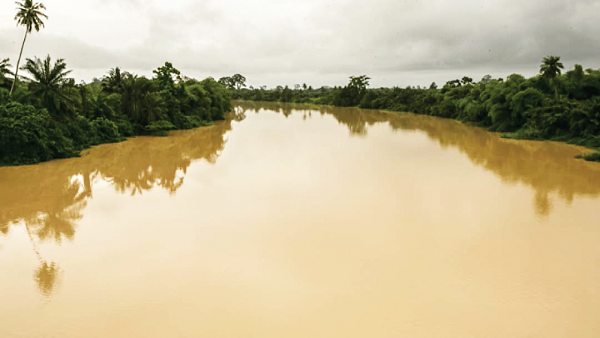
The Environmental Protection Authority (EPA) has warned residents of communities affected by illegal mining (galamsey) against drinking or using water from polluted rivers and streams.
According to the EPA, boiling galamsey water does not remove harmful chemicals, warning that boiling such water does not make it safe for consumption.

EPA disclosed that water contaminated by galamsey activities may contain hazardous substances, including mercury, cyanide and arsenic, which cannot be eliminated through boiling.
An official of the EPA’s Twifo Praso office, David Agyekum Baidoo, stated, “The notion that boiled galamsey-contaminated water is safe for drinking and other domestic activities is false. While boiling kills bacteria, it does not remove harmful chemicals such as mercury and cyanide”.
Speaking to the Ghana News Agency, David Agyekum Baidoo warned that residents who depend on polluted water bodies are exposed to serious health risks, particularly those who drink, bathe in or use contaminated water for farming and livestock.
He stressed that prolonged exposure to chemicals associated with illegal mining could result in kidney damage, neurological disorders and birth defects.
David Agyekum Baidoo urged residents in affected communities to rely on treated water and other safe alternative sources rather than assume that boiling polluted river water.
Meanwhile, the Minority in Parliament has announced plans to summon the Minister for Lands and Natural Resources, Emmanuel Armah-Kofi Buah, to Parliament to clarify the government’s position on reports that miners could commence operations without licences and regularise their activities afterwards.
The Minority Leader, Alexander Afenyo-Markin, made this announcement during a Leaders’ Media Briefing on Tuesday, November 3, 2026, expressing concern over comments attributed to the Chief Executive Officer of the Ghana Gold Board, Sammy Gyamfi.
Sammy Gyamfi had reportedly suggested that miners operating outside restricted areas, including water bodies and forest reserves, could be allowed to undertake mining activities while steps were taken to regularise their operations.
However, Afenyo-Markin argued that such a position could undermine the legal framework governing mining in Ghana, particularly the Minerals and Mining Act, 2006 (Act 703).
He maintained that the law does not permit individuals to engage in small-scale mining without first obtaining the necessary licence.
“The Minerals and Mining Act 2006, Act 703, admits no exception, and registration and regularisation must never become an amnesty,” he stated.
Under Section 82(1) of Act 703, a licence must be obtained before a person can undertake small-scale mining operations.
The Minority Leader said the caucus wanted the Lands Minister to explain whether the reported position of the Gold Board CEO reflected the government’s official policy and how the proposed regularisation process would comply with existing mining laws.
Afenyo-Markin stressed that efforts to address galamsey should not be influenced by political considerations, arguing that the destruction of the country’s natural resources affects all Ghanaians, irrespective of their political affiliations.
“Our rivers and forests are not partisan,” Afenyo-Markin declared.
Afenyo-Markin stressed that the Minority would pursue the matter through Parliament and demand clarity from the minister, warning against any approach to formalising small-scale mining that could weaken the enforcement of existing laws.