
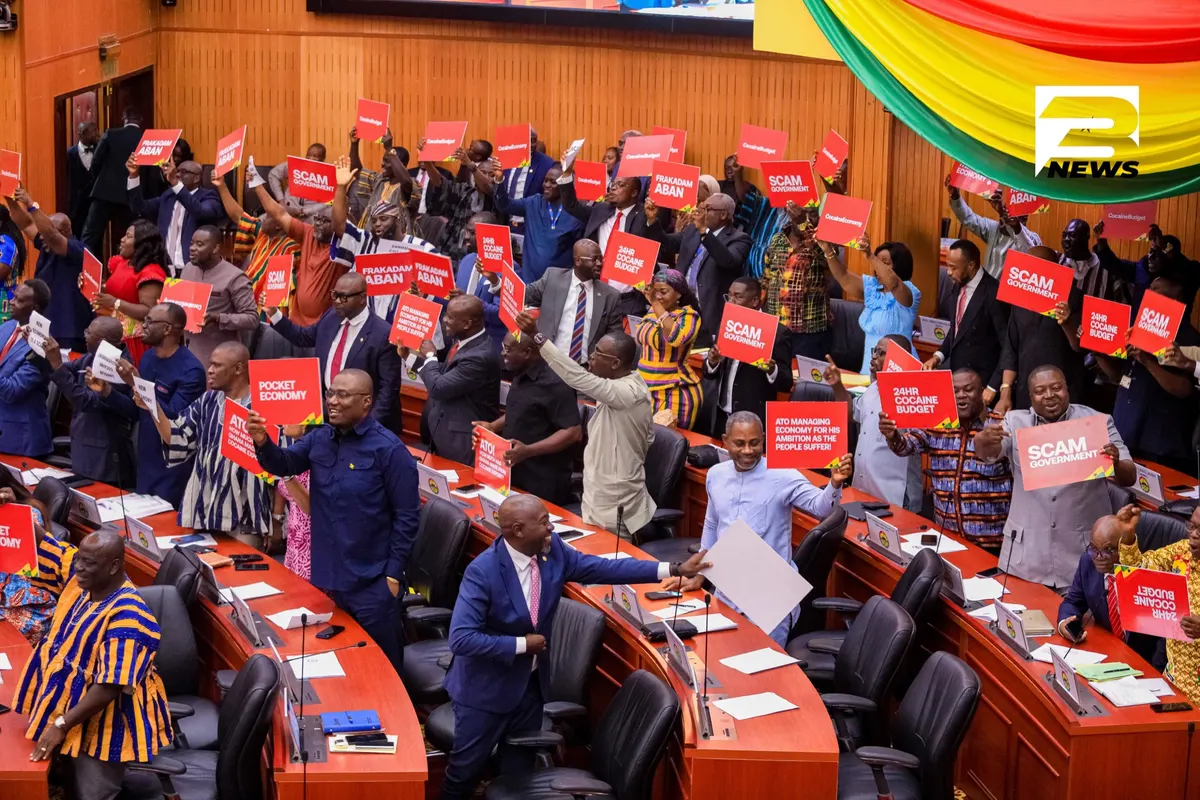
Members of the New Patriotic Party (NPP) Minority in Parliament interrupted proceedings following the presentation of the 2027 Budget Statement and Economic Policy on November 12, 2026.
The minority were captured chanting “Cocaine!” and “Cocaine economy!” in protest against what they described as the government’s failure to tackle drug trafficking in Ghana.

The NPP MPs rose from their seats and began chanting the slogans shortly after Finance Minister Dr Cassiel Ato Forson concluded his presentation of the 2027 Budget.
During the protest, several members of the caucus held placards bearing messages critical of the government, accusing it of failing to protect the country’s borders against drug trafficking.
Some of the inscriptions included “Scam Government,” “Paper Economy vs Pocket Economy,” “Frakadam Aban,” and “Ato, how much has Ghana made from cocaine?”
The placards appeared to question the government’s handling of recent cocaine seizures linked to Ghana, with particular attention drawn to the country’s alleged earnings, if any, from the intercepted shipments.
The demonstration comes amid growing political controversy over recent cocaine seizures involving shipments linked to Ghana, particularly the interception of 2.6 tonnes of the substance by Spanish authorities at the Port of Valencia.
The NPP Minority sought to turn the spotlight on the drug trafficking controversy, using the high-profile Budget presentation to register its concerns.
The protest added a political dimension to the parliamentary proceedings, momentarily shifting attention from the government’s economic projections and policy priorities for 2027 to the controversy surrounding the cocaine seizures.
The development follows Spanish authorities intercepting 2.6 tonnes of cocaine concealed in a shipment of coconuts originating from Ghana, with two men arrested in connection with the consignment.
The drugs were discovered in two containers of coconuts loaded at the Tema Port on August 2 and shipped to Spain, where they arrived at the Port of Valencia 20 days later.
According to Spanish authorities, customs officials and the Guardia Civil selected the containers for inspection after identifying them as high-risk consignments for drug trafficking.
A search of the containers uncovered packages of cocaine hidden beneath false bottoms fitted into the wooden crates used to transport the coconuts. Subsequent tests confirmed that the substance was cocaine.
Following the discovery, investigators removed the drugs but left the containers sealed to monitor the shipment and identify the individuals who would take delivery of the cargo.
Their surveillance led them to two refrigerated lorries that arrived to collect the containers. Officers subsequently followed the vehicles to a warehouse at the La Juaida industrial estate in Almería.
Two men were arrested as the cargo was being unloaded at the warehouse. They were identified as the suspected importer of the drugs and the individual responsible for supervising the unloading.
Spanish authorities released details of the operation on Wednesday, November 11, 2026, describing another major overseas drug interception involving a consignment traced to Ghana.
Meanwhile, the busts come just weeks after a Syrian national was busted in Lebanon after arriving from Ghana with 40 kilogrammes of suspected cocaine concealed in two bags at Beirut-Rafic Hariri International Airport.
Reports suggest the suspect was apprehended shortly after arriving on a flight from Accra International Airport, following what reports describe as surveillance that began before he departed from Ghana and continued until he arrived in Lebanon.
According to reports, officers from Lebanon’s General Security monitored the passenger from the moment he disembarked from the aircraft until he collected his two bags.
Watch the video below:
Minority MPs Chant “Cocaine” During 2027 Budget Presentation #GHNow https://t.co/OtbxPB9pwr
— GHnow (@ghnow_) November 12, 2026