

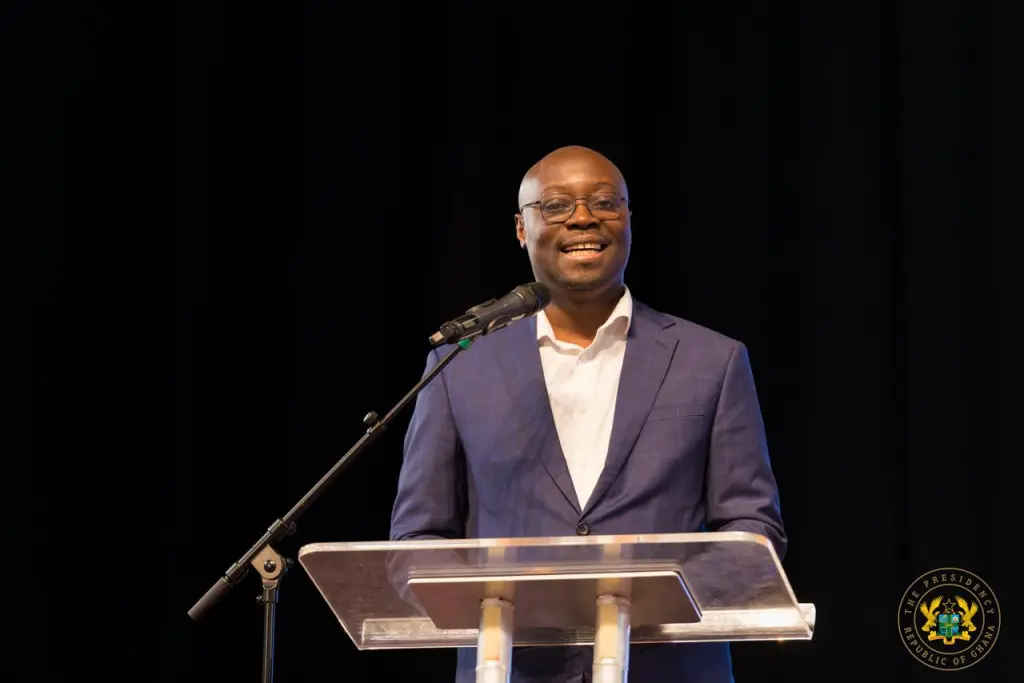
Dr Cassiel Ato Forson, the Finance Minister, has declared that Ghana’s inflation rate will remain below 5% by the end of 2026.
According to Ato Forson, despite mounting geopolitical tensions in the Middle East and their potential impact on global energy and commodity prices, Ghana’s inflation rate will remain below 5% by the end of 2026.

Speaking in an interview with Bloomberg, Dr Forson detailed, “The conflict poses conflict on the price of petroleum products and then has an impact, most importantly, on the fertiliser and supply chain. Availability isn’t a concern to us at the moment. I think the challenge has to do with price increases”.
“The good news is that in Ghana, we do not have subsidies on petroleum products. But the good news is that we had built some significant reserves,” he stated.
“And our gold production is also going up, and gold prices is also very high. And so Ghana is in a comfortable position to be able to withstand those shocks,” Dr Forson added.
He added, “Where I think we may see a bit of pressure will be on the back of inflation. We expect that inflation may inch up today; it’s about 3.4. I still think we’ll be better off. And I don’t think the country’s inflation will exceed 5% by the end of the year.”
“Because our major exports are doing well. Cocoa, yes, dipped, but the cocoa price has started going up. Oil, we’re also an oil exporter. And so, foreign exchange, we’re also getting something back.”
Also, the Finance Minister has said Ghana is now ranked as the eighth largest economy in Africa.
The Finance Minister asserted that under the previous Akufo-Addo/Bawumia administration, the Ghana economy was rated as a junk economy.
According to Ato Forson, the fiscal policies adopted since the takeover from the Akufo-Addo/Bawumia administration have positioned the country to be able to attract investors.
Ato Forson disclosed that Ghana’s GDP per capita has reached $3,385 for the first time.
He further assured the diaspora community that the country’s debt is now sustainable and the economic gains made will be fully sustained.
Speaking at a town hall meeting in London on Sunday, May 31, 2026, Ato Forson stated, “Our country is back. Today, Ghana is ranked the eighth-largest economy in Africa. Our GDP per capita is now $3,385 for the first time, and our debt is now sustainable, unlike in the past. The gains made will be sustained”.
He further appealed to investors and Ghanaians in the diaspora to come and invest in Ghana.
The Finance Minister stated, “Ghana is open for business. We welcome you. Come home and contribute. And so, we see you as an important partner. We see you as our brothers and sisters in the diaspora. And you still have a role to play in nation building.”
“And London is home to some of us. Some of us had the privilege of growing up here.
“And myself, Honourable Kwami Agbodza (Minister of Roads and Highways), not long ago used to be members of this chapter until we had the privilege to go back home to serve our country. And so, you can also be one of us if you decide to come home and take part in nation building.”
“I do not recall that our country had ever gone through such a level of economic crisis. The scale of the crisis was profound. It was extremely traumatic, if not distressful.” He stated.
“Our currency, the Ghana cedi, came under intense pressure. It nearly lost its value. Inflation rose to painful levels. Investor confidence deteriorated very sharply.”
“In February 2022, Moody’s downgraded Ghana to CAA1. In August, S&P also downgraded us to CCC+,” he stated.
“Again in the same year, August, Fitch also downgraded Ghana to CCC. And in September, Fitch again downgraded Ghana further down to double C. Finally, in October 2022, Ghana lost access to the international capital market.”
“But the good news is that today our country is back. We are back.” He said.
“But let me share some of the outturn with you. I’m pleased to report that as a result of the measures that President Mahama took, today GDP growth is back. Ghana has recorded a GDP growth of six per cent in the year 2025.” He said.
“And most importantly, non-oil GDP growth was 7.6 per cent, the highest in 14 years.”