

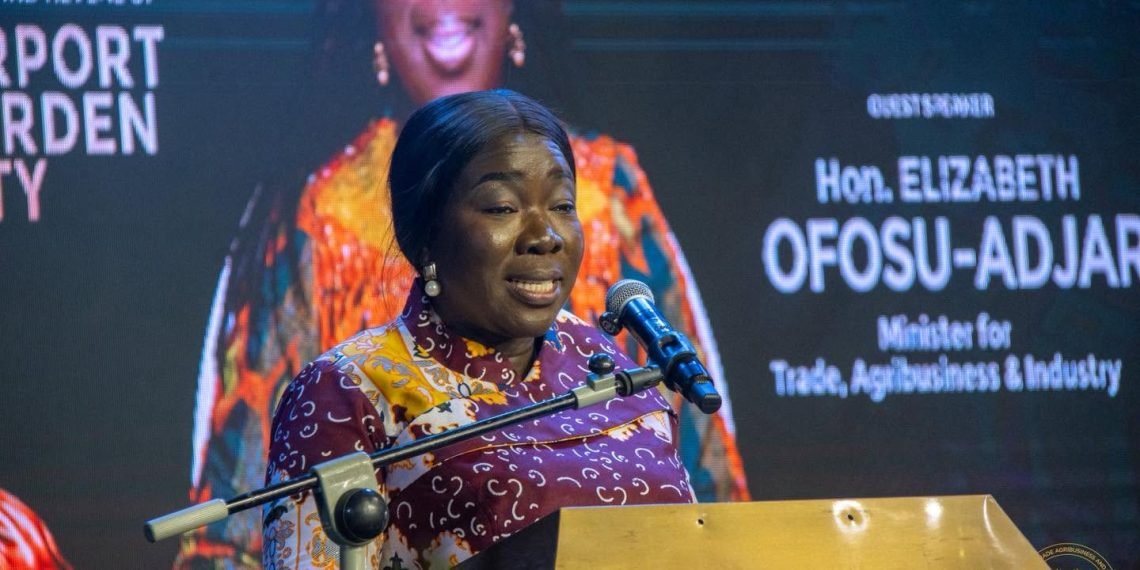
The Mahama government has announced plans to establish garment factories across four regions of Ghana.
According to the Minister of Trade, Agribusiness and Industry, Elizabeth Ofosu-Adjare, the initiative is expected to generate 80,000 direct employment opportunities, particularly for young people and women.

Elizabeth Ofosu-Adjare said the project forms part of the government’s broader strategy to expand the country’s textile and garment industry, create jobs and increase the volume of locally manufactured products for export.
The Trade Minister made this known during a bilateral engagement on the first day of the Sixth German-African Business Summit in Accra, where she outlined the government’s plans to attract investment and improve the performance of local industries.
According to Elizabeth Ofosu-Adjare, the establishment of the factories is being pursued under an approved sector policy, with the trade ministry leading efforts to translate the plan into employment and industrial growth.
“Under the approved sector policy, my ministry is driving the establishment of garment factories projected to create 80,000 direct jobs, most of them for young people and women,” she stated.
The trade minister revealed that the government intends to build on the progress recorded by North Shore, which she indicated had employed a considerable number of people within its first two months of operations.
She explained that the pilot initiative would also strengthen the capacity of Ghanaian garment manufacturers to satisfy international market standards, attract foreign buyers and compete for bigger export contracts.
The Minister stressed that securing orders from international buyers would be critical to expanding production and ensuring that local manufacturers benefit from growing opportunities in the global market.
“If you are able to meet buyers, and if you are able to secure larger export orders, it will go a long way to helping us,” she stated.
The Trade Minister further highlighted government efforts to address administrative and regulatory challenges that discourage investment and make business operations difficult.
Elizabeth Ofosu-Adjare revealed that the Trade Ministry had prepared a proposed Business Regulatory Reform Bill aimed at eliminating overlapping regulatory requirements and reducing delays in obtaining approvals and permits.
According to her, the proposed legislation is expected to make it easier for businesses and prospective investors to navigate the country’s regulatory system.
Elizabeth Ofosu-Adjare argued that the reforms would complement the Ghana Investment Promotion Authority Act, 2026, which she indicated had simplified the process for investors seeking to establish businesses in the country.
She further expressed optimism that collaboration with the World Bank Group and the International Finance Corporation would provide the necessary support.
Meanwhile, the Mahama government’s garment factory initiative is expected to contribute to job creation, industrial development and Ghana’s ambition to strengthen its position as a competitive exporter of textile and garment products.
Earlier, Elizabeth Ofosu-Adjare, announced that the John Mahama government will establish three garment factories to create 27,000 jobs.
Speaking at the Government Accountability Series in Accra on Wednesday, January 21, the Trade Minister revealed that the government will support the private sector to establish three large garment factories.
According to the Trade Minister, the garment industry has strong job creation potential due to the large number of people and requires less training.
She explained that garment factories will strengthen the country’s industrial base.
Elizabeth Ofosu-Adjare stated, “I can say for a fact that 2026 even looks better. 2026 looks better because the government is going to support the private sector to establish three big garment factories, and we seek to employ 27,000 people in the long run with these garment factories.
“A garment factory employs a lot of people. The beauty is the fact that you don’t have to learn for three or five months before you get a job. So this is good,” Minister Ofosu-Adjare stated.
President Mahama Pays Courtesy Visit to Veteran Cinematographer Chris Tsui Hesse https://t.co/oVUw1tlcQw
— GHnow (@ghnow_) November 23, 2026