

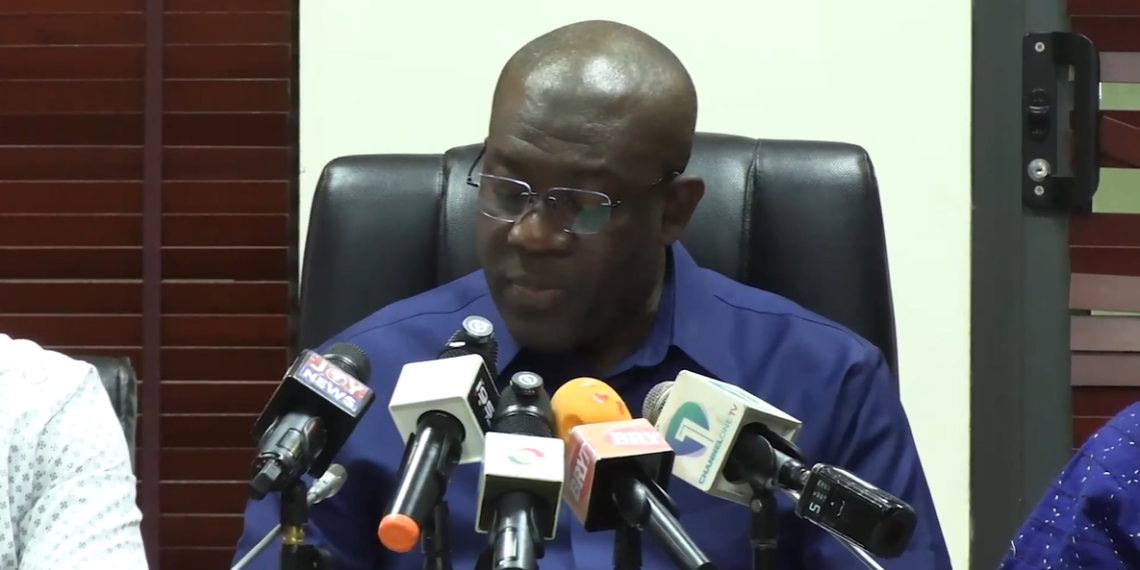
The Minority in Parliament has issued a stern warning to the Governor of the Bank of Ghana (BoG), Dr Johnson Asiama against the growing politicisation of the central bank.
According to the minority in parliament, the Bank of Ghana (BoG) is not a political party.

Kojo Oppong Nkrumah, the Member of Parliament (MP) for Ofoase-Ayirebi and Ranking Member of Parliament’s Economy and Development Committee, speaking on behalf of the minority, argued that the politicisation of the central bank could undermine its operational independence and credibility.
According to Oppong Nkrumah, the Bank of Ghana must remain insulated from partisan influence.
He warned the Bank of Ghana, the Governor, Dr Johnson Asiama, not to allow the NDC party to dictate to you how to comply with the law.
Speaking to the media on Sunday, May 3, the Member of Parliament for Ofoase-Ayirebi, Kojo Oppong Nkrumah, stated, “The Governor, the Board and the government should take note that this politicisation of the central bank will create issues for the operational independence and credibility of the bank going forward. This must stop.
“Mr Governor, if you allow the NDC party to dictate to you how to comply with the law, you will set a precedent that will collapse the operational independence of the bank. The bank is not a political party,” he stated.
Also, the Minority in Parliament disputed the official Bank of Ghana’s (BoG) figures, which claimed they made a GH¢15.6 billion operating loss for the 2025 financial year.
According to the Minority, they acknowledge the BoG’s transparency in its public disclosure, but disputed the figures.
Kojo Oppong Nkrumah, the Member of Parliament (MP) for Ofoase-Ayirebi and Ranking Member of Parliament’s Economy and Development Committee, alleged that the central bank employed “artificial recognition” and “clever accounting” to move portions of the deficit into “other comprehensive income”.
He detailed that the move effectively downplayed the scale of the operating loss.
Kojo Oppong Nkrumah argued that the BoG’s “true operating loss” is closer to GH¢34.9 billion, adding that once gold sale proceeds are factored in, the total comprehensive loss nears GH¢44 billion.
Kojo Oppong Nkrumah disputed official figures, saying, “The government and its spin doctors, led by the NDC party officials who did that press conference, are trying to convince the people of Ghana that their loss is GH¢15.6 billion.
“We regret to tell the people of Ghana that this is not true. The true operating loss of the Bank of Ghana for the year 2025 is GH¢34.9”, he remarked.
He stated, “The government says the loss is GHC15.6 billion. The true operating loss of the Bank is actually GHC34.9 billion cedis.
In fact, if you add back the 9.6 billion cedis proceeds from the Gold sales, the recalculated loss is actually GHC44 billion.”
Meanwhile, Sammy Gyamfi, the Chief Executive Officer of the Ghana Gold Board (GoldBod), has clarified the over GH¢15 billion loss made by the Bank of Ghana (BoG).
According to Sammy Gyamfi, the Bank of Ghana has not made any losses, adding that the GH¢15.6 billion loss was largely the cost of stabilisation.
He disclosed that the central bank’s financial position has been significantly influenced by the performance of the Ghana cedi.
Speaking on Newsfile on May 2, 2026, Gyamfi argued, “Issue number one: the Bank of Ghana has not made any losses. What has been described as a GH¢15.6 billion loss is largely the cost of stabilisation”.
“If the cedi had depreciated as it did previously, the Bank would have recorded revaluation gains and likely posted profits,” he noted.
He explained, “What it means is that because the cedi appreciated, foreign currency assets lost value in cedi terms, leading to what is being reported as a loss”.
Sammy Gyamfi added that without the revaluation effect, the central bank’s losses would have remained closer to the previous year’s figure of about GH¢9 billion.
The GoldBod CEO highlighted that the BoG had to mop up excess liquidity in the system, a standard central banking practice to curb rising prices.
Sammy Gyamfi added, “When there is too much money in circulation chasing fewer goods, the central bank must act to reduce that liquidity. That process comes at a cost because interest must be paid to commercial banks”.
He further refuted suggestions that alternative strategies, such as reducing production costs or taxes, would have delivered faster results in lowering inflation.
“If we had not adopted these measures, how quickly would inflation have dropped from over 23 per cent to about 3.4 per cent?” he questioned.
“The Bank of Ghana should be commended, not criticised,” Sammy Gyamfi added.