

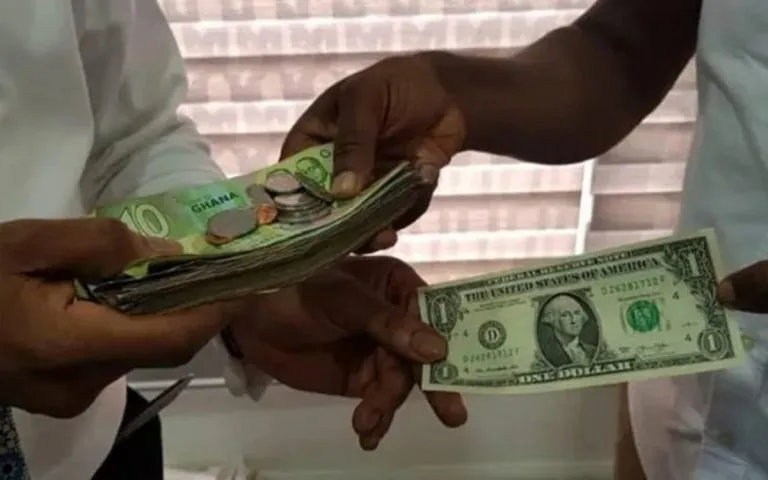
Alfred Appiah, an economist and data analyst, has calm fears despite the Cedi being ranked the worst-performing currency.
The economic analyst maintains that there is little reason for Ghanaians to panic.

According to Alfred Appiah, while the recent depreciation of the cedi may appear worrying on the surface, Ghana’s foreign exchange fundamentals remain relatively supported.
He pointed particularly to strong gold prices and continued gold purchases under the government’s Goldbod programme.
Alfred Appiah argued that the country is not facing an immediate foreign exchange supply crisis despite the cedi’s recent weakness against the US dollar.
“No need to panic about the current movements in the exchange rate,” he remarked.
Alfred Appiah stressed that Ghana currently has an important buffer that could prevent a full-blown currency crisis, which is gold, adding that it remain one of the country’s most important sources of dollar inflows.
He also expressed confidence that the Bank of Ghana still possesses enough capacity to help manage temporary exchange rate pressures if necessary.
He explained that, “As long as gold prices remain elevated and the Goldbod continues to purchase large volumes of gold from the ASM sector, foreign exchange supply to the market is unlikely to be a major challenge. The Bank of Ghana has the capacity to help meet seasonal FX demand pressures.”
He further noted that the Bank of Ghana may be allowing the currency to gradually adjust toward what he described as its “true value”.
“The Bank appears to be allowing the cedi to gradually find its “true value” while at the same time trying to repair its balance sheet as much as possible. At some point, however, more aggressive intervention may be needed to reduce the pass-through effect of cedi depreciation on fuel prices,” he noted.
His comments come on the back of Reuters publications that have described Ghana’s cedi as the weakest-performing currency in West Africa.
According to Reuters, citing market data, reported that the Ghana cedi had recently emerged as the worst-performing currency in West Africa and among the weakest in sub-Saharan Africa in recent weeks.
The cedi has suffered a steady decline so far in 2026, thereby assuming the unenviable position of the worst-performing currency in West Africa on a year-to-date basis.
“Ghana’s cedi is being dragged down by persistent corporate foreign-currency demand, particularly from the energy sector,” the Reuters report said, showing trends of consistent decline of the cedi in recent weeks using data from LSEG.
“The report predicted further decline in the weeks ahead and, true to the prediction, the slump continued, as the cedi closed trading last week at a further depreciated rate of 11.61 to the dollar, maintaining its high year-to-date percentage decline among West African currencies.
The cedi is one of nine currencies in West Africa, including the CFA franc, which is used by eight West African countries.
Among the currencies in West Africa, the cedi has so far, in 2026, recorded the biggest year-to-date decline of 10.28% as of the beginning of May, which also places it among some of the continent’s worst-performing currencies in 2026, such as the Libyan dinar, which recorded a 17.21% decline against the US dollar”, reports stated.
In related news, the May 2026 Economic and Financial Summary released by the Bank of Ghana (BoG) has disclosed that the Ghana cedi depreciated by 8.4% against the US dollar during the first five months of 2026.
The decline higher than the 6.6% depreciation recorded over the same period in 2025.
Social media commentator Koka has been granted GH¢50,000 bail at the Regional Police Headquarters after allegedly threatening a police officer.#GHNow pic.twitter.com/UbFxj6IAua
— GHnow (@ghnow_) May 25, 2026