

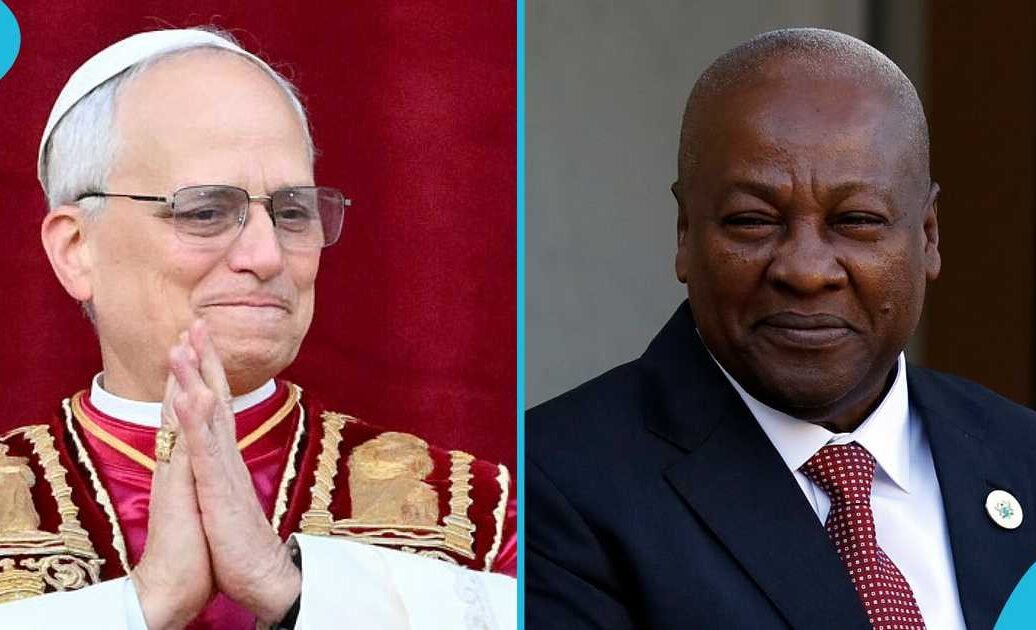
President John Dramani Mahama, through a statement issued by the Government of Ghana, has welcomed a statement by His Holiness Pope Leo XIV acknowledging and apologising for the historical role played by the Holy See of Catholic Church in legitimising and sustaining the transatlantic slave trade.
According to President Mahama, His Holiness Pope Leo XIV’s apology is particularly significant and refreshing, as it demonstrates a willingness to confront difficult historical truths in the interest of justice, understanding and reconciliation.

Parts of the statement issued by Presidential Spokesperson and Minister for Government Communications, Felix Kwakye Ofosu, on Thursday, May 28, read, “The Government of the Republic of Ghana warmly welcomes the historic statement by His Holiness Pope Leo XIV acknowledging and apologising for the role played by the Holy See in legitimising and sustaining the enslavement of Africans and the transatlantic slave trade. The statement represents an act of moral courage on the part of the Pope and an important contribution to the ongoing global pursuit of historical truth, human dignity and justice.
Ghana recognises His Holiness Pope Leo XIV’s longstanding commitment to service, compassion and the dignity of the human person. Throughout his work, he has advanced principles of social justice, solidarity with the vulnerable, dialogue across communities and moral responsibility in responding to the challenges of our changing world.”
The statement added, “For five centuries, millions of Africans and people of African descent endured unimaginable suffering and dehumanisation through systems of racialised chattel enslavement whose effects continue to shape societies and communities across the world today. Honest recognition of this painful history remains an essential step toward healing, reconciliation and a more just future.
President John Mahama considers this acknowledgement particularly significant at a time when the international community is undertaking deeper reflection on the historical consequences of slavery and colonialism. It reinforces the growing global understanding that confronting historical injustices demands truth-telling and moral responsibility as essential foundations for justice and reconciliation.
Ghana notes that during negotiations on the Resolution, questions relating to historical references concerning the role of the Church, including references to Papal Bulls and related historical issues associated with the transatlantic slave trade, generated extensive discussions. Against this background, His Holiness Pope Leo XIV’s apology is particularly significant and refreshing, as it demonstrates a willingness to confront difficult historical truths in the interest of justice, understanding and reconciliation”.
The Government of Ghana’s statement follows Pope Leo’s apology for the Church’s historical role in slavery.
According to reports, Pope Leo XIV made this historic apology on Monday for the Holy See’s role in legitimising slavery and for having failed to condemn it for centuries.
The Pope described slavery as “a wound in Christian memory” and issued an apology on behalf of the Church for its complicity in the transatlantic slave trade.
“Although Past popes have apologised for Christians’ involvement in the trans-Atlantic slave trade, no pope has ever publicly acknowledged, much less apologised for, the role that past popes played in giving European sovereigns explicit authority to subjugate and enslave ‘infidels’”, an AP report stated.
“It is impossible not to feel deep sorrow when contemplating the immense suffering and humiliation endured by so many in stark contrast to their immeasurable dignity as persons infinitely loved by the Lord,” Leo wrote. “For this, in the name of the church, I sincerely ask for pardon.”
Pope Leo XIV also stressed the need for “restorative justice,” arguing that historical injustices such as colonialism, racial discrimination and exploitation continued to affect many communities even till today.
According to the Pope, justice should not only punish wrongdoing but also seek to “mend broken bonds” and address the lasting effects of past abuses.
In his encyclical, he argued that “restorative justice could include restoring dignity and voice to affected communities, healing collective memory and providing support to people who continued to bear the consequences of historical exploitation”, reports stated.
See the statement below: