

Emmanuel Kutin, a Security Analyst has bluntly told the New Patriotic Party (NPP) and the National Democratic Congress (NDC) to stop politicising Ghana’s growing cocaine problem.
According to Mr Kutin, Ghana’s growing cocaine problem is a national security threat requires a coordinated national response.

He disclosed that the scale of the drug menace had reached a level that demanded cooperation between the two major political parties rather than partisan exchanges.
Speaking in an interview with Umaru Sanda Amadu on Channel One TV’s The Big Issue on Saturday, November 14, Emmanuel Kutin stated, “I want to make a passionate appeal to both political parties. The menace of cocaine has reached a proportion we need to depoliticise and treat as a national security issue”.
“If you look at the developed countries and check the data, the amount of money America and its European partners have spent over the last five, ten years confronting this menace, it can transform the whole economy of West Africa, if you like Africa,” he said.
He disclosed that international drug cartels are increasingly seeking less-governed territories through which to operate, with the West African coastline providing an attractive route.
“They are looking for ungoverned spaces and the West African coastline presents very fertile ground for these cartels,” he cautioned.
Mr Kutin further revealed that drug cartels sometimes paid local collaborators with drugs instead of money warning that the practice could harm Ghanaian youths.
“More often than not, these cartels don’t pay their enablers with cash; they give them the drugs,” he said.
According to Mr Kutin, Ghana could face serious consequences if drug cartels gained influence over the country’s political institutions.
“If we reach a state where the cartels are able to infiltrate our political parties and can decide who becomes our president, then it will be a very serious problem for us,” he said.
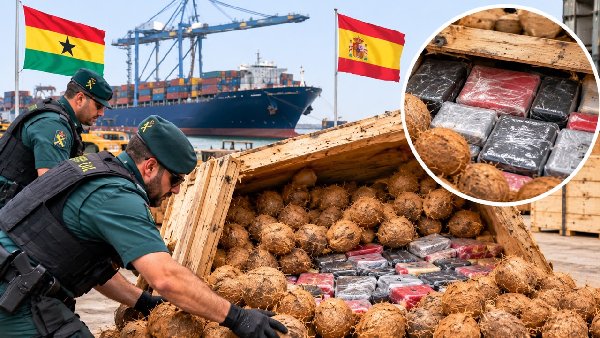
His comments comes on the heels of renewed concerns over Ghana’s links to international drug trafficking following Spanish authorities intercepting 2.6 tonnes of cocaine concealed in a shipment of coconuts originating from Ghana, with two men arrested in connection with the consignment.
The drugs were discovered in two containers of coconuts loaded at the Tema Port on August 2 and shipped to Spain, where they arrived at the Port of Valencia 20 days later.
According to Spanish authorities, customs officials and the Guardia Civil selected the containers for inspection after identifying them as high-risk consignments for drug trafficking.
A search of the containers uncovered packages of cocaine hidden beneath false bottoms fitted into the wooden crates used to transport the coconuts. Subsequent tests confirmed that the substance was cocaine.
Following the discovery, investigators removed the drugs but left the containers sealed to monitor the shipment and identify the individuals who would take delivery of the cargo.
Their surveillance led them to two refrigerated lorries that arrived to collect the containers. Officers subsequently followed the vehicles to a warehouse at the La Juaida industrial estate in Almería.
Two men were arrested as the cargo was being unloaded at the warehouse. They were identified as the suspected importer of the drugs and the individual responsible for supervising the unloading.
Spanish authorities released details of the operation on Wednesday, November 11, 2026, describing another major overseas drug interception involving a consignment traced to Ghana.
Meanwhile, the busts come just weeks after a Syrian national was busted in Lebanon after arriving from Ghana with 40 kilogrammes of suspected cocaine concealed in two bags at Beirut-Rafic Hariri International Airport.
Reports suggest the suspect was apprehended shortly after arriving on a flight from Accra International Airport, following what reports describe as surveillance that began before he departed from Ghana and continued until he arrived in Lebanon.
According to reports, officers from Lebanon’s General Security monitored the passenger from the moment he disembarked from the aircraft until he collected his two bags.
New footage allegedly captures the moments leading to the arrest of a suspect in connection with the tragic killing of 15-year-old Ghanaian teenager Javits Frimpong in the Bronx, New York. #GHNow https://t.co/NtPvHXlPFi
— GHnow (@ghnow_) November 13, 2026